
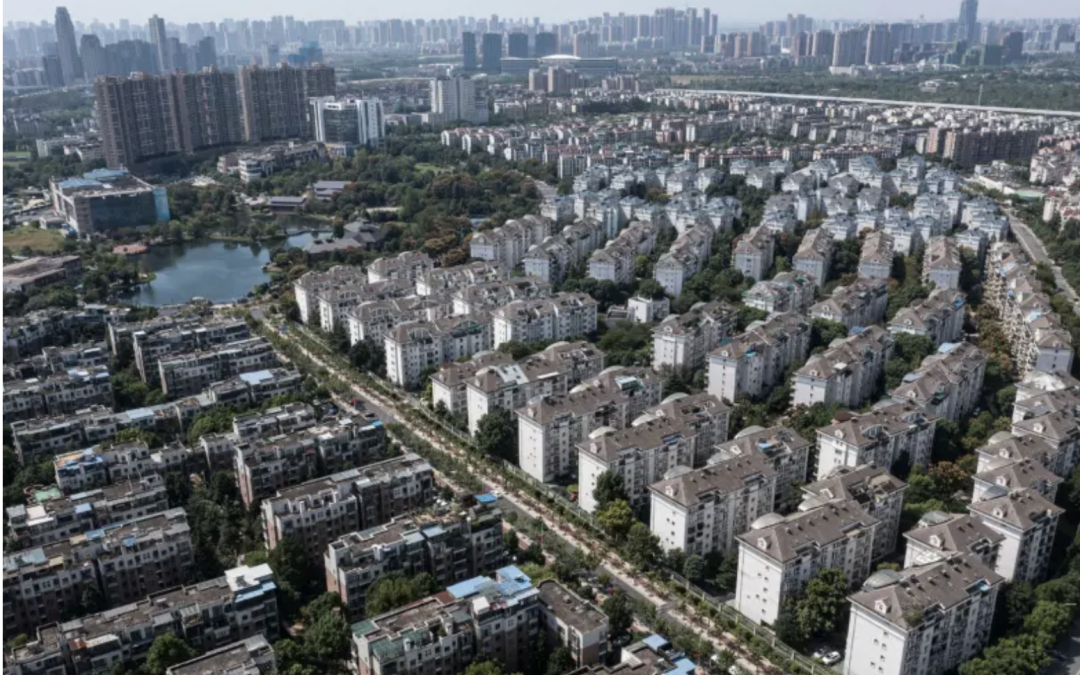
An aerial view shows the Evergrande Changqing community in Wuhan, Hubei Province, China,
China’s real estate market rocked again on Friday after another developer, Soho China, reported a significant drop in revenue hours after China Evergrande Group filed for bankruptcy in a New York court.
Soho China, a mid-sized commercial real estate company listed on the Hong Kong Stock Exchange, reported a first six-month net profit of 13.61 million yuan, down 93 percent from a year earlier.
Revenue, mostly from Beijing and Shanghai rentals, fell 8 percent, to 821.50 billion yuan, but gross profit fell sharply and the fair-value assessment of its assets reversed, cutting more than 130 billion yuan from the company’s bottom line
Reportedly, the heavily indebted Evergrande filed for Chapter 15 protection, which is meant for insolvency cases involving non-U.S. companies and other cross-border parties. The company said in its filing that it is undergoing a restructuring process in both Hong Kong and the Evergrande subsidiary in the Cayman Islands.
Tianji Holdings, its subsidiary, also sought Chapter 15 bankruptcy protection on Thursday in the United States Southern District Bankruptcy Court in Manhattan.
Last week, new contagion fears were sparked by the debt crisis at Country Garden, China’s largest property developer and formerly seen to be a financially stable company.
Evergrande’s filing, along with Soho’s poor financial performance, reinforced China’s deepening property crisis that could extend all over the country as growth slows amid shrinking domestic consumption, rising unemployment, and a weak economy.
How Bad Is the Crisis?
Already, “zombification” among Chinese real estate developers is on the rise. With the decline of new residential sale prices across China in July, companies in financial distress are abandoning unfinished construction projects, signaling that the business model of Chinese property developers based on rising real estate values has reached its limit.
The National Bureau of Statistics conducted a poll in July, and found that prices dropped from the previous month in 70 percent of the 70 major cities surveyed.
For the second month in a row, the simple average of new home prices in the cities fell by 0.2 percent in July, after falling by less than 0.1 percent in June.
On Wednesday, the statistics agency also said that in July, month-over-month prices for newly constructed homes fell in 49 locations, an increase of 11 from June. The decline in prices in major cities like Guangzhou and Shenzhen persisted in July.
Condominium prices are declining because there are fewer buyers than sellers due to ongoing economic and job market uncertainty. Many condo owners are selling because they expect declining prices to force them out of their investments.
The total investment in real estate development for the January–July period was 6.77 trillion yuan ($943.5 billion), which was 8.5 percent lower than the previous year.
The main reason for that was a 7.6 percent reduction in residential housing investment, which accounted for roughly three-quarters of the total.
Property investment also fell as many developers struggled to get financing. For instance, in the first seven months, the amount of funds available for property development was 7.82 trillion yuan, an 11.2 percent decrease from the previous year.
A Systematic Risk
News of leading trust company Zhongrong International Trust Co. scrapping its investment products this week highlighted China’s shadow banking sector’s overexposure to the real estate sector, as well.
Trapped in a severe property crisis, this Beijing-based company has halted payments to investors in its bonds while a debt restructuring is under way.
A liquidity crisis in the trust business, according to Shen Meng, a director at Beijing-based investment firm Chanson & Co, could have far-reaching ramifications for the larger economy. Retail investors with exposure to Zhongrong bonds may see their wealth diminish, listed companies may see reduced capital for growth and investment, and local governments, which are already saddled with debt, may face additional challenges when implementing measures to support China’s declining economy.
What Next?
Last month, China’s Communist Party Politburo raised the hopes of investors in the nation’s beleaguered property sector by hinting that it was considering providing support to distressed developers.
Although no bold stimulus measures have been announced up until now, analysts are hoping that Beijing could provide some form of liquidity support for project construction and delivery, but will refrain from state-funded bailouts to stem the downward spiral.
With thousands of homebuyers facing delays in obtaining their homes or worse, not getting their homes at all, “The Chinese authorities are likely to avoid such a scenario, lest thousands of homebuyers become victims of unfinished projects, and igniting a repeat of last year’s mortgage boycotts,” said a report by CrediSights on Tuesday.
With home demand still tenuous, a second round of project halts is likely to crimp homebuyer sentiment even further. Consequently, providing liquidity support for bond refinancing will likely take a back seat, the report added.
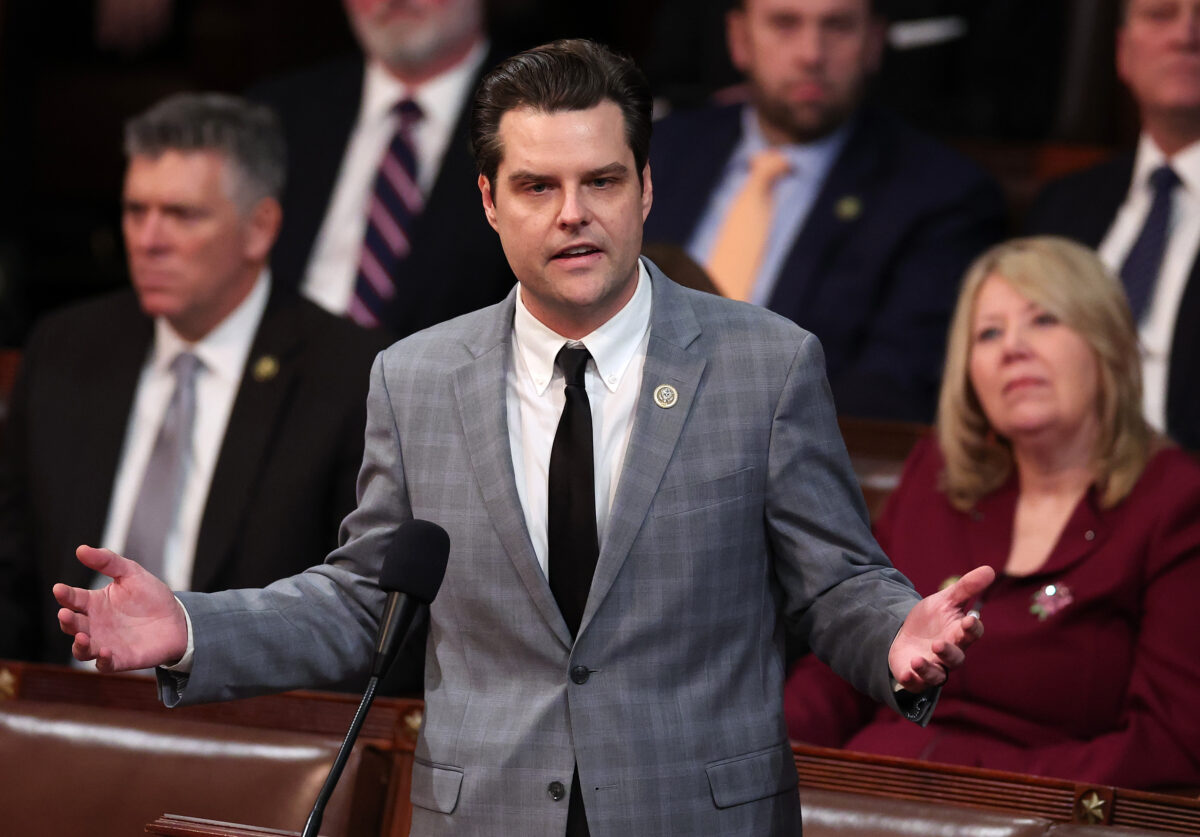 Rep. Matt Gaetz (R-Fla.) is introducing a resolution to censure U.S. District Court Judge Tanya Chutkan and open an investigation into her “for showing open bias and partisanship in her official duties on the bench.”
Judge Chutkan is overseeing a case against former President Donald Trump, brought by the Department of Justice (DOJ) for conspiracy in his challenge of the 2020 election results. She has already overseen many other cases related to the Jan. 6, 2021, Capitol protest, which is being investigated by special counsel Jack Smith. About 1,000 people have already been sentenced for crimes related to the day’s events, and Judge Chutkan has been known to hand down harsh prison sentences.
“Judge Tanya Chutkan’s extreme sentencing of January 6th defendants, while openly supporting the violent Black Lives Matter riots of 2020, showcases a complete disregard for her duty of impartiality and the rule of law,” Mr. Gaetz said.
He appeared to be referring to remarks the judge made in one Jan. 6-related sentencing.
“People gathered all over the country last year to protest the violent murder by the police of an unarmed man,” she said, referencing violent riots that erupted after the death of George Floyd. “To compare the actions of people protesting, mostly peacefully, for civil rights, to those of a violent mob seeking to overthrow the lawfully elected government is a false equivalency and ignores a very real danger that the January 6 riot posed to the foundation of our democracy.”
Mr. Gaetz’s resolution points to a few other cases of “open partisanship,” including the fact that the Obama-appointed district judge had donated thousands of dollars to his presidential campaign, and that during another Jan. 6-related sentencing she “lamented” that President Trump “remains free to this day.”
“Such partisan commentary by Judge Chutkan has been ongoing and calls into question her fitness as a judge and … Chutkan’s comments and activities on and off the bench violate all 5 canons of the Code of Conduct for United States Judges,” the resolution reads (pdf).
The canons are that a judge should uphold the integrity and independence of the judiciary; avoid impropriety and the appearance of impropriety in all activities; perform the duties of the office fairly, impartially, and diligently; engage in extrajudicial activities that are consistent with the obligations of judicial office, and refrain from political activity.
“It is deeply concerning that a United States District Court judge would exhibit such blatant political bias from the bench,” he said in a press release. “Justice may be blind, but the American people are not—we see Judge Chutkan for her actions, and we rebuke them in the greatest possible sense.”
Mr. Gaetz is proposing Judge Chutkan be censured and condemned via the resolution, and to have the House Committee on the Judiciary, on which he sits, launch an investigation seeking evidence showing that she should be removed from office on impeachment or other misdemeanors.
The Epoch Times reached out to Judge Chutkan’s office for comment.
Trump on Chutkan
President Trump has been critical of Judge Chutkan in multiple social media posts given her earlier remarks.
“She obviously wants me behind bars,” he wrote, describing her as “highly partisan” and “very biased and unfair.”
A day after President Trump pleaded not guilty to the felony charges filed by Mr. Smith, he made a social media post: “If you go after me, I’m coming after you!” He later posted a campaign ad that claimed election interference on the part of the Biden administration.
In response, Mr. Smith’s office filed a motion pointing to the initial social media post as evidence a protective order was needed. He requested the judge issue an order barring President Trump from sharing information about the case.
“Such a restriction is particularly important in this case because the defendant has previously issued public statements on social media regarding witnesses, judges, attorneys, and others associated with legal matters pending against him,” Mr. Smith wrote in a filing (pdf).
President Trump responded on social media yet again. “No, I shouldn’t have a protective order placed on me because it would impinge upon my right to free speech,” he wrote.
His legal team filed an opposing motion arguing public speech was not grounds for a gag order.
Judge Chutkan ended up issuing a limited protective order, which bars President Trump from releasing information the prosecutors label sensitive, not all information.
The prosecution has also requested a Jan. 2, 2024, trial date, with jury selection to begin as early as Dec. 11.
On Thursday, President Trump’s legal team proposed a April 2026 trial date, arguing that the prosecution was rushing the case.
“The government’s objective is clear: to deny President Trump and his counsel a fair ability to prepare for trial,” the lawyers wrote. “The Court should deny the government’s request.”
They cited a number of reasons an extension was required, including the 11.5 million pages of discovery Mr. Smith’s office has already provided.
“That is the entirety of Tolstoy’s War and Peace, cover to cover, 78 times a day, every day, from now until jury selection.”