
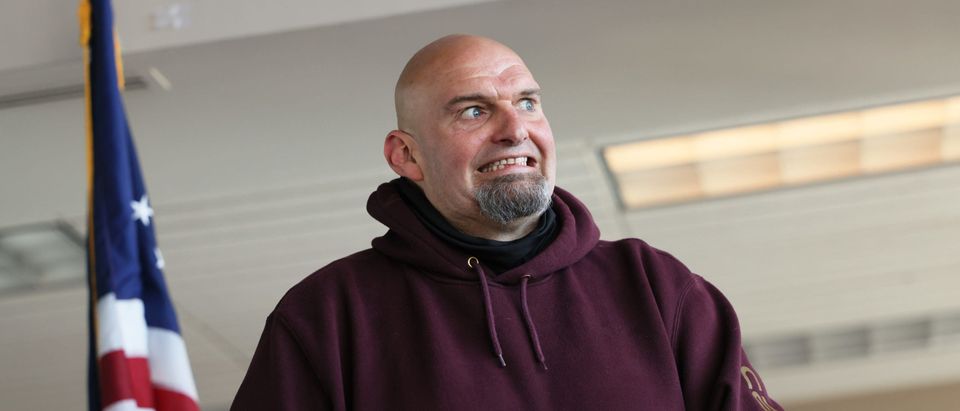
 (Photo / Michael M. Santiago)
There was no way to predict that when Democrat Pennsylvania Sen. John Fetterman won his seat in 2020, he’d eventually be on the same side as Republican Florida Gov. Ron DeSantis, but he is.
DeSantis signed SB 1084 into law on Wednesday, banning the sale of lab-grown meat in Florida. On Thursday, Fetterman tweeted a screenshot of an article discussing the ban, regretfully praising DeSantis for making the right decision.
“Pains me deeply to agree with Crash-and-Burn Ron, but I co-sign this. As a member of @SenateAgDems and as some dude who would never serve that slop to my kids, I stand with our American ranchers and farmers,” Fetterman tweeted.
Pains me deeply to agree with Crash-and-Burn Ron, but I co-sign this.
As a member of @SenateAgDems and as some dude who would never serve that slop to my kids, I stand with our American ranchers and farmers. 🇺🇸 pic.twitter.com/zZLYf8t5lI
— Senator John Fetterman (@SenFettermanPA) May 2, 2024
If you ignore the cheap “crash-and-burn” shot Fetterman took at the Florida Governor, his statement was not that much different from DeSantis’s press release.
“Today, Florida is fighting back against the global elite’s plan to force the world to eat meat grown in a petri dish or bugs to achieve their authoritarian goals. Our administration will continue to focus on investing in our local farmers and ranchers, and we will save our beef,” DeSantis said.
This is so important because there aren’t many topics that Republicans and Democrats agree on that are actually helpful to the American people and bring about a healthy way of life — ensuring that we protect American ranchers and farmers from climate change and animal rights parasites is one of the more important issues facing our country.
Global elites want to control our behavior and push a diet of petri dish meat and bugs on Americans.
Florida is saying no. I was proud to sign SB 1084 to keep lab grown meat out of Florida and prioritize our farmers and ranchers over the agenda of elites and the World Economic… pic.twitter.com/vHdWaJtckU— Ron DeSantis (@GovRonDeSantis) May 1, 2024
Florida became the first state in the nation to outlaw the manufacturing, selling, or distribution of cultivated meat, that is, meat grown in a lab from cultured cells. American ranchers have long felt the pain of tightening federal regulations under the guise of climate change and animal cruelty, which makes continuing to produce our nation’s beef and other animal products extremely difficult.
Ranchers were appalled in 2021 when Colorado Gov. Jared Polis declared March 20 “Meatout Day,” where he urged residents to eat alternative proteins despite the possible adverse effects that would prevail against the state’s second-largest industry. It backfired. Residents declined Polis’ invitation to dine on other proteins and instead ate as much red meat as possible, Deseret reported.
Colorado Farm Bureau’s former vice president of advocacy, Shawn Martini, called Polis’ declaration an “assault” on the state’s agriculture industry.
“That’s why you saw such a huge fallout from the governor’s proclamation, which had no force of law. But overall, it goes to the threat the industry is facing that something like that could generate such a huge backlash in this state and around the country,” he told the outlet.
Utah Farm Bureau President Ron Gibson told Deseret that proclamations, like the one out of Colorado, would have a disastrous effect on the nation’s ranchers and farmers. “It is about their goal to destroy agriculture 100%,” Gibson said.
Bipartisan legislation introduced by Republican Kentucky Rep. Thomas Massie and Democrat Maine Rep. Chellie Pingree is stalled in the U.S. House of Representatives. H.R. 2814, The PRIME Act, would make it easier for farmers and ranchers to sell directly to consumers by removing federal regulations that make completing these types of transactions cumbersome across state lines.
Congress could easily pass Massie’s PRIME Act to resolve this.
They haven’t done it for one reason:
It would reduce federal control over the food supply https://t.co/r0uMzfEa1O— Oilfield Rando (@Oilfield_Rando) May 5, 2020
“Consumers want to know where their food comes from, what it contains, and how it’s processed. Yet, federal inspection requirements make it difficult to purchase food from trusted, local farmers. It is time to open our markets to give producers the freedom to succeed and consumers the freedom to choose,” Massie said in the press release.
This legislation “would give individual states freedom to permit intrastate distribution of custom-slaughtered meat such as beef, pork, or lamb to consumers, restaurants, hotels, boarding houses, and grocery stores,” according to the bill’s authors.
Current federal law requires slaughtered animals to go through federal inspections unless it’s for personal, household, guest, or employee use. All others must be sent to a USDA-inspected slaughterhouse before being eligible for lawful national distribution. This is a problem for these producers as sometimes these specialty slaughterhouses are located hundreds of miles away from the farms and ranches, driving up transportation costs and adding to the chance their products will come in contact with industrially-produced meat.
It's easier to sell foreign meat in the US than local meat. Did you know that to ship meat across state lines it has to be inspected by both a state inspection facility and the federal USDA facility? Their inspections are identical. Because there are few federal facilities or… pic.twitter.com/LK1gJwRlg1
— Chef Andrew Gruel (@ChefGruel) April 21, 2024
“More and more, consumers want to know where their food is coming from, especially after the pandemic exposed break downs in our supply chains,” Pingree said. “A farmer in Maine shouldn’t have to drive hours to get to a USDA-inspected processing facility when other safe options are available. The bipartisan PRIME Act will make it easier for local farms to compete with big meat companies and make locally-raised livestock processing more widely available. This bill will address the needs of communities in a way that supports them by allowing America’s family farms to do what they do best – feed their neighbors.”
With Fetterman sounding the alarm that it’s time to protect America’s ranchers and farmers, hopefully, the nation will come into a time where it takes this issue seriously. It seems like a no-brainer that, at the very least, the federal government should be safeguarding a centuries-long, billion-dollar industry that serves the American people. But like with everything else, as the federal government grows, so does the pain for regular Americans.