
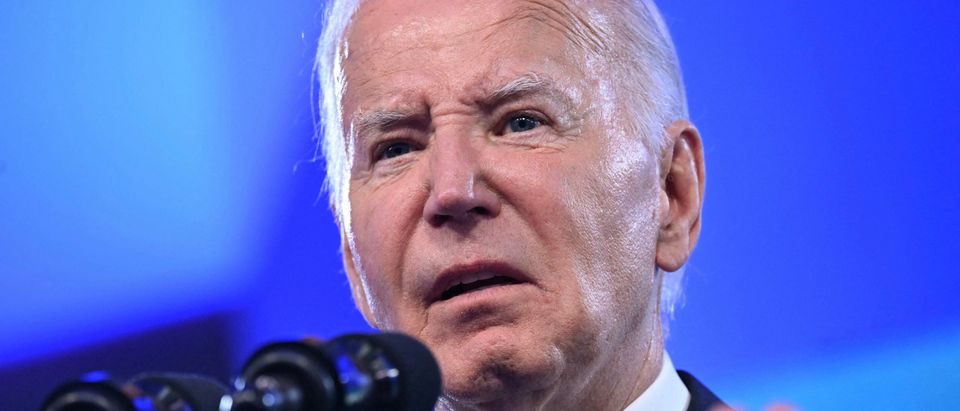
(Photo / SAUL LOEB)
While there is still a long way to go until the November presidential election, former President Donald Trump looks like the favorite to win the White House in 2024 in a polling different from a typical sampling of likely voters.
The latest polling model from The Economist spells outright doom for Biden’s reelection campaign.
How has Donald Trump gone from being cast out by his party to being likelier than not to win another term? Incumbent leaders are doing badly everywhere; Joe Biden’s approval ratings are terrible and inflation is taking a toll https://t.co/iuQYFL26Km 👇
— The Economist (@TheEconomist) June 19, 2024
First, let’s explain why this poll is different. Unlike national voter polling, which takes a sampling of likely voters to determine which candidate has more votes at a given snapshot in time, The Economist’s statistical forecast was developed by political scientists led by Columbia University professor of statistics and political science Andrew Gelman to create a poll that calculates Trump and Biden’s probabilities of winning each state and the election overall.
The Economist’s model uses information from national polls and fundamentals-based forecasts to predict the final election results. Most are familiar with national polls but not so much with what a fundamentals-based forecast means. The latter shows the structural factors influencing voters’ decisions, like how they react to political issues closer to election day and when their party affiliations begin kicking in.
.@Polymarket – Presidential Election Winner
🟥 Trump: 56.5%
🟦 Biden: 33.5%
🟦 M. Obama: 3.3%
🟨 RFK Jr: 1.5%
—
GOP VP Odds
• Doug Burgum: 28%
• Ben Carson: 15%
• Byron Donalds: 14%
• J.D. Vance: 10%
• Marco Rubio: 10%
• Sarah H. Sanders: 7% https://t.co/BBwAM9qWMw pic.twitter.com/7NL15b0l5l— InteractivePolls (@IAPolls2022) June 19, 2024
Now, on to the actual polling results. Unsurprisingly, President Joe Biden is not the front-runner in an election in which the economy and illegal immigration are the most important topics among American voters. However, The Economist’s model shows just how low Biden’s chances are against Trump in 2024.
Despite the feverish dreams of leftists, the popular vote does not put a candidate in the White House. The electoral map is the ultimate decider in a presidential election. This means that the ballots from heavily populated areas, typically on the coasts, don’t outweigh the voters in Middle America.
The Economist currently predicts that Trump will win the electoral college vote over Biden 306-232.
“To work out the probable electoral-vote totals, we run over 10,000 simulations of the election. The chance of a tie in the electoral college is less than 1 in 100,” The Economist said.
The model shows that six states worth 77 electoral votes will decide the electoral map for each candidate. All six of these states are currently trending toward Trump over Biden. In 2016, Trump won five of these six states; in 2020, Biden won them all.
Commonwealth of Pennsylvania:
Pennsylvania has 19 electoral votes up for grabs, the most out of the six states. The model shows Trump has a 2-point lead over Biden, the Keystone State. If Biden loses Pennsylvania, the model only gives him a 7 in 100 chance of winning enough electoral votes to beat Trump. The case is not the same for Trump. The Economist predicts that even without winning Pennsylvania, Trump still has a 21 in 100 chance of gaining the 270 electoral votes needed to win back the White House. Still, Pennsylvania is a must-win for either candidate.
Michigan:
Michigan has 15 electoral votes and is arguably the most important state for Biden because Michigan is typically a predictor for Wisconsin voters, and it drastically lowers his ability to win enough electoral college votes. Trump is up by 1-point, according to the model. Without winning Michigan, the model only gives Biden a 5% chance of gaining the necessary electoral college votes. On the inverse, Trump can lose Michigan and still have a 31 in 100 chance of becoming president.
Wisconsin:
Trump is up by 2-points over Biden in Wisconsin, which has 10 electoral votes at play. Trump’s chances in Wisconsin are more favorable by every metric. If he loses the state, he still has a 31% chance of winning the White House. For Biden, the outlook is more dim. If Wisconsin swings Trump’s way, as the model currently predicts, Biden only has an 8% probability of earning enough electoral votes.
Georgia:
Georgia has 16 electoral votes and is currently trending toward Trump by 4 points. Biden has a 21% chance of gaining the required electoral votes without Georgia. Still, Trump comes out on top with or without the state. If Biden pulls out a win in the Peach State, the model gives Trump a 40% probability of winning the presidency.
Arizona:
Trump is up by 4 points over Biden in Arizona, which has 11 electoral college votes up for grabs. Without Arizona in Biden’s bag, the model gives Biden an 18 in 100 chance of winning enough electoral votes. For Trump, it predicts a 38% probability of him still being able to gain enough votes.
Nevada:
Like Arizona, Nevada is more of a must-win state for Biden compared to Trump. Nevada has six electoral college votes at play. The model gives Biden an 18% chance of winning the White House if he loses Nevada. Should Biden win the state, Trump still has a 47% probability of gaining enough electoral votes.
Overall Electoral Vote Probability:
“Most Americans have already decided who will get their vote. Given that Mr Biden has been behind in national polls all year, even if only by a bit, that is deeply worrying. The electoral college still favors Republicans, so the current president needs to be ahead to have an even chance of winning. His path to victory is scarily narrow. He must win Wisconsin, Michigan and Pennsylvania (plus Omaha’s single electoral college vote) to get to 270. If he loses any of those, he will have to win one of Arizona, Georgia, Nevada, or North Carolina—where he is currently several points down in the polls. In other words, there is no clear plan b,” The Economist said.
🇺🇲 2024 PRESIDENTIAL FORECAST @TheEconomist (chance of winning)
🟥 Trump: 68%
🟦 Biden: 31%May 30: Trump 60-39%
—
Electoral College
🟥 Trump: 300
🟦 Biden: 238
——@DecisionDeskHQ (chance of winning)🟥 Trump: 59%
🟦 Biden: 41%May 30: Trump 56-44%
—
Electoral College… pic.twitter.com/ilsaAXvIvV— InteractivePolls (@IAPolls2022) June 18, 2024
Back in March, the model showed a much closer race between Biden and Trump, with a 58% chance for Trump compared to Biden’s 42%. However, The Economist now predicts Trump has a 69% chance of gaining the 270 electoral votes it takes to win the presidency. Biden’s is much lower at 31%.
There is still a long way to go until the November election. Republican voters are apprehensive about trusting polling, not because of their accuracy but because of their fear of election irregularities. However, the odds are still in Trump’s favor to pull off a historic victory in 2024.