
(Photo / Joe Raedle)
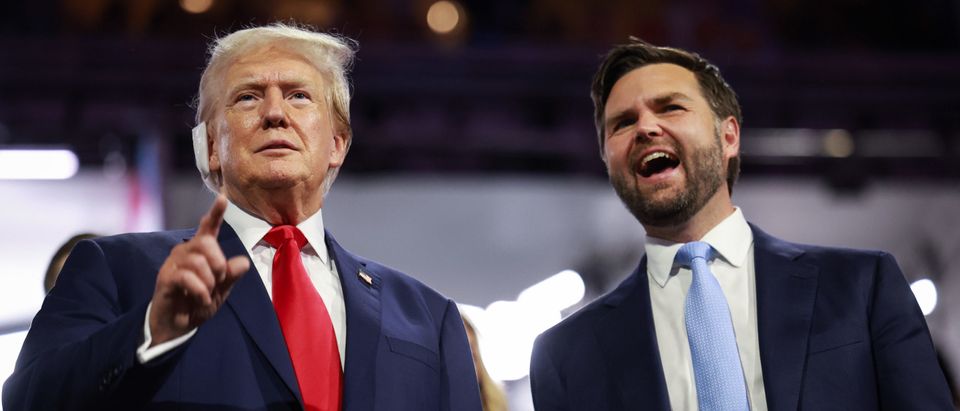 Abraham Lincoln famously put together a “team of rivals” to help him fight and win the Civil War. At the Republican National Convention this week, it’s become clear that Donald Trump is following in his footsteps.
As soon as he won the White House, Lincoln began assembling a “team of rivals” — a term popularized by historian Doris Kearns Goodwin in her book, “Team of Rivals: The Political Genius of Abraham.”
His strategy was as ingenious as it was necessary. The Republican presidential primary of 1860 was notably vicious. There was a large field of candidates juggling factional interests and intense personal rivalries, often leading to sabotage and acrimonious attacks. There were sharp philosophical divides on existential issues like slavery and abolition, possible secession and territorial expansion. This contentiousness may have been novel over a century ago, but today, it’s just politics as usual. Democrats warn Trump will put an end to democracy, while Trump’s own GOP rivals have been prone to echo their talking points when it suits them.
There’s a real team of rivals thing happening tonight with the headliners at the RNC
— Geoffrey Ingersoll (@GPIngersoll) July 17, 2024
But what did Lincoln do once he secured the White House? He turned all his former enemies into allies.
William H. Seward was a strong front-runner in the primary, but Lincoln eventually outmaneuvered him. The two men attacked each other in speeches and campaign literature; Seward went after Lincoln’s inexperience, while Lincoln went after Seward’s radicalism. A dirty trick by the Lincoln camp — tame by today’s standards — packed the crowd with enthusiastic supporters at the Convention, making Lincoln seem more popular than he was to secure the nomination. Despite the bitter rivalry, Lincoln made Seward his Secretary of State. He grew to become one of Lincoln’s closest and most trusted advisors.
Solomon P. Chase, another primary contender, served as Lincoln’s Secretary of the Treasury during the war. Lincoln relied on Chase’s financial expertise to establish the national banking system and a standardized currency, without which the war effort could not have been financed.
Another rival, Edwin Bates went on to become Lincoln’s Attorney General. Bates was a respected elder statesman, and Lincoln saw the benefits of his experience balancing out his own relative inexperience.
Lincoln even reached across the aisle, appointing Edwin Stanton — a staunch Democrat who was fiercely critical of Lincoln — as his Secretary of War. Stanton eventually switched parties.
Like Lincoln, Donald Trump has an exceptional talent for making allies out of enemies. Think back to 2016 when no one took a reality star as a serious candidate for president. Sure, Trump had his diehard base from the beginning, who took glee in watching the establishment squirm. But the broader GOP base was widely split between Jeb Bush, Ted Cruz and Marco Rubio, at least in the beginning. As Trump’s strengths became clear, those voters coalesced around him and carried their once-favorite choice along with them. Cruz and Rubio became Trump allies, while Bush faded into obscurity.
The same goes for J.D. Vance, once a hostile adversary and now Trump’s choice for Vice President. Perhaps no one in the Republican sphere of influence had harsher words for Trump than Vance did in 2016. “I go back and forth between thinking Trump is a cynical asshole like Nixon who wouldn’t be that bad (and might even prove useful) or that he’s America’s Hitler,” Vance texted a friend. He wrote a long-winded piece for The Atlantic calling Trump “cultural heroin.” Yet he grew and evolved, and today, there’s no one better to carry the torch of Trumpism. Trump himself realizes this, which is likely why he chose him for VP.
Now, all of Trump’s primary rivals came home during the RNC.
During the primary, there was lots of contrived whining about Trump’s “base problem;” Nikki Haley did have a fairly substantial primary showing. The two rivals traded insults, with Trump calling her Bird Brain and Haley questioning his mental fitness and whether she would even endorse him as the nominee.
Haley’s still not totally in step with the modern GOP. She used her speaking time at the RNC to talk about Russia and Ukraine, something few Republican voters care about. But that’s fine; she won’t be leading U.S. foreign policy. What matters is that she stood behind the man who will be.
“Donald Trump has my strong endorsement, period,” Haley said in a show of unity. This sends a signal to the voters here: I’m with Trump, and you should be too.
The same goes for Florida Gov. Ron DeSantis. No one drew more fire than DeSantis, who Trump accused of being “disloyal.” Trump coined multiple vicious nicknames from Meatball Ron to DeSanctimonious. He was Trump’s biggest rival from the beginning, and Trump made sure to neutralize him hard and fast. For his part, DeSantis haphazardly committed to supporting Trump as the nominee, only raising his hand once he saw others on the primary debate stage did as well.
There was enough vitriol to cause bad blood for a lifetime. But both men put country over party and put the rivalry behind them at the RNC. DeSantis would have never been permitted to take the stage if Trump still harbored a grudge. And DeSantis saw the wisdom of moving forward, giving Trump a full-throated endorsement. “Let’s send Joe Biden back to his basement, and let’s send Donald Trump back to the White House,” DeSantis said of roaring applause.
If Trump takes back the White House, he will be surrounded by former enemies. But these days, staunch enemies have grown to become some of his fiercest supporters.
Trump too has shown that he’s evolved since he first came down the escalator. He’s willing to pull punches when it’s politically necessary, build bridges and strive for unity, showing more and more of the political ingenuity of Abraham Lincoln. The only difference is that he’s survived to finish the job.