
Testicular cancer is relatively rare, affecting about one in 250 men, with an estimated 500 dying from it in 2024.
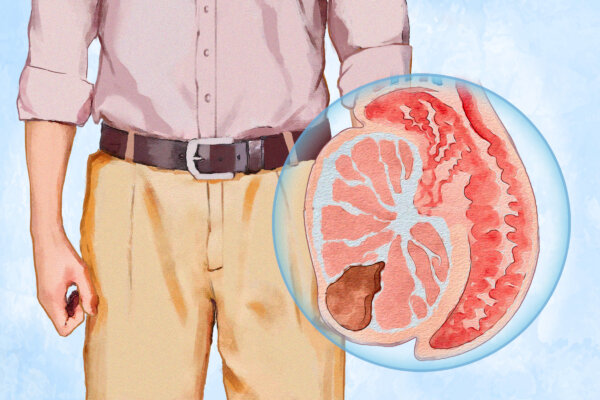 Testicular cancer occurs when malignant cells form in the tissues of one or, less commonly, both testicles. It affects approximately one in 250 males at some point in their lifetimes.
In the United States, the American Cancer Society estimates approximately 9,760 new cases of testicular cancer and around 500 deaths from the disease in 2024. Since testicular cancer is typically treatable, the lifetime risk of a man dying from it is very low, roughly one in 5,000.

What Are the Types of Testicular Cancer?
Seminomas
Seminomas are the most common type of germ cell cancer, accounting for 54 percent of all testicular cancer cases. They typically occur in men between 20 and 45 and grow more slowly than nonseminomas.
Nonseminomas
Nonseminomas account for about 43 percent of all testicular cancers and primarily affect men in their late teens to 30s. Under a microscope, nonseminoma cells appear distinct from seminoma cells, and their treatments differ from those of seminomas. There are four main types of nonseminomas, including:
- Embryonal carcinoma: This nonseminoma grows quickly and can spread beyond the testicle. Under a microscope, these tumors resemble very early embryos, hence their name.
- Yolk sac carcinoma: This type is rare in adults but the most common testicular cancer in children and babies. It generally responds well to treatment in children.
- Choriocarcinoma: This is a rare and aggressive testicular cancer that can rapidly spread to distant organs such as the lungs, bones, and brain. It is often part of a mixed germ cell tumor.
- Teratoma: Teratoma contains tissue resembling all three layers of a developing embryo (endoderm, mesoderm, and ectoderm). Pure teratomas are rare and more commonly found as part of a mixed germ cell tumor.
Mixed Germ Cell Tumors
This type of germ cell tumor consists of both seminoma and nonseminoma components. They are treated in the same manner as nonseminomas.
What Are the Symptoms and Early Signs of Testicular Cancer?
Symptoms
Testicular cancer has a very favorable prognosis when detected early. Men who regularly perform self-examinations are more likely to find the cancer at its earliest stage. Its common symptoms include:
- Swelling, a lump, hardening, or fluid accumulation in the testicles: Most testicular cancers consist of a painless mass in the testicle, typically palpable and several centimeters in size. Some do cause pain, however. Small, nonpalpable, asymptomatic masses without signs of distant disease are more likely to be benign. Studies show up to 80 percent of nonpalpable, asymptomatic tumors 2 centimeters or smaller are benign.
- Unusual changes in testicular size.
- Irregular or lumpy texture of the testicles: For instance, swelling that causes the testicle to become larger than usual.
- A dull ache in the abdomen or groin: Abdominal, flank, or back pain may be caused by invasion or obstruction of muscles, blood vessels, or the ureters.
- Decreased sexual activity.
- Presence of blood in the semen.
- Gynecomastia: Breast tenderness or growth.
- A feeling of heaviness in the scrotum or abdomen.
- Fluid buildup in the scrotum.
- Enlarged lymph nodes in the neck.
- Difficulty breathing or shortness of breath: This may be caused by pulmonary metastases.
- Hemoptysis: Coughing, occasionally with blood.
- Chest pain: This may be caused by pulmonary metastases.
- Difficulty swallowing.
- Swelling in the chest.
- Pleural effusion: Fluid accumulation around the lungs.
- Weight loss.
- Early signs of puberty in boys: Examples include deepening voice and facial and body hair growth.
- Infertility.
- Headache.
What Causes Testicular Cancer?
What Are the Stages of Testicular Cancer?
- Stage 1: Cancer is confined to the testicles.
- Stage 2: Cancer has spread to lymph nodes behind or beyond the membrane lining the abdomen and pelvis (retroperitoneal) or near the aorta (paraaortic).
- Stage 3: Cancer has spread beyond the retroperitoneal or paraaortic lymph nodes.
Who Is at Risk of Testicular Cancer?
- Age: Testicular tumors are most commonly found in young men aged 15 to 45. It is the second most common cancer in young men aged 15 to 19, with about 6 percent of cases occurring in children and teens and around 7 percent in men over 55.
- Race: In the United States, testicular cancer is most common in white men. Testicular germ cell tumors are currently the most common cancer among young men of white Northern European ancestry but are less so among Asians and Africans. However, the incidence is increasing among Hispanic or Latino men and Asian and Pacific Islander men, who may also develop the disease at a younger age.
- Cryptorchidism: The most common risk factor is a history of cryptorchidism (undescended testicle). Normally, testicles descend from the abdomen into the scrotum before birth, but in around 3 percent of boys, one or both testicles fail to do so. This condition increases cancer risk, particularly in the undescended testicle (a risk that is four to six times higher), although the risk is also increased in the normally descended testicle. The increased risk isn’t directly due to the failure of the descent itself but instead suggests an underlying abnormality in the testicle that makes cancer more likely. The higher the undescended testicle remains (such as in the abdomen), the greater the cancer risk. Surgery to move the testicle into the scrotum reduces but does not eliminate cancer risk. The risk is higher if the condition remains uncorrected or in men who haven’t undergone surgery by puberty.
- Personal history: Men who have had testicular cancer are at the highest risk of developing it again, with a 12 times higher risk compared to those without a history of the disease. However, only 2 percent of men will develop cancer in both testicles.
- Family history: A family history of testicular cancer significantly increases the risk; men have an eight-to-12 times higher risk if a brother has the disease and a two-to-four times higher risk if their father does. Although no specific gene is linked to testicular cancer, it is highly heritable. Men with a first-degree relative who has the disease are typically diagnosed two to three years earlier than the general population. However, since testicular cancer is rare, it is uncommon for it to run in families.
- Low sperm count: One retrospective cohort study found that men with poor semen quality had a 50 percent higher risk of multiple types of cancer, including testicular. However, those with azoospermia (no sperm count) had no increased risk. The researchers pointed out that this finding could be due to small sample size. Research has shown that sperm counts have been declining globally. While many factors are likely at play, two proposed theories relate to endocrine disruption caused by the increasing ubiquity of microplastics and a growing influx of electromagnetic radiation (EMF) exposure due to wireless devices.
- Extra X chromosome: Klinefelter syndrome (often referred to as KS, XXY, or Klinefelter’s) is a condition where boys and men are born with an extra X chromosome.
- Germ cell neoplasia in situ: Most testicular cancers develop from a precursor lesion called germ cell neoplasia in situ (GCNIS). It is found near testicular cancer in 80 percent to 90 percent of cases. If GCNIS is detected for other reasons, there’s a 50 percent risk of developing testicular cancer within five years and a 70 percent risk within seven years, making GCNIS a significant risk factor.
- Down syndrome: Testicular cancer is more common in men with Down syndrome, possibly because they are more likely to have cryptorchidism.
- Low birth weight or preterm birth: Males born with low birth weight have a 34 percent higher risk of testicular cancer than men born with normal weight. Preterm males have an increased risk of 31 percent compared to those born at term.
- Inguinal hernia: An inguinal hernia occurs when a part of the abdomen pushes through a weak spot in the lower abdominal wall, causing a bulge. Men with this condition have a 63 percent higher risk than men without the condition.
- Hypospadias: Hypospadias is an abnormality that affects the penis and urethra.
- Marijuana: Since the 1950s, the incidence of seminoma and nonseminoma—particularly affecting men in their 30s and 40s—has increased by 3 percent to 6 percent annually in the United States, Canada, Europe, Australia, and New Zealand. This rise has coincided with an increase in marijuana use in these regions. Research has shown that using marijuana for over 10 years is linked to an increased risk of developing testicular cancer, specifically the nonseminoma type. The study found that long-term marijuana use was associated with a 36 percent higher risk of testicular cancer overall and an 85 percent higher risk of the nonseminoma subtype.
- Leather tanning: Leather tanners who are exposed to dimethylformamide (DMF) have an increased risk of developing testicular cancer, and DMF is known to cause testicular damage.
- HIV/AIDS: Men with HIV appear to have an increased risk of developing testicular cancer, with the risk potentially being even higher for those with AIDS.
- Muscle-building supplements: A study published in 2015 found that muscle-building supplement use is a potentially adjustable risk factor that may be linked to testicular germ cell cancer.
- Radar guns: A 1993 study observed that all six police officers out of a cohort of 340 who developed testicular cancer had routinely used hand-held radar guns, holding them close to their testicles, which was the only common risk factor among them.
- Natural and synthetic hormones: Animal studies have shown that synthetic hormones and endocrine disruptors can affect hormone levels and the development of early germ cells, potentially leading to cancer. Endocrine disruptors are natural or synthetic chemicals that can mimic, block, or disrupt hormones. However, more research is needed to determine if these substances are linked to the increase in testicular cancer cases. Human studies are challenging due to the long time between early exposure and cancer development and the many factors that can complicate results, such as contaminants in food, packaging, and cosmetics. Currently, there is limited evidence connecting endocrine disruptors directly to testicular cancer, although some studies have found higher levels of certain toxins in the mothers of men with the disease.
How Is Testicular Cancer Diagnosed?
Screening
There is no standard screening test for early detection of testicular cancer. Men discover cancer most often by chance, during self-exams, or by a doctor during a routine physical exam. Early detection can make treatment easier and may reduce the need for extensive chemotherapy or surgery. If a lump is found, further tests may be needed.
Exams
To diagnose and stage testicular cancer, a series of exams and tests are often required. The doctor will examine the testicles for swelling, tenderness, and lumps and will also check the abdomen, lymph nodes, and other areas of the body for signs of cancer spread. The exam results are typically normal except for any changes in the testicles.
Transillumination may also be performed. This is a physical exam in which the doctor holds a flashlight up to the scrotum. In the case of a tumor, the light does not pass through the lump.
If a lump or other indication of testicular cancer is detected, further tests will be required to determine the cause. It’s crucial to accurately determine whether scrotal masses are testicular (often malignant) or extratesticular (usually benign), as distinguishing between them can be challenging during a physical exam.
Scrotal ultrasound is an imaging test that looks at the scrotum. It can confirm the scrotal mass’s origin.
If a testicular mass is confirmed, a blood test for tumor markers will be needed.
Many testicular cancers produce increased levels of tumor markers, such as alpha-fetoprotein (AFP) and human chorionic gonadotropin (HCG), in the blood. For instance, nonseminomas often increase AFP or HCG levels; pure seminomas may raise HCG levels but never AFP levels. Therefore, an increase in AFP indicates a nonseminoma component in the tumor, though tumors can be mixed. Sertoli and Leydig cell tumors do not produce these markers, and some cancers may be too small to affect marker levels. Additionally, increased levels of the enzyme lactate dehydrogenase (LDH) can indicate widespread disease but can also be raised by noncancerous conditions.
The most promising new serum marker for testicular cancer is micro-RNA (miRNA) 371a-3p. It is highly effective in detecting seminomas and nonseminomas in children and adults, except for differentiated pure teratomas. The miRNA 371a-3p test has better specificity than traditional serum markers and is particularly useful for detecting and monitoring seminomas that do not produce HCG or AFP.
If testicular cancer is suspected, instead of a biopsy, doctors typically recommend a radical inguinal orchiectomy, where the entire testicle is removed. A pathologist then examines the removed testicle to confirm the presence of cancer and determine its type and extent. This approach is often based on ultrasound and blood tumor marker tests, which provide enough evidence to proceed directly to surgery.