
 The internal civil war within the Chinese Communist Party (CCP) had, by Jan. 25, broken completely into the open, ending the facade of Party unity and control.
It was this facade of Party solidarity that all combatants within the Party war wanted to preserve if they had any hope of maintaining control of mainland China in the near term.
The breakdown within the Party now virtually removes all restraint on civil unrest, forcing nominal CCP leader Xi Jinping to rely entirely on the security forces to suppress unrest within the civilian population, as well as within the Party and the People’s Liberation Army (PLA). The burden of protecting Xi and controlling the country has been thrust onto the Ministry of Public Security and its main operating arm, the Public Security Bureau, as well as the People’s Armed Police.
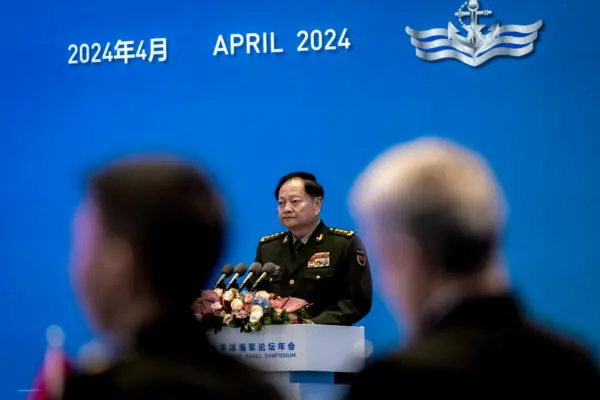
Over much of the past year, the effective control of the PLA had moved to Central Military Commission (CMC) Vice Chairman Gen. Zhang Youxia, who had removed most of Xi’s appointees from key posts within the PLA.
However, Xi Jinping—also the general secretary of the CCP and chairman of the CMC—was, by around Jan. 18, able to escape from his political containment and strike back against his main rivals.
It has been a retaliatory move that defied earlier attempts to reach a quiet settlement, which would have left the CCP with the appearance of unity and normalcy. Xi’s “comeback,” particularly against Zhang Youxia and CMC Joint Staff Department Chief of Staff Gen. Liu Zhenli, was enabled by the lack of willpower of Xi’s main opponents at the Fourth Plenary Session of the 20th Party Congress held between Oct. 20 and 23, 2025. It was at this event that, to maintain the appearance of Party unity, Xi was allowed to keep his formal titles on the understanding that he would have little or no input into policy.
They had the opportunity to remove Xi completely at that time, and failed to do so. Xi knew that if he did not retaliate quickly, he would be finished.
Xi was to be allowed to “retire on health grounds” sometime early in 2026, after a period in which he would be denied a role in decision-making. The decision, however, gave Xi the breathing space to find a way to defeat his adversaries. After the Fourth Plenum, Gen. Zhang on Nov. 22 visited Moscow at the invitation of Russian Defense Minister Andrei Belousov, where he was given far higher protocols and access than any of Xi’s officials. During his flight to Moscow, there was a failed attempt to assassinate Zhang, according to some sources. This alerted the anti-Xi faction that Xi would not surrender office without a struggle, and that he still had resources at his command.
Significantly, according to some sources, Zhang then briefly disappeared from view after his Moscow visit, reportedly stopping in the Russian Far East on his return—this time not by PLA Air Force transport—to Beijing.
On Dec. 13, it was announced that Gen. Chang Dingqui, the commander of the Air Force and a protégé of Xi Jinping, had suddenly died of a heart attack during liuzhi detention and questioning at the hands of the Jiang Zemin faction.
The anti-Xi faction then demonstrated that they could strike at Xi directly. Within a week of Chang Dingqui’s death—the third of a senior general in custody—there was an explosion in the G95 Capital Ring Expressway tunnel (on Beijing’s Seventh Ring Road) on Dec. 17, targeting an official convoy. Among the dead was allegedly one of the “body doubles” of Xi Jinping, indicating either the intention to assassinate Xi or to warn him to back off. The explosion was blamed on an accident with a fuel tanker truck.
It is not possible to know if this was a real attack on Xi (which it could well have been) or merely a demonstration that he was reachable.
Clearly, by that point, the war between the Xi faction and the opponents—the Zhang/PLA faction, plus the Party elders and reformers—was now direct and open. Pretense of unity within the CCP was becoming impossible to disguise, even though all combatant parties knew that the appearance of Party disunity would mean that the Party would soon lose all legitimacy and authority to govern the state.
Still, Gen. Zhang apparently felt sufficiently confident to plan the seizure of Xi Jinping himself.
Xi had been moving from residence to residence in January 2026 for security reasons, spending only a day or two at each location in rotation, according to some sources. One of the key rotational residences was the Jingxi Hotel, which is a CCP senior officials-only hotel within the Zhongnanhai CCP headquarters framework.
Is this where it ends, for the time being?
In fact, immediately following Gen. Zhang’s seizure, scores more PLA officers were detained, down to one star (senior colonel) level; only four full generals now remain in the PLA apparatus. The question is: which officers were being purged by Xi and which were being purged by the Zhang camp? The tumult and the shouting have not yet ceased.
By Jan. 25, there was considerable uncertainty about the outcome of the internal civil war within the Party. For Xi to be sure of his safety, it would be necessary for him to undertake further counterstrikes against the Zhang faction and the politicians and former politicians within the senior ranks of the CCP. He would also have to purge many or most of the influential “princelings”—the descendants of senior first-generation CCP leaders—who had aligned themselves with Zhang because Xi had essentially disinherited them of their power.

But the very fracturing of the CCP, now out in the open, and the prospect that many PLA units will not support Xi, means that the disenfranchised and impoverished population of China, now openly displaying anger with the Party, may find some motivation to escalate their street actions. The Party elders had hoped to use a combination of stick and carrot to persuade the populace to accept the idea that life was likely to improve under the Party’s leadership, but that vision now holds little credibility.
So what does this mean for the prospect—which Xi continues to claim is his primary objective—of a war against Taiwan, the Republic of China?
Firstly, there is no cohesive or trustworthy command-and-control capability to undertake a formal military invasion of Taiwan in the near future, even if Xi could persuade a rump of the PLA to attempt it.
Secondly, there is no materiel or technology capability for the PLA to seize Taiwan, short of the use of nuclear-warhead ballistic missiles. All conventional assault patterns would result in massive PLA losses, leading to the CCP’s almost certain collapse.
Thirdly, the hope among some in Beijing that the United States would be militarily preoccupied with events in Iran or with NATO dysfunction over the Greenland issue has not been borne out. NATO is, for the moment, calm again. A PLA attack on Taiwan would automatically engage Japanese forces, and that would automatically engage U.S. support forces. Moreover, the Indian government has made clear its preparedness to seize the Tibetan Plateau (and with it the water sources feeding major rivers in China, the subcontinent, and Southeast Asia), in the event of a PLA distraction over Taiwan.
There is no scenario that plays out well for a Chinese attack on Taiwan. The final question is whether that reality would deter Xi Jinping from his historical mission.
In the short term, it appears that Xi and his key ally, Cai Qi, may have gained a temporary respite. It may well be that Zhang and Liu could be killed quickly. But will seizure of control of the CCP be a pyrrhic victory for Xi? He regains the Party and, possibly briefly, regains control of mainland China, but both the Party and the national economy are in an uncontrollable slide toward full collapse.