
OAN Staff Katherine Mosack and Brooke Mallory
6:27 PM – Friday, January 30, 2026
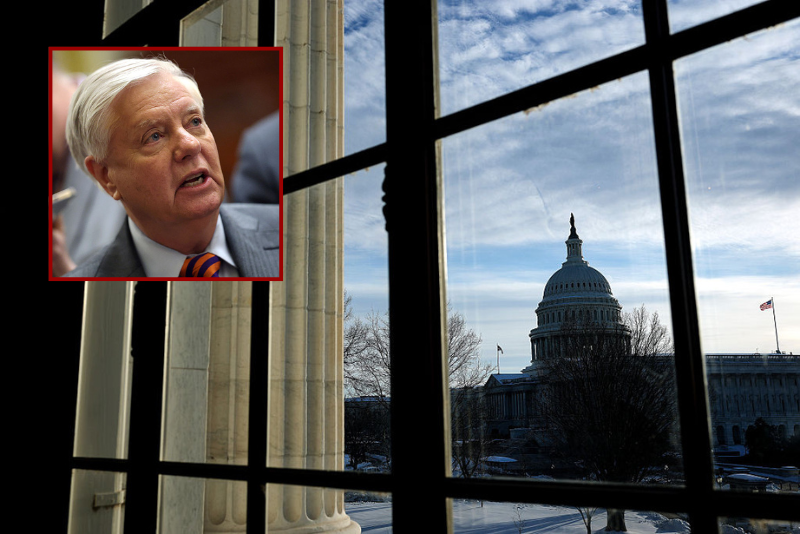
In a late-night session on Friday, the Senate passed a critical $1.2 trillion government funding package, breaking a tense deadlock after GOP Senator Lindsey Graham lifted his hold on the legislation.
However, despite the 71-29 vote, the federal government is set to enter a partial shutdown at midnight tonight since the House of Representatives is not scheduled to reconvene until Monday.
Before the final 71‑29 vote, an earlier procedural vote to advance a broader funding bill failed 55–45, largely because these Republicans sided with Democrats — Rand Paul (Kentucky), Ted Budd (North Carolina), Ron Johnson (Wisconsin), Mike Lee (Utah), Ashley Moody (Florida), Rick Scott (Florida) and Tommy Tuberville (Alabama).
The path to passage cleared only after Graham reached an agreement with Senate Majority Leader John Thune (R-S.D.) for a future vote on legislation to crack down on “sanctuary cities.”
Graham had spent much of Friday morning threatening to derail the package, asserting that local officials who refuse to cooperate with federal immigration authorities should face penalties. He also reportedly secured a commitment for a vote on a separate measure that would allow private citizens and groups to sue for damages if their records were obtained during the “Arctic Frost” investigation led by former Special Counsel Jack Smith.
Meanwhile, the spending deal was forged in the wake of national unrest following the fatal shootings of two anti-ICE protesters by federal agents in Minneapolis earlier this month.
While Democrats seemingly attempted to use the shooting deaths in Minneapolis to stall the national agenda, Republicans secured a strategic path forward that prioritizes the rule of law. By successfully decoupling the Department of Homeland Security (DHS) from the broader $1.2 trillion funding package, President Trump and Senate leaders appeared to neutralize Democrat attempts to hold the entire government hostage.
This rare compromise allows 96% of the government to remain operational while isolating the DHS debate for a focused, two-week showdown.
Rather than a debate over agency “conduct” framed by Democrat lawmakers and activists, the focus has returned to the fundamental failure of “sanctuary” jurisdictions to cooperate with federal law — a policy Senator Graham and others maintain is the true source of the recent chaos in U.S. cities.
Democrats have demanded body cameras for ICE agents, a ban on agents wearing masks, and stricter warrant requirements.
The package includes:
- Full-year funding, through September, for five of the six remaining major appropriations bills, including Defense, Health and Human Services, and Labor.
- A two-week stopgap Continuing Resolution (CR) funding the DHS is in effect, set to expire on February 13th.
- A commitment to negotiate reforms to immigration enforcement.
While the Senate has done its part, the House of Representatives remains in recess. Speaker Mike Johnson (R-La.) indicated that the House will not return until Monday evening to take up the Senate-passed measure.
The Office of Management and Budget (OMB) has already instructed federal agencies to begin executing shutdown plans. However, because the lapse occurs over a weekend, the practical impact on most federal services and employees is expected to be minimal if the House acts swiftly on Monday.
The two-week extension for DHS sets up a high-stakes showdown in mid-February.
Senate Minority Leader Chuck Schumer (D-N.Y.) has warned that Democrats will not support further DHS funding unless “meaningful and transformative” restrictions are placed on immigration enforcement tactics. Conversely, Republicans like Senator Eric Schmitt (R-Mo.) have called such restrictions a “non-starter,” signaling that the peace achieved on Friday night may be short-lived.
President Trump, who urged a “bipartisan YES vote” to avoid a shutdown, is expected to sign the bill as soon as it clears the House.
Stay informed! Receive breaking news alerts directly to your inbox for free. Subscribe here. https://www.oann.com/alerts
What do YOU think? Click here to jump to the comments!
Sponsored Content Below