
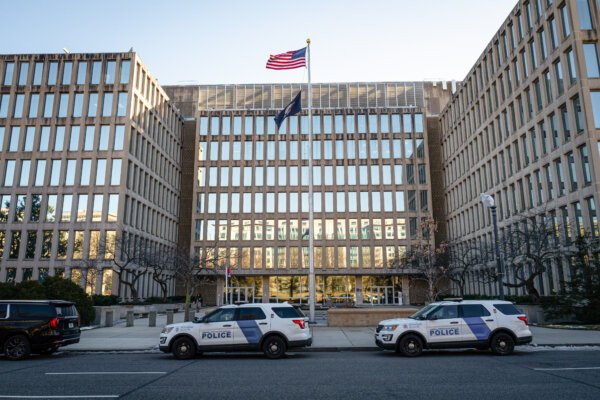
 The Trump administration is positioning itself to make it easier to discipline and possibly fire career federal workers in senior positions throughout the government, which could affect roughly 50,000 federal employees.
The agency overseeing the federal workforce, the Office of Personnel Management, is publishing a final rule on Feb. 6 that establishes an employee category for senior career workers who are engaged in implementing administration policy called “Schedule Policy/Career positions.”
“OPM amended its regulations [in U.S. Code Title 5] … to exclude Schedule Policy/Career employees from the procedures governing performance-based and adverse actions,” the agency’s memorandum reads. “Thus, agencies may take personnel actions such as suspensions, demotions, and terminations against Schedule Policy/Career employees without the procedures created by those regulations.”
Even though agency political appointees are at-will employees who serve the president’s administration, career workers have key job protections that historically have allowed them to appeal dismissals, disciplinary actions, or suspensions to an independent board in the government.
Federal workers who fall under the Office of Personnel Management’s “Schedule Policy/Career positions” category will no longer be able to appeal that board.
The office’s memorandum instructs federal agencies to update their internal policies to reflect the new rule changes, including for “disciplinary and administrative grievance procedures,” and to notify employees and job applicants that they will no longer be afforded the previous statutory protections “based on unacceptable performance and conduct.”
The final rule, set to publish on Feb. 6, will be effective within 30 days, according to the office.
“Democracy is replaced by bureaucracy—unelected civil servants who may subvert the will of the people by pursuing policies of their own making and resisting policies put in place by the elected president,” he wrote.
“While most civil servants execute the law faithfully, there are many clear examples where government employees resist or slow-walk the policy initiatives of the president, secure in the knowledge that there will be no repercussions for this behavior.”
Kupor said the rule change would not remove existing whistleblower protections for “designated individuals” and that agencies would need to create rules to protect employees in the new category from “retaliation for raising allegations of waste, fraud, abuse, or violation of laws through appropriate channels.”
The roughly 50,000 employees who may be affected by the rule change are a relatively small portion of the roughly 2 million people employed by the federal government in civil service positions in the executive branch as of December 2025.
The Pendleton Act in the late 1800s transformed the federal civil service from a partisan spoils system into a professional workforce in which positions are awarded based on merit and employees are largely shielded from partisan interference.
Kupor wrote in his blogpost that the rule change “expressly prohibits disenfranchising or terminating any policy making executives based upon their personal or political support (or lack thereof) of the president or his policies.”
“Rather, they are required to faithfully implement Administration policies to the best of their ability, consistent with their constitutional oath and the vesting of executive authority in the president,” he said.
The American Federation of Government Employees (AFGE), the largest federal employee union in the United States, criticized the rule change, saying that it is eroding “competence, stability, and professionalism” from the federal government.
“When people see turmoil and controversy in Washington, they don’t ask for more politics in government, they ask for competence and professionalism. OPM is doing the opposite