
Authored by Jeff Louderback via The Epoch Times (emphasis ours),
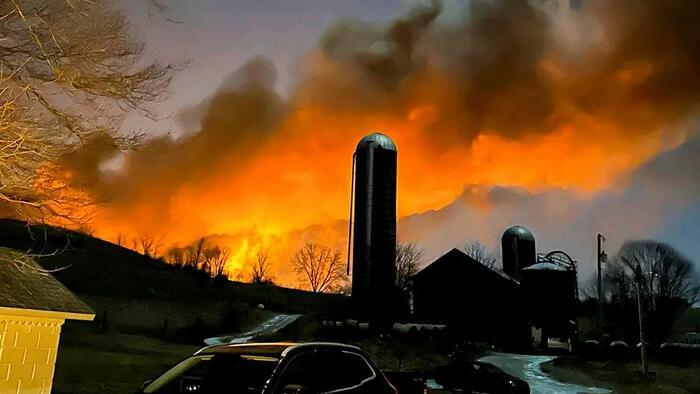
Three years have passed since a Norfolk Southern freight train carrying hazardous chemicals derailed in East Palestine, an eastern Ohio village near the Pennsylvania border.
On Feb. 3, the disaster’s third anniversary, The National Institutes of Health (NIH) held a grand opening ceremony for the East Palestine Train Derailment Health Research Program Office.
The office will serve as the home to a five-year, $10 million research initiative to assess and address the long-term health outcomes stemming from the derailment.
“NIH’s research hub offers the people of East Palestine a pathway to clear answers about their health they deserve,” said Health Secretary Robert F. Kennedy Jr.
“Everyone affected by this environmental disaster deserves access to independent, gold-standard science that puts their well-being first.”
Life in East Palestine abruptly changed around 9 p.m. on Feb. 3, 2023.
The crew of a Norfolk Southern Railway freight train carrying 151 cars saw smoke and fire, and realized that 38 cars had derailed.
The flammable, toxic chemicals in 11 derailed cars had ignited, with flames spreading to an additional 12 cars.
According to the National Transportation Safety Board, nine cars were carrying hazardous materials in addition to the 11 that derailed.
The hazardous chemicals, including vinyl chloride in some of the rail cars, began to spill onto the ground and into the air.
Vinyl chloride is used to make PVC pipes and other products.
The National Cancer Institute notes that the toxic chemical has been linked to cancers of the brain, lungs, blood, lymphatic system, and liver.
Vinyl chloride creates carbon monoxide and hydrogen chloride when it burns.
When the latter mixes with water, it generates hydrochloric acid, a corrosive substance that can burn the skin and eyes, and is toxic if inhaled.
Burning vinyl chloride also produces a small amount of phosgene gas, which was used as a chemical weapon on World War I battlefields.
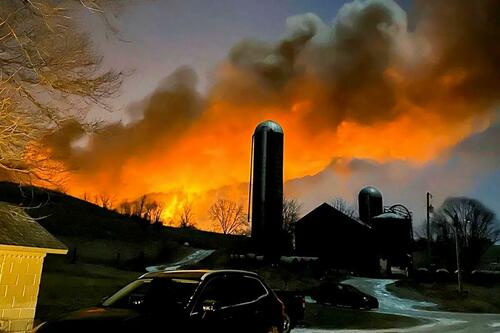
As the fire continued, authorities on Feb. 6—fearing shrapnel from a major explosion—decided on a controlled detonation of five cars, which sent a massive cloud of black smoke into the sky.
Visible for miles, it was likened to the mushroom cloud caused by a nuclear weapon.
The government characterized it as a “controlled burn,” but residents said it was anything but controlled.
A dark cloud of chemical-filled smoke could be seen for miles, and debris landed on properties several miles away.
The train cars were ruptured in the detonation, and spilled the rest of their contents into a drainage ditch connecting to Sulphur Run, a stream that flows through the heart of East Palestine.
Before the burn, Ohio Gov. Mike DeWine urged residents to evacuate a one-by-two-mile area surrounding East Palestine, which included parts of Ohio and Pennsylvania.
DeWine described the urgent evacuation as a “matter of life and death.”
Three days later, DeWine held a press conference announcing that the evacuation order had been lifted and residents could return to their homes.
Norfolk Southern trains resumed their routes through East Palestine, and federal and state officials said testing showed that the air and water were safe.
Fear and uncertainty remain among East Palestine residents.
Many locals complained about a toxic smell in the air, burning eyes, rashes, headaches, and other health issues.
These reports prompted concerns about potential long-term health effects, including “maternal and child health, as well as psychological, immunological, respiratory and cardiovascular health,” according to the NIH.
“This research program is designed to bring rigorous, independent science directly to the community,” NIH Director Dr. Jay Bhattacharya said.
“By establishing a local presence, we can better engage residents, support enrollment in studies, and ensure the research reflects the real experiences and concerns of the people affected.”
After the grand opening, a community meeting was held to outline the research program, explain how residents can enroll in studies, and provide people a chance to ask questions and share their experiences directly with researchers.
Jami Wallace was a lifelong East Palestine resident until the derailment.
She no longer lives in the community but has served as an outspoken advocate for people who have experienced health consequences from the disaster.
“I was diagnosed after the derailment with hypothyroidism. I’ve been diagnosed with asthma, I’ve been diagnosed with an adult chronic cough, I have a cyst on my right ovary that I have to have an operation on,” said Wallace, who is co-founder of the Chemically Impacted Communities Coalition.
“I get phone calls every day from people who are seeing cancers and thyroid disease, respiratory and neurological issues. You can’t tell me it’s not from those chemicals.
“I’ll fight Norfolk Southern, and I will fight my own government until we get accountability and we get justice.”
The Feb. 3 event included researchers and representatives from NIH’s National Institute of Environmental Health Sciences, the University of Kentucky, the University of Pittsburgh, and Yale University.
“Since the beginning, we have seen the public experience respiratory issues, we’ve seen and heard about rashes, nose bleeds in children, eczema, reproductive health questions and concerns, so now we have a team of about sixteen scientists on our team that can help answer those questions for the public,” Dr. Erin Haynes of the University of Kentucky said.
“We have learned that the community is experiencing health conditions from the derailment, and we want to be able to give them answers to know if it is a true direct association.
“A lot of things are unanswered, but this large-scale study that we now have funding to do will really help answer those questions.”
Loading recommendations…