
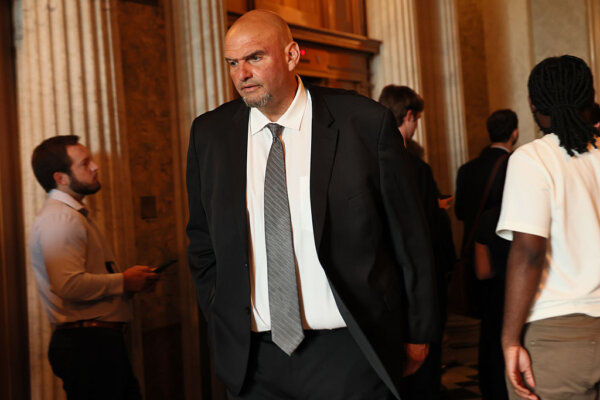
 Sen. John Fetterman (D-Pa.) said on Feb. 8 that requiring voters to show identification is not “unreasonable,” breaking with Democratic messaging as Republicans push to tie the Safeguard American Voter Eligibility (SAVE) America Act’s voter ID provisions to upcoming Department of Homeland Security (DHS) funding.
Fetterman made the comments on the Fox News program “Sunday Morning Futures” in a discussion that began with the risk of a shutdown affecting DHS agencies such as the Transportation Security Administration and Federal Emergency Management Agency. In the interview, he said he expected DHS funding to lapse and that he did not want to “jump back” into shutdown politics.
Fetterman noted that Wisconsin voters “also elected a very, very liberal justice into their supreme court” in the same election.
“So it’s not a radical idea for regular Americans to show your ID to vote,” he said.
Fetterman also pushed back on comparisons between voter ID requirements and historical voter suppression as made by Senate Minority Leader Chuck Schumer (D-N.Y.).
“It’s absolutely, those things are not Jim Crow or anything,” he said, calling Jim Crow segregation “an awful, awful legacy” of the United States.
Schumer on Feb. 5 criticized the proposal, saying that it amounted to a modern version of voter suppression and that it would fail in the Senate.
“It’s Jim Crow 2.0, and I called it Jim Crow 2.0,“ Schumer said this past week on MS Now’s ”Morning Joe.”
“What they’re trying to do here is the same thing that was done in the South for decades to prevent people of color from voting.”
He argued that the bill could block eligible voters who lack certain documents or whose names do not match.
“For instance, if you change, if you’re a woman who got married and changed your last name, you won’t be able to show ID, and you’ll be discriminated against,” Schumer said. “You will not get a single Democratic vote in the Senate.”
Fetterman suggested that the bill’s path is constrained by Senate rules rather than simply by Democratic leadership opposition.
“For me, the SAVE Act is not going to pass because of the filibuster, because they would need at least seven or eight Democratic votes to pass that,” he said.
The SAVE America Act is being pulled into the broader DHS funding dispute, in which both parties are trying to use leverage ahead of the Feb. 13 deadline.
Republicans are escalating their calls to include it in the final funding package for DHS.
The proposed law would require voters to prove U.S. citizenship when registering to vote in federal elections and would direct states to remove noncitizens from voter rolls. It also requires voters to show photo ID in federal elections.
By contrast, the 2025 SAVE Act, which passed the House and stalled in the Senate, focused on proof of citizenship for voter registration and voter-roll checks, and it did not create a separate federal photo ID requirement for voting.
Senate Democrats, who have demanded reforms to DHS and its subsidiary Immigration and Customs Enforcement as a condition for their support of the funding legislation, have described this as a non-starter in the upper chamber.
The four House Democrats who voted for it last year included Reps. Ed Case (D-Hawaii), Henry Cuellar (D-Texas), Jared Golden (D-Maine), and Marie Gluesenkamp Perez (D-Wash.). These representatives have not indicated whether they will vote for the updated bill this time around.
Voter ID requirements in public polling remain popular with many voters even as the parties argue over federal legislation.
Fetterman said his position is consistent with what he called basic expectations from voters, saying that he supports securing the border and deporting “all the criminals.” He reiterated that he does not want to vote for another shutdown.