
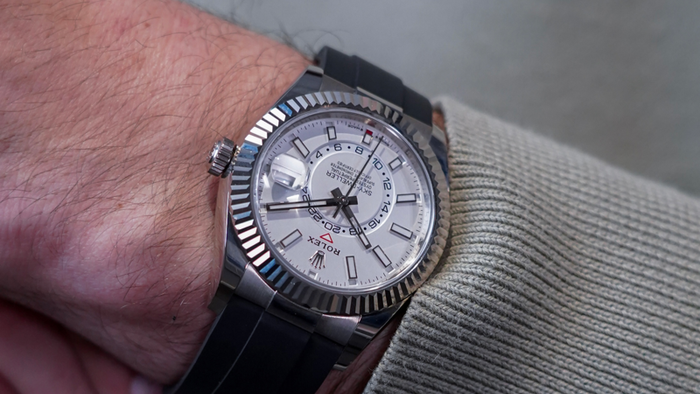
The Bloomberg Subdial Watch Index, which tracks secondary-market prices for the 50 most-traded watches by value, has been ticking higher for about a year, rebounding from a multi-year slump that followed the Covid-era luxury watch mania fueled by cheap interest rates and easy money.
Our last note on the secondary watch market was about a month ago, covering the rebound in prices from a 2025 low (read here) and the shifting tastes of Gen Z collectors (or at least the ones with money).
To add more color to the Swiss watch cycle, UBS analysts, led by Zuzanna Pusz, spoke with a veteran industry insider.
Pusz’s key takeaway from the conversation with the expert is that the industry has “entered a stabilization phase following the post-Covid boom and the subsequent normalization period marked by pronounced weakness in China.”
Here’s the full takeaway that gives readers more guidance on what to expect from the luxury timepiece industry this year:
Stabilising industry momentum, but outlook remains uncertain
Earlier today, we hosted a call with a seasoned Swiss watch industry expert to discuss the latest industry trends and brand dynamics. In summary, the expert believes the industry has entered a stabilisation phase following the post-Covid boom and the subsequent normalisation period marked by pronounced weakness in China. While he expects 2026 to be a better year than 2025, it remains uncertain whether growth will return across the board given ongoing macro-political uncertainty. Market trends remain volatile and divergent: (1) US continues to show strength; (2) Europe faces uncertain demand, heavily influenced by tourism flows and FX; and (3) Asia lacks broad-based momentum, with China stabilising but Japan weakening. Overall, the call reinforced our view that the luxury recovery is still in its early stages and that investors should remain selective. LVMH and CFR remain our top picks, while Swatch and Pandora continue to be rated Sell.
“Winner takes all” amid polarised brand performance
On brand performance, the expert highlighted continued market share gains among the outperformers, including Rolex, albeit with shorter waiting lists. He also noted the rising popularity of “microbrands”, which are gaining visibility thanks to lower barriers to entry and growing “wrist/voice” share. Regarding Swatch Group specifically, the expert did not identify any clear idiosyncratic drivers behind the improving H2 sales momentum (c. FX +5% vs. Swiss watch exports -3%), aside from positive traction at Breguet and the group’s ability to more easily supply retailers amid tariff concerns (inventory >100% of sales) compared to stock constrained peers. Nevertheless, he also pointed out the likely distortion of the FHS Swiss watch export statistics due to tariff-related volatility in today’s context. Lastly, he expects continued consolidation within the retail landscape, with publicly listed groups likely to optimise their brand portfolios and refocus on more efficient assets.
Growing appreciation for luxury watches among younger cohorts
The expert also pointed to a structural shift in the consumer base, driven by the sustained entry of younger buyers into the watch category – despite long concerns that younger generations are moving away from traditional wristwatches. This cohort, initially drawn in through social media, sneaker culture, the MoonSwatch phenomenon, and reselling dynamics, played a key role in both the Covid-era surge and the subsequent normalisation as speculative behaviour faded. Despite this volatility, the expert views this demographic shift as durable, with younger consumers now firmly embedded in the market and representing a long-term tailwind for the industry. He also noted a modest increase in women’s self-purchases, though not yet at a scale that materially reshapes overall demand. When asked whether the appeal to younger buyers might be linked to the rise in metal prices and a perceived “store of value” dynamic, he stressed that this narrative applies mainly to vintage models rather than modern watches. Looking at brand implications of recent “fashion” trends in the category, he reiterated his positive stance on Cartier and a potential improvement in dynamics for Piaget (both Richemont, Buy).
Earlier Tuesday, shares of French luxury group Kering jumped as much as 14% in Paris trading, the biggest intraday move in almost six years, after better-than-expected fourth-quarter sales at its Gucci unit. The UBS Luxury basket (UBXELUX) rose nearly 2%, driven largely by hopes of a turnaround at the luxury house.
At UBS, analyst Justinus Steinhorst told clients that Kering’s results “boosted hopes of a turnaround,” lifting the UBXELUX basket.
From luxury watches stabilizing to early signs of traction at Gucci, the bigger question is whether the luxury industry as a whole is finally turning.
Professional subscribers can learn more about the consumer trends on our new Marketdesk.ai portal.
Loading recommendations…