
Midterm elections have rarely been kind to the party in the White House. Republicans lost both chambers in 2006 under George W. Bush; Democrats were crushed under Barack Obama in 2010 and again in 2014; Republicans lost the House under Donald Trump in 2018; and Democrats narrowly lost the House under Biden in 2022. The lone exception was 2002, when Republicans gained seats in both chambers after 9/11. Otherwise, the pattern is clear: the president’s party almost always faces setbacks.
With the 2026 midterm elections months away, Democrats have many reasons to feel confident they will, at the very least, win back control of the House, which would be enough to effectively stall Trump’s agenda, and most certainly find something to impeach for.
Over at RealClearPolitics, Democrats currently hold an average lead in the generic congressional ballot of +4.6 points. Only one pollster in the average – RMG Research – shows Republicans ahead, and even then by just 2 points. The Democratic advantage isn’t particularly large, and there’s ample reason to believe that a strong economy could boost the GOP in November, but when you look at gubernatorial elections, the advantage is clearly with the Republican Party.
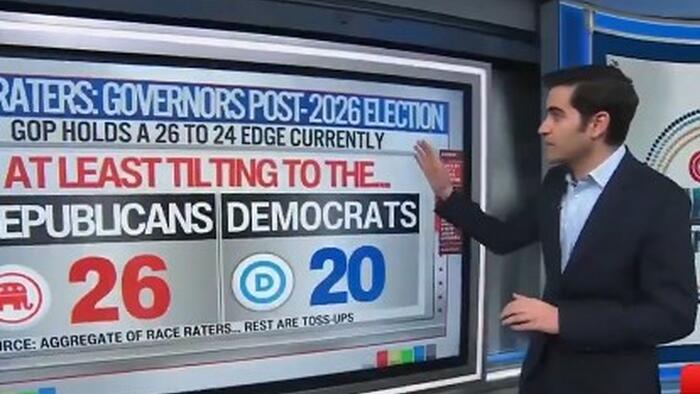
On Wednesday, CNN’s Harry Enten painted an unflattering picture of the Democrats when it comes to this year’s gubernatorial races.
“Look at this, a majority, a majority, 26. That is, at this point, the number of governors that are expected at least tilting towards the Republican Party at this point. Democrats come in at just 20. The rest of the races are toss-up,” Enten said. “Of course, you sum up to 50. And I will note that the Republicans right now hold a 26 to 24 gubernatorial seat advantage.”
That’s the current baseline. Republicans enter 2026 holding more governor’s mansions, and the trajectory doesn’t appear to favor a Democratic reversal. But, according to Enten, even accounting for toss-up races, the GOP is likely to come out ahead. “So at this point, it doesn’t look like Republicans on the net and the aggregate are actually going to lose any governorships. In fact, when you add in those toss-ups, they may gain,” he explained. “So this should stand as a major wake-up call to Democrats, because if there’s a wave building, it has not, at least at this point, hit the state level when it comes to governorships.”
Governor races nationwide should stand as a wakeup call for Dems.
At this point, the GOP will more likely than not continue to hold a majority of governorships post-election.
Dems haven’t held a majority of governorships since 2010 — their longest streak in over 100 years. pic.twitter.com/DRKAryEFL8
— (((Harry Enten))) (@ForecasterEnten) February 18, 2026
Democrats have not held a majority of governorships since 2010 – the longest stretch of gubernatorial minority status the party has endured in at least a century. Republicans have controlled a majority of state legislatures since 2012. One might call that a structural realignment that’s been hiding in plain sight while national media fixates on presidential elections and control of Congress.
Why does any of this matter? Enten answered that directly. “This is a massive problem for Democrats, because as we mentioned at the top, a lot of the policy is determined on the state level. And if all of a sudden you can’t actually lead a majority of governorships, the executive branch on the state level, that means Republicans are in fact forming and implementing most of the policies in the states, and therefore a lot of the policies nationwide,” he said.
The way Enten sees it, congressional seats may generate headlines, but governorships generate policy at the state level, which could have nationwide implications, including Medicaid expansion decisions, election integrity, redistricting, and regulatory enforcement – all of it flows through state executives.
Democrats clearly enter the 2026 midterm elections with a structural advantage in winning control of Congress, but the GOP may still have a hidden advantage due to its majority of governorships.
Loading recommendations…