
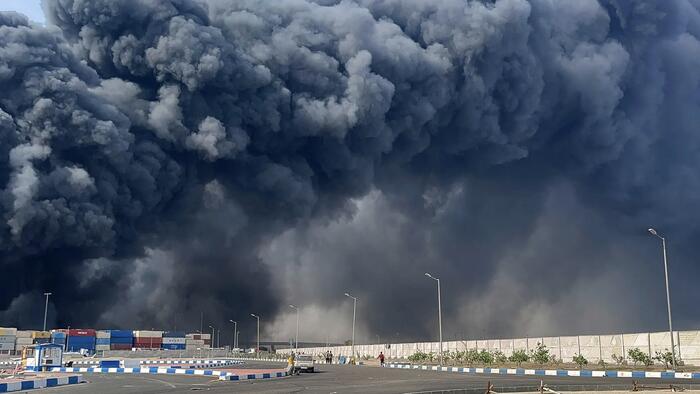
With a potential globally-catastrophic escalation looming on Tuesday, Middle East mediators are communicating with Iran and the United States about a proposed 45-day ceasefire, Axios reported Sunday evening. The ceasefire is being positioned as the first of a two-phased deal, with the second phase being a negotiated, permanent end to the war that Israel and the United States started with a surprise attack on Feb. 28 amid ongoing negotiations.
The slim ray of hope comes after President Trump issued a profane, Easter Sunday threat to make life miserable for 90 million Iranians whom he just weeks ago promised to liberate: “Tuesday will be Power Plant Day, and Bridge Day, all wrapped up in one, in Iran. There will be nothing like it!!! Open the Fuckin’ Strait, you crazy bastards, or you’ll be living in Hell.”
How it started vs. how it’s going. pic.twitter.com/LNgxOsF5GK
— Brandan P. Buck (@brandan_buck) April 2, 2026
In addition to vitriol, Trump’s social media posts also brought an extension of what had been a 10-day deadline for Iran to open the Strait of Hormuz — a deadline that was initially set to expire on Monday evening. Now Trump says Iran has until 8pm on Tuesday. In the interim, Trump has scheduled a 1pm news conference on Monday. The described it as a press conference “with the military,” suggesting it may be focused on celebrating US Special Forces’ retrieval of a downed US Air Force weapons officer over the weekend. Held in the Oval Office, it may be open to only a small subset of the White House press corps.
The combination of the ever-so-slightly encouraging Axios report and the Trump presser could make for the latest of many market whipsaws since the war started. Trump told Axios that there are “deep negotiations” ongoing with a “good chance” of success. On the other hand, he was quick to add that “if they don’t make a deal, I am blowing up everything over there.” Trump’s threats to lay waste to Iran’s civilian infrastructure has elicited Iranian promises to retaliate in kind across the Persian Gulf. In a video issued Sunday, Iran threatened “complete and utter annihilation” of OpenAI’s $30 billion Stargate data center in Dubai.
Iran leveling up
They released a video of threatening to strike 1GW Stargate AI datacenter in the UAE.The data center is hidden on Google maps they even shown that pic.twitter.com/LuOGIp3BVj
— Furkan Gözükara (@FurkanGozukara) April 3, 2026
While the precise nature of the negotiations is unclear, Axios reported that Pakistani, Egyptian and Turkish mediators are at the center of the conversations, and that there have been “text messages sent” between Trump’s envoy Steve Witkoff and Iranian Foreign Minister Abbas Araghchi. Significantly, the outlets’ sources said mediators couldn’t foresee a full re-opening of the Strait of Hormuz until a final deal is inked.
- The mediators want to see whether Iran could take partial step on [nuclear enrichment and Strait of Hormuz navigation] in the first phase of the deal. They are also working on steps the Trump administration could take to give Iran guarantees that the ceasefire will not be temporary and that the war will not resume.
- The Iranian officials made clear to the mediators they don’t want to be caught in a Gaza or Lebanon situation where there is a ceasefire on paper, but that the U.S. and Israel can attack again whenever they want to. — Axios
Going into these latest conversations, the gap between US and Iranian demands was enormous. Among other things, Trump is demanding that Iran weaken the ballistic missile program it now used twice to retaliate against US-Israeli aggression, and to cease any nuclear enrichment, even though Iran is otherwise privileged to do so as a signatory to the nuclear Non-Proliferation Treaty (a status Israel lacks). Iran has demanded reparations for the damage caused by Israeli and US attacks, the closure of US bases in the region, the lifting of all sanctions, and a hard-wired guarantee against more rounds of intermittent US-Israeli attacks. Regarding the latter demand, some have envisioned passage of a US law that would cut off aid to Israel if it attacks Iran again.
Beyond the potential for escalation via attacks on civilian infrastructure, there’s also the potential for a US commitment of ground forces. Trump may feel emboldened about proposed operations to seize Kharg Island and/or strait-adjacent territory following the dramatic weekend rescue of a downed F-15E crew member — which itself brought the first known deployment of soldiers on Iranian soil. (We should note that there’s a growing number of veterans and other people — pointing to factors like the involvement of C-130 cargo craft and the location of their makeshift airfield — theorizing that the rescue was actually a failed attempt to capture Iran’s cache of 60%-enriched uranium.)
US PILOT ‘RESCUE’ OP COST:
— 2 MC-130 aircraft ($100 MILLION+ EACH) ‘intentionally DESTROYED’
— 4 MH-6 Little Bird helicopters
Iran drops NEW WRECKAGE IMAGES pic.twitter.com/TMYCEspepc
— RT (@RT_com) April 5, 2026
Meanwhile, there’s little to indicate that Israeli Prime Minister Benjamin Netanyahu is interested in deescalation.