
Authored by T.J.Muscaro via The Epoch Times,
Astronauts are back in lunar space for the first time in more than 50 years.
Artemis II’s Orion spacecraft, Integrity, crossed into the Moon’s gravitational influence at approximately 12:41 a.m. ET on April 6, officially making NASA’s Reid Wiseman, Victor Glover, and Christina Koch, as well as the Canadian Space Agency’s Jeremy Hansen, the first astronauts to enter lunar space in more than half a century.
While they are not parking in lunar orbit or attempting a landing, the point where lunar gravity becomes more powerful than the Earth’s is considered the arrival point to lunar space. It is a threshold that only 24 explorers had crossed—until now.
The crew was scheduled to wake up at 10:50 a.m. ET, when a historic day of firsts, records, and opportunities for discoveries lay before them.
They will be the largest crew yet to fly around the moon, and they are expected to set a new distance record for the farthest human beings have ever traveled from the surface of the Earth. They are also expected to observe areas of the lunar surface that have never been seen firsthand by human eyes, and a complete solar eclipse, before lunar gravity essentially throws their spacecraft on a course back home.
NASA’s live coverage is expected to begin at 1 p.m. ET. Here is what to know about the day’s events.
Lunar Observation Timeline
1:30 p.m.—The crew will have a conversation with the science officer in Mission Control for final review and solidification of the surface targets for observation and other objectives.
2:45 p.m. ET—Artemis II’s seven-hour lunar flyby will officially begin.
Integrity’s course will send the crew behind the moon, passing on looker’s left, and swinging around to reemerge on looker’s right.
From their vantage point, the crew will be able to see elements of both the near and far sides, with about 20 percent of the far side illuminated, with plenty of opportunities to see things for the first time with human eyes.
The crew will work in pairs, observing the moon in 55-to-85-minute shifts due to Integrity’s limited window space.
Juliane Gross, Artemis sample curation lead who was tasked with helping choose sites targeted for observation, praised in-person human observation as being best for being able to provide immediate descriptions compared to robotic spacecraft.
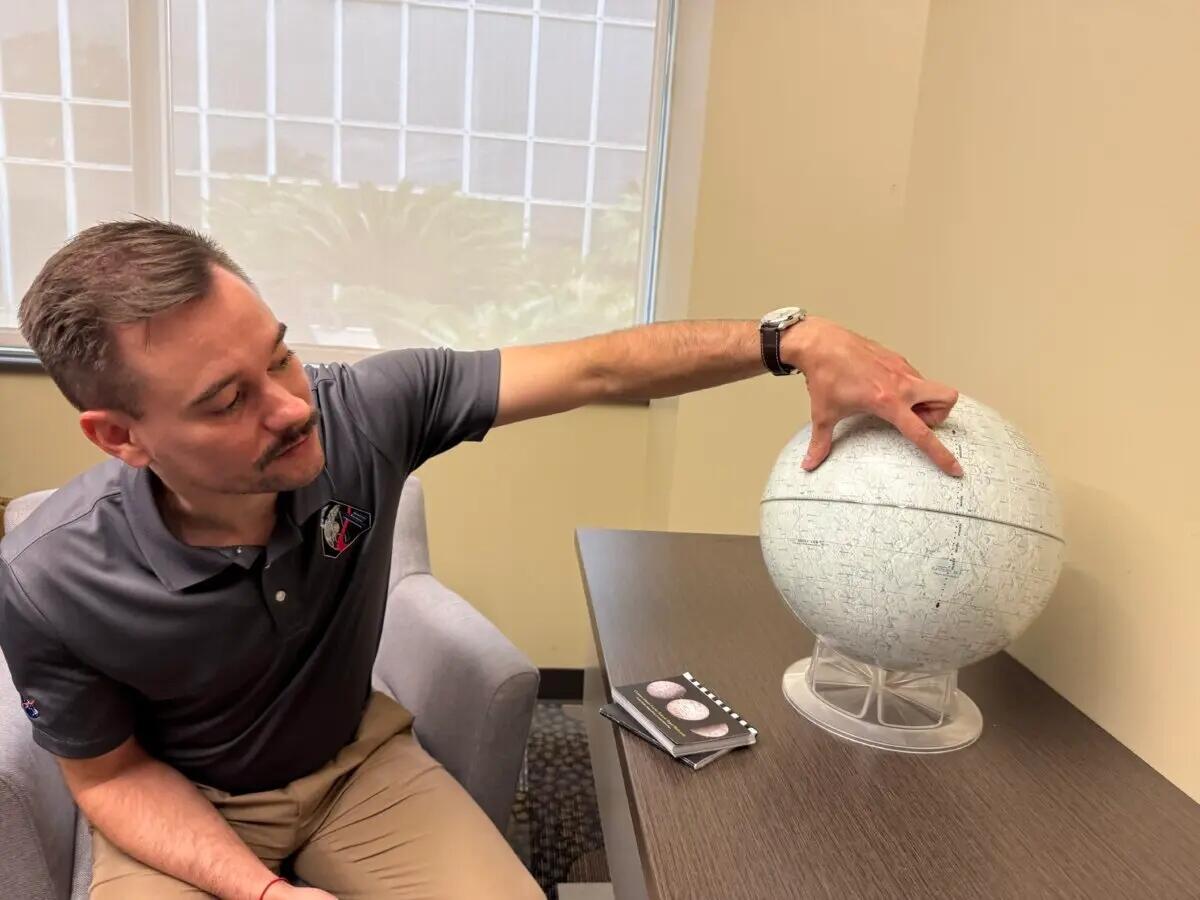
Jacob Richardson, Artemis II’s deputy lunar science lead, indicates roughly how much of the moon’s far side will be illuminated on April 5, 2026, ahead of Artemis II’s flyby. (T.J. Muscaro/The Epoch Times).
“The human brain is so good at looking at a surface and immediately picking out … those changes in the blink of an eye,” she told The Epoch Times. “Orbiters and spacecraft, they will take months and years to get their data.”
Lunar scientists told The Epoch Times that there are spots on both the far and near sides that they are excited to observe.
On the far side, those targets include Orientale Basin and an older basin called Hertzsprung.
On the near side, Gross said she was most excited to observe the Aristarchus Plateau.
Kelsey Young, Artemis II science lead, said that the crew will also be able to see the Apollo 12 and Apollo 14 landing sites.
Wiseman, Glover, Koch, and Hansen were also instructed to break free of the scientists’ wishlist and take observations of what they found interesting on the surface.
“The whole purpose of all the Artemis missions is discovery,” Jacob Richardson, Artemis II’s deputy lunar science lead, told The Epoch Times. “We want them to discover, and when I train crews, I say that the whole purpose is to make the scientists today look like fools, because if we rewrite the textbook about the moon with Artemis missions, then we’ve done our job.”
Gross said that both pairs will be observing the same features at different points in the flyby, and they will be tasked later with discussing the differences in their reports. She said observations and images already taken by the crew were proof they were fully trained and ready to undertake their mission.
“Every human is different with what they can notice and describe,” she said. “And so we’re really excited about these discussion periods that we gave them.”
Richardson also shared his excitement about the astronauts’ observations of the view shared with those looking up from Earth, and the contrasting descriptions a difference of more than 240,000 miles provides.
6:45 p.m.—Artemis II will witness an “Earthset” and experience a loss of communication with Mission Control as the moon’s position moves directly between Integrity and the Earth, like the Apollo missions that came before it.
7:02 p.m.—Artemis II is expected to make its closest pass to the lunar surface at an altitude of approximately just more than 4,000 miles. At that distance, mission leaders said that the moon will appear the size of a basketball held at arm’s length. That distance will give Integrity’s astronauts a unique perspective compared to those of Apollo, who flew much closer.
7:25 p.m.—Communication is supposed to be reacquired, and an “Earthrise” will be observed.
9:20 p.m.—Lunar observations are expected to be complete.
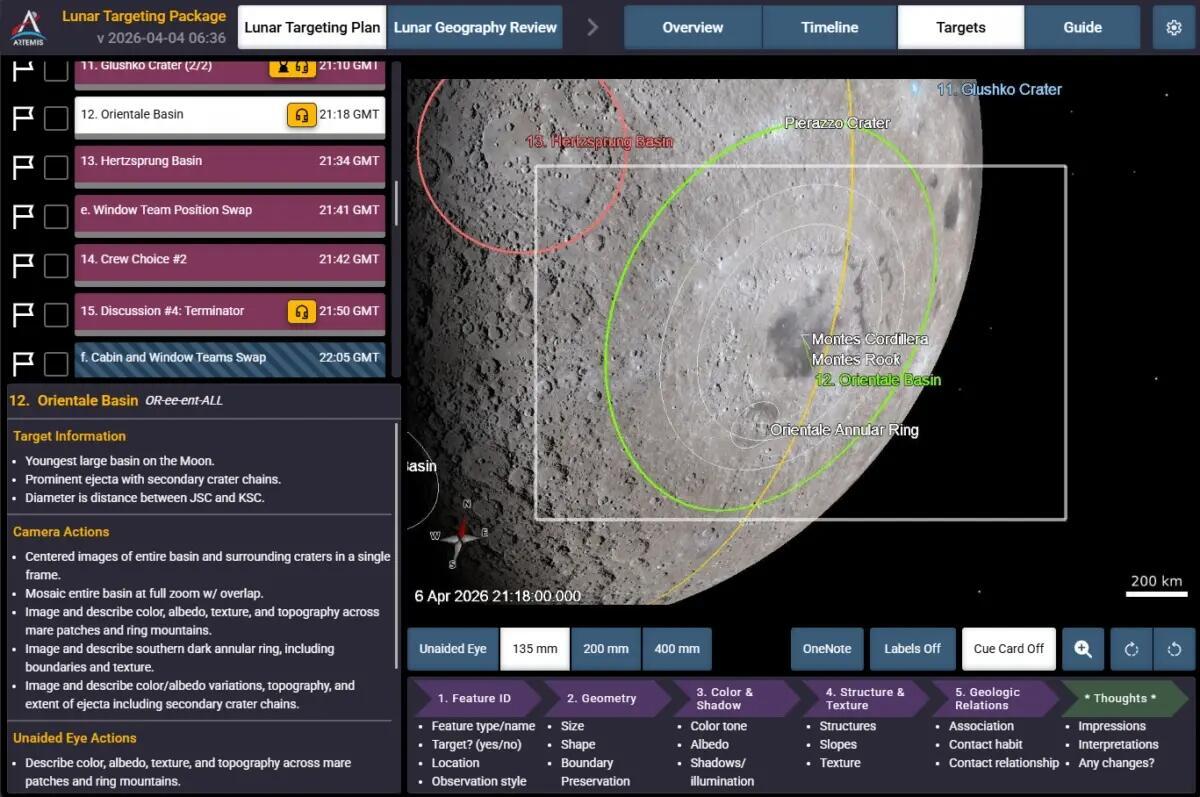
A screenshot of the application the Artemis II crew sees on their PCDs that guides them in the execution of the lunar science observation plan. This custom software was built by the Crew Lunar Observations Team, a subset of the Artemis II lunar science team. In this screenshot you can see Orientale basin, target number 12 circled on the bottom right of the Moon, and to its left, target number 13, Hertzsprung basin.
(Courtesy of NASA).
Record Distance, Solar Eclipse
Wiseman, Glover, Koch, and Hansen will make most of their lunar observations while flying where no one has gone before.
Approximately 1:56 p.m.—Artemis II will travel beyond the furthest point from Earth humans have ever reached: 248,655 statute miles by Apollo 13 in 1970. Remarks are expected to be given by the crew commemorating the trailblazing moment shortly after.
7:07 p.m.—The foursome will reach their maximum distance from Earth: 252,760 statute miles.
It will take Integrity more than five hours to cover the additional more than 4,000 statute miles. While its starting speed toward the Moon was nearing 25,000 miles per hour, the spacecraft’s forward motion has slowed to just a fraction of that speed over the past several days due to Earth’s gravity trying to pull it back.
8:35 p.m.—The moon will begin eclipsing the Sun, allowing the astronauts to observe the Sun’s corona and look to confirm Apollo reports about the Sun’s ability to disperse moon dust. The eclipse will also allow the crew to collect data on how their solar-powered spacecraft handles being taken out of direct sunlight and other stresses that would be experienced on future Artemis II missions.
9:32 p.m.—Solar eclipse concludes.
Upon completion of their objectives, the Artemis II crew will begin sending some of the imagery they collected to science teams on the ground. NASA’s scientists will review the material overnight and then have a conversation with the crew about their findings on April 7.
1:25 p.m. on April 7— Artemis II will begin its journey home immediately after its pass around the moon. It will leave the moon’s gravitational pull and begin falling back to Earth.
Artemis II is scheduled to splash down in the Pacific Ocean off the coast of San Diego at 8:07 p.m. on April 10.