
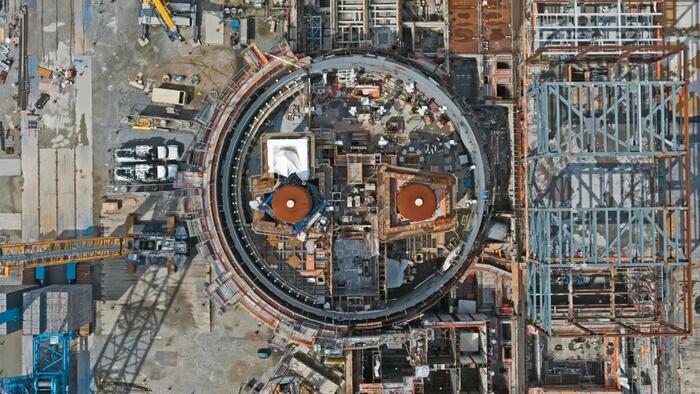
As we have been detailing for months, the Trump administration is pushing the deployment of nuclear energy in ways never before seen in modern times. Among the dozens of major regulatory changes, award programs, and high-speed development initiatives, the administration seems to be clearing a new roadblock every week, yet in reality it is greatly lagging global rollout of NPPs, and especially China which is currently building at least 39 nuclear reactors.
Four months later, China has added 9 more reactors and is now building a total of 39 nuclear power plants. Meanwhile the US has added 0 and is still building 0 https://t.co/TJ6BoMghNk pic.twitter.com/O4idOANNUr
— zerohedge (@zerohedge) April 15, 2026
Forbes recently detailed one of the most significant regulatory changes to date with the publishing of a new reactor licensing path, referred to as Part 57, by the Nuclear Regulatory Commission (NRC).
Microreactor developer Nano Nuclear released a statement highlighting the benefits of the new licensing option and how their reactor designs stand to benefit…
$NNE “NANO Nuclear Sees KRONOS MMR™ Well-Aligned with NRC’s Evolving Advanced Reactor Frameworks Under Part 53 and Proposed Part 57” The NRC’s Part 53 final rule, which becomes effective on April 29, 2026. #NuclearEnergy #Microreactor #USA ⚛️🇺🇸https://t.co/izWmh7oFZz
— NANO Nuclear Energy (NASDAQ: NNE) (@nano_nuclear) April 28, 2026
Until now, reactor developers have had to choose between two licensing paths, either Part 50 or Part 52.
Part 50 is the legacy path tailored to large, water-cooled reactors like the Westinghouse AP1000 models that were built at the Vogtle site in Georgia.
Part 52 was later introduced to streamline the steps of Part 50 to avoid regulatory delays, especially lawfare from NIMBY activists. Part 52, though, is still tailored to large, water-cooled reactors.
Just this year, Part 53 was finally published. Part 53 allows advanced reactor developers to skip over the requirements of Parts 50 and 52 that are not required or not applicable, and streamline the path to operations even further.
This brings us to the latest regulation released in draft form just last week, Part 57.
Part 57 is explicitly tailored towards microreactors and is formatted to allow for approval of fleets of these smaller modules as opposed to individual licensing of one reactor at a time.
The new licensing path also includes authorizations for unique modes of operation, simplified environmental reviews, and the possibility of early construction to further speed up reactor deployment.
One of the most notable takeaways from the newest licensing path from the NRC is the regulator’s estimation of savings coming in at almost $4 billion dollars on the low end from reduction in exemption requests and streamlining reviews. The regulator also claims permits could be issued on timelines as short as 6-12 months, compared to previous timelines which stretched to several years.
Forbes also touched on the Idaho National Laboratory (INL) Demonstration of Microreactor Experiments (DOME) facility. We have covered developments at the INL DOME multiple times, with the anticipation that Radiant Nuclear will be taking their Kaleidos pilot design critical by July 4th of this year.