
Authored by Amy Howe via scotusblog.com,
The Supreme Court on Monday night granted a request to immediately finalize its opinion in Louisiana v. Callais, in which it struck down that state’s congressional map, to allow Louisiana to draw a new map in time for the 2026 elections.
[ZH: Democrats are raging as] that map is expected to favor Republicans, who currently hold four of the state’s six seats in the U.S. House of Representatives but could pick up one or even two more under a revised map.
The United States Supreme Court, in the eyes of America and the world. pic.twitter.com/xerjBPgDz4
— Bill Madden (@maddenifico) May 1, 2026
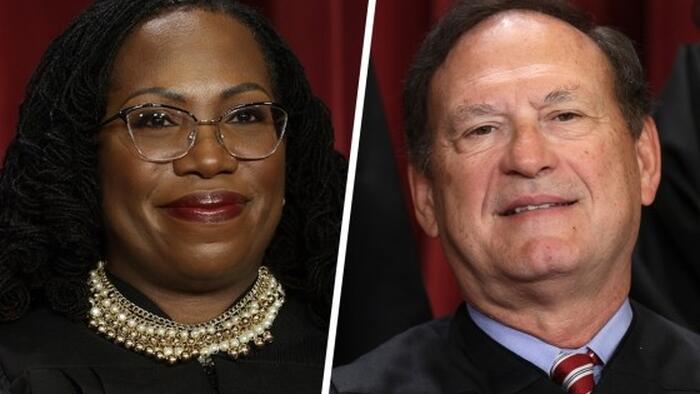
The court’s decision drew sharp criticism from Justice Ketanji Brown Jackson, the lone dissenter. Jackson argued that the court’s ruling “has spawned chaos in the State of Louisiana.”
Justice Samuel Alito, joined by Justices Clarence Thomas and Neil Gorsuch, wrote a concurring opinion that responded to Jackson with equally sharp words, countering that her rhetoric “lacks restraint.”
🚨 JUSTICE SAMUEL ALITO HAS HAD IT WITH KETANJI BROWN JACKSON
Joined by Clarence Thomas and Neil Gorsuch, Alito EVISCERATED Jackson for her combative and “insulting” dissent:
“Instead the dissent offers 2 reasons for its proposed course of action. One is TRIVIAL at best, and… pic.twitter.com/u4idr8ALPT
— Eric Daugherty (@EricLDaugh) May 5, 2026
In an unsigned, one-paragraph order, the court explained that, to give the losing party time to ask the justices to reconsider their decision, the Supreme Court’s clerk normally waits 32 days after a decision is issued before sending a copy of the opinion and the judgment to the lower court.
But, the court wrote, in this case the Black voters defending the map at the center of the dispute “have not expressed any intent to ask this Court to reconsider its judgment.”
The court issued its decision in Louisiana v. Callais on Wednesday, April 29. By a vote of 6-3, it invalidated a map adopted by the Louisiana Legislature in 2024, which created two majority-Black districts after two lower courts ruled that an earlier map with just one majority-Black district likely violated Section 2 of the Voting Rights Act, which bars racial discrimination in voting.
Later that day, the “non-African-American” voters who had challenged the 2024 map came to the Supreme Court, asking the justices to bypass its normal 32-day waiting period and finalize the opinion as soon as possible. The voters told the justices that the Louisiana Legislature was “considering pushing back” the deadlines for the state’s congressional primaries to allow them “to occur under a remedial map.” Finalizing the opinion immediately, they argued, could give the state more breathing room in which to operate, given the short timeframe in which the state would need to revise the map.
One day later, Louisiana told the court that it would indeed postpone the state’s primary elections for Congress, which had been scheduled for May 16. In the view of Louisiana Gov. Jeff Landry, a Republican, the use of the 2024 map would constitute the kind of emergency that justifies a postponement under Louisiana law, because “electing members to Congress under an unconstitutional map flies in the face of the United States Constitution and subjects Louisiana voters to representatives that are impermissibly elected as determined by the United States Supreme Court, in a 6-3 decision.”
In her four-page dissent, Jackson suggested that the court itself was taking sides in the battle over redistricting. She wrote that developments in the wake of last week’s ruling in Callais “have a strong political undercurrent.” Louisiana’s effort to redistrict, she said, “unfolds in the midst of an ongoing statewide election, against the backdrop of a pitched redistricting battle among state governments that appear to be acting as proxies for their favored political parties.”
Moreover, Jackson noted, in the last 25 years, when one litigant has objected to a request to fast-track the issuance of its final opinion, the court has only granted the request twice. “To avoid the appearance of partiality,” she emphasized, “we could … opt to stay on the sidelines and take no position by applying our default procedures.” But by granting the challengers’ request, she said, the court’s action “is tantamount to an approval of Louisiana’s rush to pause the ongoing election in order to pass a new map.”
In a five-paragraph concurring opinion, Alito called Jackson’s suggestion that the court should allow the 32-day waiting period to expire “to ‘avoid the appearance of partiality’” “baseless and insulting.” Complying with the waiting period, Alito posited, could itself be construed as partisan, because it would favor the defenders of the 2024 map. Alito also pushed back against Jackson’s contention “that our decision represents an unprincipled use of power,” calling it a “groundless and utterly irresponsible charge.”
The Louisiana Legislature plans to hear public comments on Friday on a new proposed map, which would include one majority-Black district. Meanwhile, lawsuits have been filed in both federal and state courts in Louisiana, challenging Landry’s postponement of the May 16 primary.