
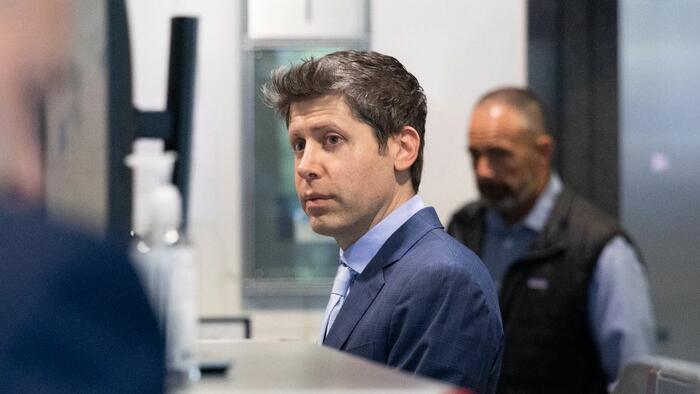
OpenAI CEO Sam Altman spent roughly four hours on the witness stand Tuesday defending the company’s shift from a nonprofit to a for-profit model, directly rebutting Elon Musk’s claims that he and co-founder Greg Brockman “stole a charity” when they restructured the artificial intelligence lab.
“I think it’s wonderful that through the hard work of thousands of people … we’ve been able to create one of largest nonprofits in the world, [and] that it has this role to protect the technology and the impact on the world,” Altman told the court.
The testimony came during the third week of Musk’s federal lawsuit against Altman, Brockman, and OpenAI in U.S. District Court in Oakland, California. Musk, who helped found OpenAI in 2015 but left its board in 2018, accuses the pair of betraying the original mission to develop safe AI for humanity after he provided tens of millions in early funding. He is seeking Altman’s and Brockman’s removal from leadership, more than $150 billion in damages, and the unwinding of OpenAI’s 2019 conversion to a for-profit structure now backed heavily by Microsoft. Musk has accused the pair of bilking him out of $38 million in donations, then restructuring the nonprofit lab they coufounded by exclusively licensing their flagship product to Microsoft. This, Musk’s team argues, betrayed OpenAI’s founding mission to operate an open-source charity that would counter the existential risks of profit-driven AI.
Altman told the jury that Musk had pushed for significant personal control from the outset, including an early proposal that he receive 90 percent equity in the company – an idea Altman said made him “extremely uncomfortable.” He also rejected Musk’s suggestion of a merger with Tesla, saying it would have compromised OpenAI’s independence because “Tesla needs to serve its customers and sell cars.”
On the central issue of the for-profit conversion, Altman testified that Musk either supported the move or did not oppose it. “Quite the opposite,” he said when asked whether Musk had resisted the change. Altman portrayed Musk’s current lawsuit as driven by “sour grapes” after Musk launched the rival xAI lab, attempted to poach OpenAI researchers, and engaged in what Altman described as “business interference.”
Musk, meanwhile, told the court “You can’t just steal a charity.”
Altman shot back when his turn came: “No, you can’t steal it, but Mr. Musk did try to kill it.”
As the Epoch Times notes further, Altman said Musk abandoned the company in 2018 to start his own for-profit competitor, xAI, when other founders rejected his bid to take full control of the operation.
“I thought incredibly highly of Elon, and felt like he had abandoned us, not come through on his promises,” Altman said, suggesting Elon’s withdrawal of support jeopardized the mission. “We were left for dead.”
He acknowledged Musk was a critical contributor but added, “I also wish he would stop doing what he is doing here, which in my opinion is jealousy as we get more and more successful.”
In the bitter feud between the former friends and cofounders, which in recent years has unfurled on social media, both volley accusations of betrayal, double-dealing and hypocrisy.
Altman on Tuesday described his tumultuous tenure at OpenAI’s helm as painful and difficult, its successes unimaginable just a decade prior.
The once-embattled and underfunded nonprofit startup, founded in 2015, was recently valued at $852 billion following a 2025 restructuring as a public benefit corporation, in which the nonprofit arm received a 26 percent stake in the for-profit, based on a transfer of intellectual property. Microsoft, following $13 billion in investments since 2019, currently owns a 27 percent stake in the company.
‘Hurt and Angry’
Of the circumstances surrounding his chaotic 2023 ouster by former nonprofit board members, who at the time cited his “consistent pattern of lying” and concerns over safety protocol issues, Altman said it was one of the most painful moments in his life.
“I had poured the last years of my life into this. I was watching it about to be destroyed. … I was very angry and hurt and upset. It felt like an incredible betrayal,” he said, noting he could have made a lot of money and had a “much easier life” if he had gone to work for Microsoft.
Microsoft CEO Satya Nadella testified Monday that at the time, he offered to create an AI project for Altman, Brockman and any potentially departing employees, in an effort to prevent the wholesale implosion of OpenAI—and along with it his company’s formidable investments.
Musk alleges Microsoft “methodically entrenched itself” into OpenAI, helping to engineer the 2023 “coup” and seize the company’s board of directors.
Altman returned to OpenAI just days later, at the board’s invitation, he said, because he “cared about the mission and the people,” and thought it would be the last chance to create an AI lab with OpenAI’s unique mission and structure.
“I was not trying to deceive the board,” Altman said. “I was certainly not trying to do anything other than make safe AI and distribute it to humanity. I feel badly for the misunderstandings … but that was never my intent.”
In court Tuesday, Steven Molo, an attorney for Musk, pressed Altman about his conditions for return, which included firing the original board—and vetting a new one with Nadella’s approval.
Musk is suing Microsoft for aiding and abetting OpenAI’s breach of a charitable trust, allegations Nadella disputed when he testified May 11 about his involvement in the messy 2023 shakeup and a landmark financial agreement between the two companies the same year.
Power Struggle
Following a 2017 milestone demonstration of OpenAI technology at a gaming event, the founders realized they had a chance at becoming competitive but would need significantly more capital and computing power to take on Google, at the time an undisputed leader in the field.
Each floated various ideas for profit and nonprofit configurations; Musk at one point suggested rolling OpenAI into Tesla. Throughout late 2017 and early 2018, discussions became more contentious as the power struggle between Musk and Altman intensified.
At one point, Altman said, Musk suggested giving himself a 90 percent equity stake in a for-profit entity; Musk meanwhile, pointed out that he proposed taking an initial majority stake that would be diluted with additional investment over time.
Altman said Tuesday that Musk contributed only 28 percent of the nonprofit’s funding from 2015 to 2020, and failed to come through on a $1 billion pledge, leaving the startup with few options.
Molo pressed Altman, suggesting he had a “fixation” with being CEO. The attorney referenced an email from Brockman and fellow cofounder Ilya Sutskever during the period of intense negotiations over the future funding and structure of OpenAI.
“We don’t understand why the CEO title is so important to you. Your stated reasons have changed, and it’s hard to really understand what’s driving it,” the two wrote. “Is AGI your primary motivation? How does it connect to your political goals?”
Artificial General Intelligence refers (AGI) generally refers to the theoretical point at which machine “intelligence” meets or surpasses human cognitive abilities and can operate autonomously, which many experts view as an existential threat to humanity. Musk cites the risks of runaway AGI as the express motivation for founding OpenAI.
Altman on Tuesday said, by way of explanation, “I was thinking about running for governor at the time.”
Molo challenged OpenAI’s contention that its nonprofit board has control of OpenAI’s for-profit ventures and governance.
In a poignant moment, the plaintiff’s attorney played a brief clip of Altman’s 2024 appearance on a popular podcast, in which he appears to acknowledge former board members’ contentions that he maintained de-facto control over the nonprofit’s board of directors, and impeded their ability to carry out their duties.
Asked on the podcast if he trusted himself with the kind of power that will come with being first to develop AGI, Altman paused and said he was going to offer a standard response about how no one person should have total control over AGI.
“I think you want a robust governance system,” he said, noting a number of issues related to “our board drama.”
“But as many people have observed, although the board had the legal ability to fire me, in practice it didn’t quite work. And that is its own kind of governance failure,” he said.
Under re-direct by OpenAI attorney William Savitt, Altman clarified the outgoing board technically fired him, rehired him, and appointed a new board.
Toxic Management Style
Altman said he was “annoyed” when Musk resigned from the OpenAI board in 2018 to pursue his own AI venture.
“He really had lost confidence in the organization and did not believe we were going to be successful. … And he didn’t want to be associated with something he couldn’t control,” Altman said.
That left questions about funding gaps, competition and, Altman said, whether Musk would “take revenge” on his former cofounders.
“I don’t think Mr. Musk understood how to fund a good research lab,” Altman said, noting he had “demoralized” some of the company’s most key researchers, including by suggesting they be ranked by accomplishments.
Musk’s management style, he said, may work in other industries, but upset the culture in a fledgling, frontier lab where people needed “psychological safety” and long periods of time to develop their work.
Reaction to his departure, Altman said, was mixed. It introduced instability but also provided a “morale boost.”
Challenging Altman’s Credibility
Musk’s lawyer, Steven Molo, hammered Altman – citing prior testimony that described a “toxic culture of lying” at OpenAI and statements from former executives who questioned Altman’s trustworthiness. He repeatedly asked whether Altman had misled people in business dealings. Altman responded that he believed he was “an honest and trustworthy business person,” while acknowledging there had been times he had not told the full truth and that he had heard others describe him as a liar.
Molo also highlighted Altman’s personal financial interests, including a roughly $1.7 billion stake in Helion Energy, suggesting potential conflicts during OpenAI’s negotiations. Altman’s own lawyer, William Savitt, focused on Altman’s commitment to the company, including his decision during the 2023 board crisis to return rather than leave for Microsoft. Altman described that choice as being willing to “run back into a burning building to save it.”
Musk did not remain in the courtroom for Altman’s testimony – while closing arguments are expected on Thursday. An advisory jury may begin deliberations shortly afterward, though the judge will ultimately decide any remedies.
The case centers on whether OpenAI’s leaders violated a charitable trust when they created a for-profit subsidiary in 2019 to attract talent and capital. OpenAI maintains that Musk was aware of and supported the restructuring at the time. Musk argues the conversion enriched Altman and Brockman at the expense of the original nonprofit mission.
Brockman’s private journal – awkward…
One bit of awkwardness; During Brockman’s testimony last week, hundreds of pages from his personal journal – kept since 2010 – were introduced as evidence. The entries, written in 2017, captured Brockman’s internal debate over balancing financial pressures with OpenAI’s founding mission and his uncertainty about Musk’s role and intentions. One entry from November 2017, labeled Exhibit 161, was written before and after a key meeting with Musk and has been frequently cited by both sides.
The journal first surfaced in January during the discovery phase of the case. Musk’s legal team obtained the full document and began questioning Brockman about specific passages during his deposition. OpenAI tried to keep large portions sealed, arguing they were cherry-picked and taken out of context, but the judge allowed several entries to be entered as exhibits and even quoted from them in her ruling that let the trial proceed.
The entries that have drawn the most attention were written in 2017, during a particularly turbulent period as OpenAI was wrestling with its future direction and Musk’s role in the company.
One August 2017 entry showed Brockman grappling with the tension between financial realities and the original mission to benefit humanity. A September entry captured his stream-of-consciousness reasoning about the complicated Musk situation – written in the same “chain of thought” style that would later become famous in AI models. The most cited entry, labeled Exhibit 161, was written in November 2017, both before and after a pivotal meeting with Musk. It revealed a founder full of uncertainty, ambition, self-doubt, and a clear desire to do the right thing for the company’s long-term mission.
Brockman testified that he used the journal to process important decisions and that he wrote only for himself. He described the public disclosure as “very painful” but said there was “nothing in there that I’m ashamed of.” He stopped documenting OpenAI matters in the journal in 2023. Musk’s attorneys have referred to the document as a “diary,” while OpenAI’s lawyers have called it a “journal.”