
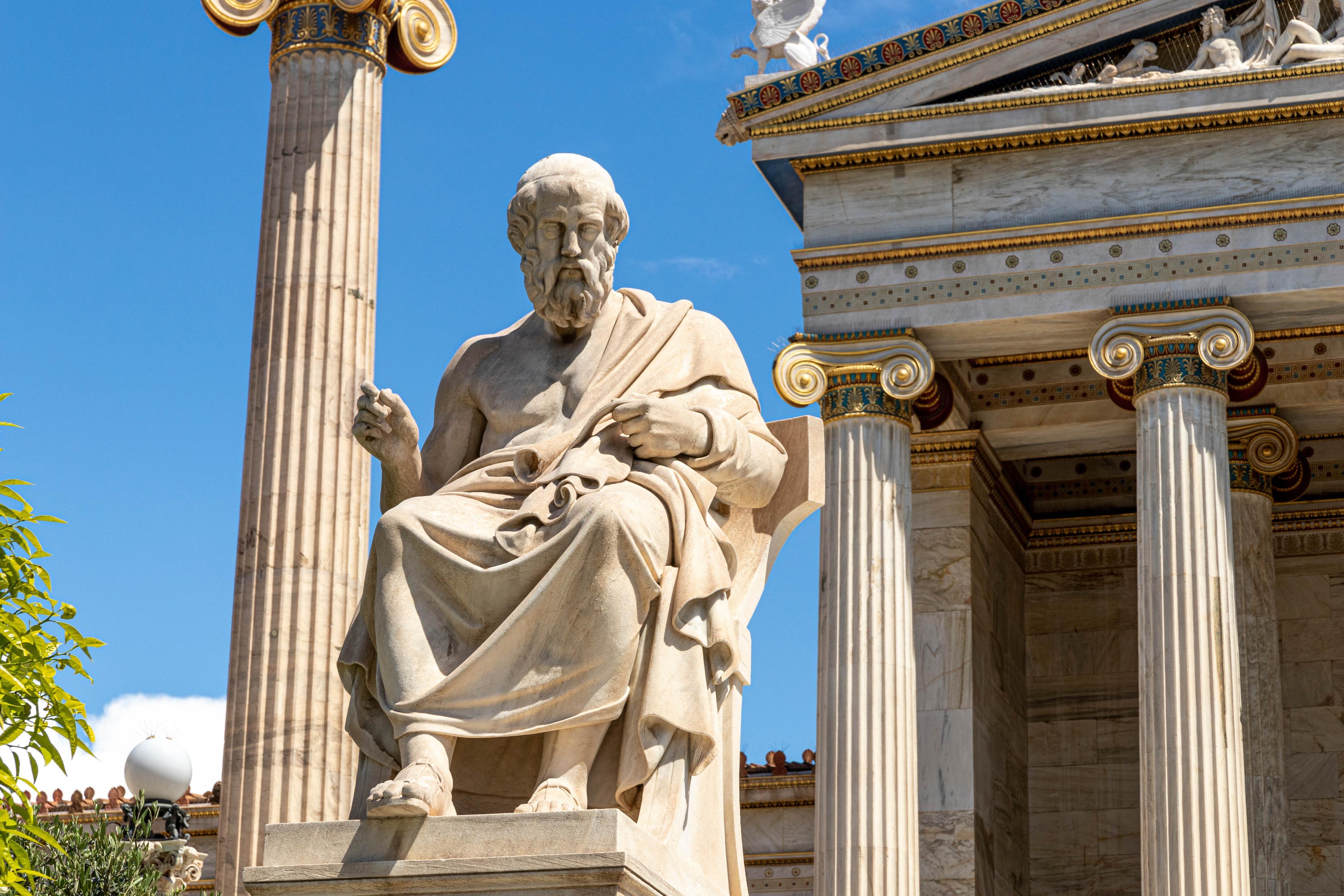
 In 399 B.C., at the Heliaia, the principal court of Athens, an elderly man addressed a jury of his peers. Accused of impiety and corrupting the youth, the man, aged about 70, said he was innocent, guilty only of making enemies by arguing that the men of greatest repute in Athens were foolish, “and that some inferior men were really wiser and better.”
The charges carried the death penalty, yet the man made it clear he feared neither trial nor death, having survived battles at Potidaea, Delium, and Amphipolis. Nor would he shame himself—or Athens—by groveling before the jury to appease Meletus, his primary accuser, saying it would be illogical to demean the truth to save his life.
“I have seen men of reputation, when they have been condemned, behaving in the strangest manner,” Socrates told the jury. “They seemed to fancy that they were going to suffer something dreadful if they died, and that they could be immortal if you only allowed them to live.”
Today, we still read Plato’s “Apology,” where this scene is recorded, and which appears in countless introductory Western philosophy courses. My niece, who attends the University of Wisconsin–Milwaukee, recently brought the text home for Easter break.
There are many reasons the work endures. It is short and historically important, and it also raises fundamental questions about moral integrity in the face of power. But its lasting grip lies in a deeper question: How should humans face death?
advertisement
Death is a certainty. We will lose loved ones, and we will die ourselves. Whether death ends consciousness or is “nothing more than a change of mind” (to borrow a phrase from James Madison) remains unknown, at least to the living. It is the “undiscovered country,” William Shakespeare wrote, “from whose bourn no traveler returns.”
Those words come from “Hamlet,” arguably the greatest play ever written. Death is its central theme. The drama begins when the prince of Denmark is visited by the ghost of his father, who reveals he was murdered by his brother, setting in motion a chain of events that leads to the death of every major character.
Shakespeare returned to the theme of death again and again, in works including “Macbeth” and “Romeo and Juliet.” He was not unique in this preoccupation.
Joaquin Ossorio Castillo/Shutterstock
“Human stories,” J.R.R. Tolkien observed, “are practically always about one thing, aren’t they? Death.”
Tolkien was right. The greatest stories of the ages center on death—how people face it, or how they respond to loss.
In “Braveheart,” William Wallace takes up Scotland’s cause after his wife is killed by an English soldier. In “The Return of the King,” Eowyn risks her life to slay the Witch-king after her uncle Theoden falls. In “Wonder Woman,” Steve Trevor sacrifices himself to save others, flying away with a payload of poison gas.
The lesson of these stories is clear: When humans stop fearing death, they are capable of extraordinary things. Yet fear of death is common—nearly half of Americans report fearing death.
Many consider this natural, but Socrates disagreed. He called fear of death “the pretence of wisdom,” observing that “no one knows whether death, which they in their fear apprehend to be the greatest evil, may not be the greatest good.”
Socrates understood the same lesson of our stories: When we no longer fear the grave, we can live our full life. He was not the only teacher to grasp this truth.
“For whoever wants to save their life will lose it,” Jesus of Nazareth says in the Gospel of Matthew.
Lik Studio/Shutterstock
The idea that we cannot live fully until we accept death appears in other religious texts and can also be found in modern films. It is the premise of David Fincher’s 1997 film “The Game,” a psychological thriller starring Michael Douglas and Sean Penn that is resolved when the wealthy but isolated investment banker Nicholas Van Orton (Douglas) is reborn when he believes he is losing his life.
Ward Farnsworth, dean of the University of Texas School of Law, notes in “The Practicing Stoic” that freedom from the fear of death was a central goal of Stoic philosophy.
“We must make ready for death before we can make ready for life,” Seneca wrote in “Epistles.”
The way one faced death was of such importance in the Greek tradition that many believed a man’s life could not be judged until he had died. Writing in the 16th century, Montaigne shared an anecdote about the Theban general Epaminondas (4th century BC), who was asked who should be held in the highest esteem, himself or the Athenian generals Charbrias or Iphicrates.
“You must see us die before deciding,” Epaminondas replied.
To modern readers, this emphasis on death may seem strange. But the ancients understood that confronting mortality is essential to living a full life.
Modern life, by contrast, makes it easy to forget. The prosperity created by capitalism—longer lifespans, advanced medicine, abundant food, and material comfort—has distanced us from the immediacy of death. These are real achievements to be celebrated, yet they also make it easier to hide from the reality of death—a problem compounded by cultural trends that push it into hospitals and nursing facilities rather than the home.
advertisement
“Mortality remains an inescapable fact,” filmmaker Caylan Ford observed in “First Things,” “but it has been tamed, sanitized, and banished to the margins of our consciousness.”
This trend should be resisted. Acknowledging mortality doesn’t just liberate us; it shapes our values. By recognizing death’s inevitability and learning not to fear it, we live fuller lives.
Few demonstrate this better than Socrates.
Despite a compelling defense showing he was neither impious nor a corruptor of youth, the jury found him guilty and rejected his offer to pay a fine. Too old to go into exile, Socrates unflinchingly accepted his death sentence.
Plato and Xenophon describe him calmly conversing with friends until the end, then walking to his execution outside the Agora, where he drank hemlock under the supervision of state officials.
Some would call it a tragic end—and it was. But it was also courageous and inspiring, which is why we still read and discuss it nearly 2,500 years later.