
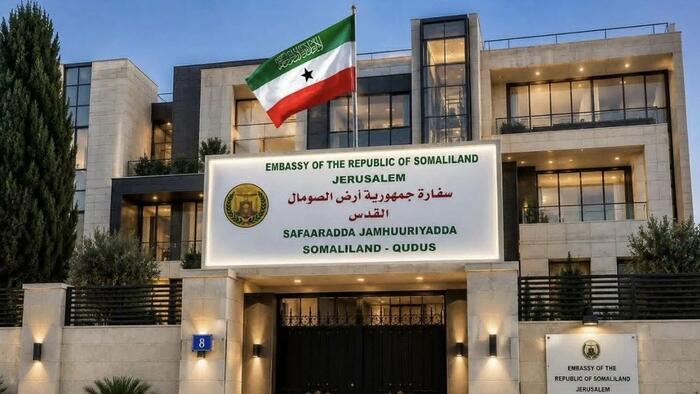
Fifteen Arab and Islamic countries condemned on Sunday the decision of the breakaway region of Somaliland to open an embassy in occupied Jerusalem. The foreign ministers of Egypt, Saudi Arabia, Qatar, Jordan, Turkiye, Pakistan, Indonesia, Djibouti, Somalia, Palestine, Oman, Sudan, Yemen, Lebanon, and Mauritania denounced the move in a joint statement on Sunday.
The countries condemned “in the strongest terms the illegal and unacceptable step taken by the so-called ‘Somaliland’ region in opening a purported ’embassy’ in occupied Jerusalem,” according to the statement.
The countries issued the statement one week after Israeli President Isaac Herzog welcomed Somaliland’s first-ever ambassador to Israel, Dr. Mohamed Hagi, at the President’s Residence in occupied Jerusalem. “This new and important partnership between our countries will lead to a future of cooperation in a variety of fields – for the benefit of both our peoples and the entire region,” Herzog stated.
Seven countries have opened embassies in Jerusalem since the US, under President Donald Trump, recognized the city as Israel’s capital in 2017.
The decision sparked widespread international condemnation, given that Israeli forces illegally occupied East Jerusalem during the Six-Day War in 1967, which Palestinians call the Nakba. Since then, Israel has colonized East Jerusalem in violation of international law by expelling indigenous Palestinian Muslims and Christians and facilitating the settlement of Jewish Israelis in their place.
The 15 countries rejected any unilateral measures to entrench “an illegal reality in occupied Jerusalem or conferring legitimacy on any entities or arrangements that contravene international law and relevant United Nations resolutions.”
The statement reaffirmed the fact that “East Jerusalem has been occupied Palestinian territory since 1967” and said any measures seeking to alter its legal or historical status are “null and void.”
The foreign ministers also expressed full support for the unity, sovereignty, and territorial integrity of Somalia, rejecting any unilateral actions that undermine Somali sovereignty.
In April, Somalia condemned Israel’s appointment of an ambassador to the breakaway region of Somaliland, calling the move a “breach” of its sovereignty and international law. “This action represents a direct breach of Somalia’s sovereignty, unity, and territorial integrity,” the Somalian Foreign Ministry said, adding that it “undermines the established international consensus.”
Mogadishu added that the decision violates its territorial integrity and contradicts the UN Charter and African Union principles. The ministry stressed that Somaliland “remains an integral part” of Somalia, rejecting any attempt to grant it diplomatic recognition outside federal authority.
On December 26, 2025, Israel formally recognized what it termed the Republic of Somaliland, marking a significant shift in its policy toward the Horn of Africa. The move altered the political equation along one of the world’s most sensitive maritime routes.
It consolidates a four-party alignment linking Israel, India, the UAE, and Ethiopia. This emerging axis focuses on securing maritime chokepoints in the Gulf of Aden and Bab al-Mandeb, while laying the groundwork for an alternative to China’s Belt and Road Initiative (BRI) in eastern Africa.
16 Arab Islamic Countries Condemn Somaliland’s Opening of Purported Embassy in Jerusalem
Doha | May 24, 2026
The Ministers of Foreign Affairs of the State of Qatar, the Arab Republic of Egypt, the Kingdom of Saudi Arabia, the Hashemite Kingdom of Jordan, the Republic of… pic.twitter.com/F7gsx4Elsf
— Ministry of Foreign Affairs – Qatar (@MofaQatar_EN) May 24, 2026
The timing followed months of escalating regional pressure, including the 12-day Israeli–Iranian war in June 2025 and the Yemeni maritime blockade targeting vessels bound for Israeli ports following the beginning of Israel’s genocide of Palestinians in Gaza.
Securing these waterways became a core component of Israeli national security planning. Somaliland’s geography explains its importance. Somaliland’s territory overlooks one of the world’s busiest maritime arteries, facilitating trade flows linking Asia, Africa, and Europe.