
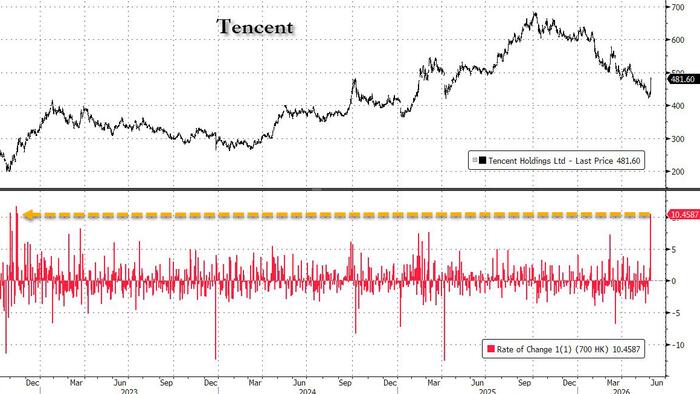
Tencent shares jumped the most since late 2022 after an FT report that the Chinese company was testing a prototype AI agent for WeChat, China’s most widely used app for everything from messaging and social media to ride-hailing and payments, fueled optimism about the company’s artificial intelligence efforts.
The Chinese internet giant plans to begin a compliance process for a public launch of the agent as soon as this month, the Financial Times reported, citing sources. After that, Tencent plans to test the agent on a small group of outside users before initiating a phased rollout, the newspaper said.
Shares of Tencent closed up 10.5%, its biggest jump since November 2022, with turnover at the highest in more than a year. The stock gave a boost to the Hang Seng Tech Index, which rose 4.7%.
Users will be able to access the chat box for the AI agent by swiping right on the main WeChat screen, according to a person who has seen an early demonstration. They can then enter instructions for the agent to automatically tap into WeChat’s millions of mini-apps, the bedrock of the app’s broad functionality, and complete tasks such as finding a café and ordering a drink based on certain flavor and price requirements.
A successful introduction of an AI agent for the popular WeChat service would mark a step forward for Tencent’s bid to catch up to rivals in the rapidly emerging technology. While Tencent has vowed to at least double investments in the field to more than 36 billion yuan ($5.3 billion) this year, it trails peers like ByteDance and Alibaba in both user adoption and advances in developing state-of-the-art large language models.
“Tencent has been a huge underperformer this year because market perceives it as an AI laggard,” said Vey-Sern Ling, managing director at Union Bancaire Privee. “The AI agent, if successful, could change such a perception. Even though there’s very little detail right now, we know Tencent has a huge ecosystem to make it work.”

According to Citigroup, while the adoption of an AI agent in WeChat had been anticipated by the market, its earlier-than-expected timing likely prompted the positive share price reaction.
Goldman’s Graham Ambrose cautions that it’s still not clear how this will evolve and the market is so far unconvinced on Tencent management’s explanation of their strategy to confront the challenge.
- The infrastructure was upgraded in March
- The Hunyuan 3.0 foundation model powering the agent was launched in April
- A Developer Beta recently started
- The pilot launch is planned for June for Weixin users
- The broad roll-out is expected to be in Q3 (not confirmed by management yet) with full integration across the domestic Weixin app, including deep “AI Search” and “Agentic Pay” features.
The news sparked a major move higher in Chinese stocks: in addition to Tencent developments, a slew of positive drivers including Meituan’s earnings and upbeat delivery figures by electric vehicle makers supported the Hang Seng Tech Index. Other internet and e-commerce heavyweights such as Alibaba and JD.com Inc. rose more than 6% as sentiment improved.
The rebound comes after the gauge, with its reliance on Chinese internet giants, has trailed the blistering surge in tech hardware-heavy benchmarks such as South Korea’s Kospi and Taiwan’s Taiex this year.
Prosus NV, Tencent’s biggest shareholder, jumped as much as 11% on Tuesday in Amsterdam. Its parent company Naspers rose at a similar pace in Johannesburg trading.
“Tencent’s move potentially shifts the China AI story from model development to real consumer distribution,” said Charu Chanana, chief investment strategist at Saxo Markets in Singapore. “It’s still too early to say, but if WeChat can integrate an AI agent into a platform with around 1.4 billion users, that gives investors a clearer path to usage, engagement and eventually monetization.”
Bloomberg notes that even with Tuesday’s rebound, Tencent remains down about 20% for the year. Options suggest some investors are making bets on a further recovery after Tuesday’s rally, as China is about to get its own gamma squeeze. Trading of bullish options on Tencent surged to a record high, with more than 430,000 calls changing hands against 177,000 puts.

The four most-active contracts in Hong Kong were Tencent calls, and those with an exercise price 10% above Tuesday’s closing price led the pack. Meanwhile, the cost of hedging against declines in the next three months plunged to its lowest level in almost a year.