
Authored by Jacob Burg via The Epoch Times,
AI companies would be required to submit their frontier models on a voluntary review basis before public releases.
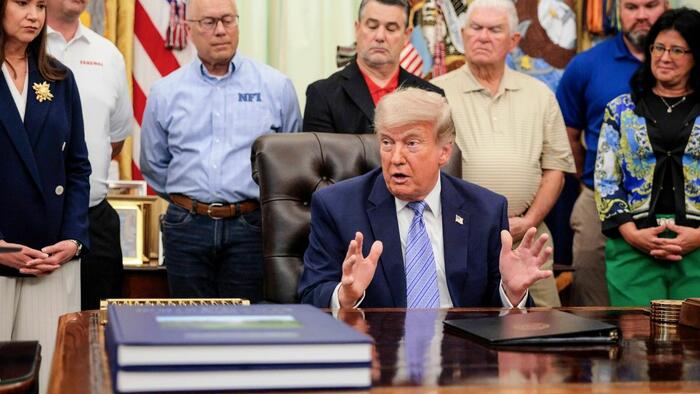
President Donald Trump signed an executive order on June 2 intended to address cybersecurity threats posed by artificial intelligence (AI) technology and the new frontier models being released by major industry players.
Signed in private, the order allows some AI firms to submit their cutting-edge frontier models to a voluntary government review 30 days before a full public release.
That would entail “provid[ing] the Federal Government with access to covered frontier models, subject to appropriate confidentiality, cybersecurity, insider-risk, and intellectual-property protection, use, and nondisclosure requirements, for a period of up to 30 days before they plan to release such models to other trusted partners.”
The order also gives the Pentagon, the Department of Homeland Security, the Cybersecurity and Infrastructure Security Agency, the Office of Management and Budget, and other related agencies 30 days to “expedite and prioritize the cyber defense of civilian Federal Government information systems” and establish or expand a federal program that would “enhance AI-enabled defensive tools.”
Trump’s order also creates an “AI cybersecurity clearinghouse” that would function in “voluntary collaboration” with the AI industry and other critical infrastructure operators. The goal would be to scan for software vulnerabilities in frontier AI models while prioritizing “remediation and distribution of vulnerability patches.”
Trump had planned to sign a previous version of this executive order, but said on May 21 that he would delay the signing after becoming dissatisfied with “certain aspects of it.”
Earlier that month, the Commerce Department’s Center for AI Standards and Innovation announced partnerships with AI giants Google, Microsoft, and xAI to test their new frontier models for potential security risks ahead of full public releases.
Cybersecurity concerns over frontier AI models surged after Anthropic on April 7 announced its Claude Mythos Preview model, which is not yet publicly available due to the company’s concerns that bad actors could use it to find critical software exploits.
The Trump administration had previously moved to ban Anthropic from doing business with the federal government after the company refused to grant the Pentagon unrestricted access to its Claude models, stating that it was concerned they would be used for mass domestic surveillance or fully autonomous weapons, which the Pentagon denies.
Despite the ban, Anthropic co-founder Jack Clark said in April that he had been in talks with the Trump administration over Claude Mythos Preview.
The Alliance for Secure AI, a nonprofit that “educates the public about the implications of advanced AI,” on June 2 called for Congress to codify Trump’s executive order to “create a legal framework that makes federal government review of advanced AI models mandatory.”
Trump’s executive order allows AI companies to submit their frontier models to government review on a voluntary basis.
“After the national security wake-up call from advanced AI models like Mythos, we are pleased to see that the Trump administration is taking the risks of these models seriously. However, we know that Big Tech will still try to cut corners on safety and security,” Brendan Steinhauser, CEO of The Alliance for Secure AI, said in a statement.
“The next AI models will be even more powerful and will pose even bigger threats to our country than Mythos. These companies need oversight and cannot be trusted to do the right thing voluntarily.”