
Authored by Sujita Sinha via Interesting Engineering,
Germany’s first F-35A fighter jet is now closer to delivery after its engine was installed during final assembly, according to Lockheed Martin. This milestone shows steady progress on one of Germany’s biggest defense modernization efforts since the Cold War.
Lockheed Martin Europe posted the update on social media, describing the engine installation as “another key production milestone on the path to delivering advanced 5th Gen capability for Germany.”
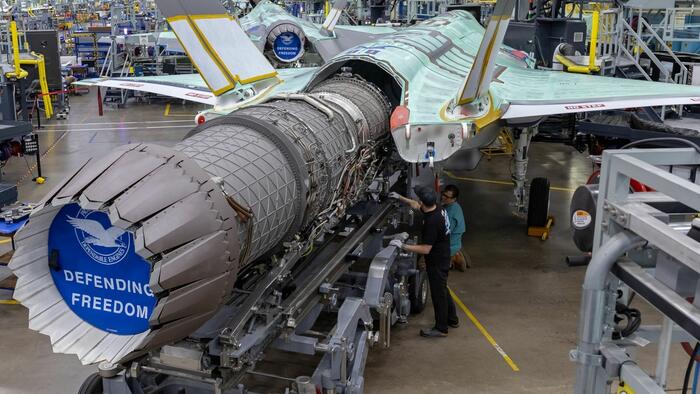
The company shared photos of the aircraft on the assembly line as workers installed the Pratt & Whitney F135 engine. Now that the engine is in place, the jet will move on to final testing before its first flight and handover to the German Air Force.
Powerplant Transforms Aircraft Into Operational System
Germany’s first F-35 uses the Pratt & Whitney F135, which is the most powerful engine in any Western fighter jet today. It produces about 43,000 pounds of thrust with afterburner and is a key part of the jet’s design.
The F135 was made specifically for the F-35 and cannot be swapped for another engine. Besides providing power, it also helps the jet stay stealthy. Engineers shaped the exhaust nozzle and air intake to lower radar visibility from different directions.
Installing the engine is a major step in final assembly because it marks the change from a finished airframe to a working combat jet. After the engine is in, technicians start checking how the propulsion system works with the jet’s controls, sensors, and software.
Die Power hinter Deutschlands erster F-35 🇩🇪
Mit dem erfolgreichen Einbau des Triebwerks hat das Flugzeug einen weiteren wichtigen Meilenstein erreicht – auf dem Weg zur Auslieferung modernster Fähigkeiten der 5. Generation für Deutschland. pic.twitter.com/foTw7YotgE
– Lockheed Martin Europe (@LMEuropeNews) June 4, 2026
Berlin’s Response To A Changing Security Environment
Germany decided to buy the F-35A soon after Russia began its full invasion of Ukraine in February 2022. The F-35A will replace the Luftwaffe’s old Tornado jets, which have been used for NATO nuclear-sharing missions for many years.
As part of NATO, Germany keeps aircraft and trained pilots ready to deliver U.S. nuclear weapons if needed. With the Tornado nearing retirement, German officials looked for a replacement that could handle future missions.
The F-35A, which takes off and lands like a regular jet, became the top choice for its stealth, survivability, and certification for nuclear missions. German leaders found that no European jet matched these features for the job.
Multi-Billion-Dollar Investment In Future Air Power
Germany has ordered 35 F-35A jets for about $8.4 billion. The deal covers more than just the planes – it also includes pilot training, simulators, logistics, weapons integration, and the infrastructure needed to run the fleet.
This purchase puts Germany in a growing group of European countries that have joined the F-35 program. The Netherlands, Norway, Denmark, Belgium, Italy, Poland, Finland, and Switzerland have all either received or ordered the jet.
As more European countries use the F-35, NATO is shaping its future air combat plans around this common fifth-generation jet. Using the same aircraft makes training, maintenance, and joint missions easier.
Next Steps Before Delivery
The engine was installed following the usual steps at Lockheed Martin’s F-35 production line in Fort Worth, Texas. After installation, the jet undergoes additional system checks, fuel testing, and ground runs to ensure everything works properly.
Next, engineers check how the engine works with the jet’s software and flight systems before allowing flight tests. Once these steps are done, the jet can be accepted by the customer.
For the Luftwaffe, acquiring the F-35A will give it new capabilities that Germany’s current fighter jets do not have. The Eurofighter Typhoon and Tornado can handle air combat and strikes, but neither was built to be stealthy.
The F-35’s stealthy design allows it to fly in heavily defended airspace and makes it harder for enemy radar to detect. As advanced air defenses spread, this feature is expected to be key in Germany’s future military plans.