
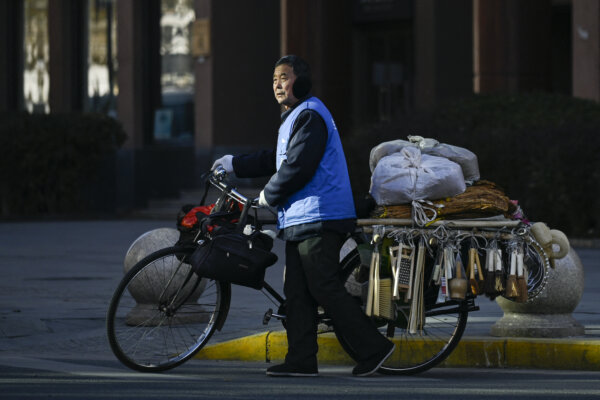
 The population engaged in “flexible employment” in mainland China has exceeded 300 million, according to a recent report.
Observers told The Epoch Times that by rebranding gig workers, temporary staff, and platform-based workers as those with “flexible employment,” China’s ruling Communist Party (CCP) is using statistical rhetoric to downplay the persisting high unemployment issue.
The China New Employment Forms Research Center, a Beijing-based research firm, recently released its “2025 Research Report on Blue-Collar Employment in China.” According to the report, the number of workers engaged in “flexible employment” in China stood at 280 million in 2025 and is projected to reach 320 million in 2026, accounting for more than 40 percent of urban employment, state-controlled major Chinese financial media outlet Yicai reported on June 4.
The research report is based on a sample of 28,450 valid responses and covers various groups, including food delivery workers, domestic workers, truck drivers, live-streamers, delivery riders, manufacturing workers, construction workers, cleaners, and security guards.
Liu An, a China-based economist who used a pseudonym out of fear of reprisal from the Chinese regime, told The Epoch Times that China’s official employment figures include a large number of people in “unstable employment.”
“China’s total employed population is approximately 734 million; however, the number of ‘flexible employment’ workers has reached 300 million, and the total number of migrant workers is also close to 300 million,” he said. “While there is significant overlap between these two groups, this indicates that a substantial portion of the officially recorded employed population does not hold stable jobs.”
If measured by criteria such as fixed positions, stable wages, labor contracts, and social security coverage, the population with truly stable employment may be far lower than the total employment figure officially reported, Liu said.
The research report indicates that China’s blue-collar workforce reached a size of 427 million in 2025, an increase of about 0.5 percent from the 425 million recorded in 2024. Among them, the number of domestic service workers stands at 46.8 million, while the number of food delivery workers has risen to 15.9 million. The report further notes that “flexible employment” has shifted from being a “supplementary form” of the labor market to becoming a “key pillar.”
Tao Wei, a China-based labor issues observer who used a pseudonym out of fear of reprisal, told The Epoch Times that by categorizing gig workers, temporary staff, platform workers, street vendors, and those without fixed employment under the umbrella of “flexible employment,” the CCP is broadening the statistical definition of employment. “Under Western labor statistics standards and social policy, many of these individuals would be classified as engaged in non-standard, informal, or underemployment.”
“If someone who works only a few hours a week—earning an income insufficient to support themselves—is counted as part of the employed population, it does not help in understanding the true unemployment situation,” Tao said.

Data in the research report also shows that the gap in average monthly income between blue-collar and white-collar workers narrowed from a peak of 3,344 yuan ($494) in 2013 to 2,250 yuan ($332) in 2025. Some high-paying blue-collar jobs include maternity matrons, food delivery workers, and truck drivers; among them, maternity matrons earn an average of 10,128 yuan ($1,495) per month, food delivery workers 8,325 yuan ($1,229), and truck drivers 8,279 yuan ($1,222), according to the report.
The emphasis by the Chinese state-controlled media on blue-collar income growth outpacing that of white-collar workers tends to mask the polarization of income structures in China, according to Zhao, a mainland Chinese writer who only gave his surname out of fear of reprisal.
“While some individuals among maternity matrons, food delivery riders, and truck drivers do earn relatively high incomes, this does not mean that the blue-collar workforce as a whole is well-paid,” he told The Epoch Times.
“For many, these earnings come at the cost of excessively long hours and physical exhaustion. The more deliveries a rider makes, the greater the traffic risks they face; truck drivers may appear to earn decent wages, but they must personally cover expenses such as fuel, vehicle loans, platform commission fees, and fines.”
He said he has seen “truck drivers pushing themselves to the limit with continuous, fatigue-inducing driving,” yet earning only 2,000 yuan ($295) a week.
Manipulating Rhetoric

Zhao said the economic downturn in China has led to widespread unemployment, yet authorities are misleading the public about the situation by manipulating the figures. He said that the CCP has always manipulated the rhetoric on the issue.
“Around the time of the Reform and Opening-up [in 1978], China faced a massive number of jobless young people; officials substituted terms like ‘awaiting employment,’ ‘awaiting assignment,’ or ‘social youth’ for ‘unemployment.’ The CCP simply changed the terminology because it was unwilling to admit that unemployment could exist under its totalitarian system.”
“They are doing the same today. In reality, the number of unemployed people is much higher, but because many rely on their parents for support, they are not included in the official statistics.”