
Submitted by QTR’s Fringe Finance
There was a time when Bitcoin’s biggest selling point was that it existed outside the financial system. No governments. No central banks. No bailouts. No “too big to fail.” It was supposed to be the antidote to everything that happened in 2008. In fact, I once argued that another 2008 is what could standardize bitcoin.
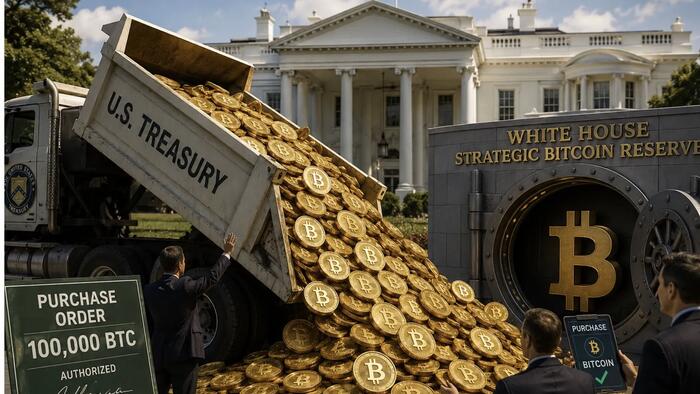
Fast forward fifteen years, and we’ve somehow reached the point where I’m asking myself whether the last remaining bailout for crypto might actually be…the U.S. government. Think about how unbelievably sickening that would be. It’s the terminus I kept arriving at yesterday while thinking about the only way Strategy would be able to survive if Bitcoin continued getting decimated from these prices. And sadly, the idea isn’t really unimaginable given our current administration’s ties with crypto.
Yesterday I wrote that Strategy’s new capital framework effectively buys the company time. And to be fair, it does. Management rolled out dedicated cash reserves, formal dividend policies, billions of dollars in buyback authorizations, and what at least appears to be a more disciplined approach to capital allocation.
But none of those changes alter the one variable that ultimately matters: Bitcoin’s price. Everything rests on the price of Bitcoin, from Strategy’s trajectory as a public company, to some of Bitcoin’s biggest and most well known advocates using it as a gauge as to when they would admit defeat on the long thesis.
Strategy has now openly acknowledged that Bitcoin is no longer untouchable. For years, Strategy built its identity around buying Bitcoin and never selling it. Now it has explicitly stated that those holdings can be monetized if necessary to fund dividends, replenish reserves, service obligations, or support buybacks. If Bitcoin keeps climbing, nobody will care. If Bitcoin starts falling hard, suddenly everyone will.
Selling Bitcoin to raise liquidity sounds perfectly prudent until you’re forced to sell into a declining market. At that point, the math starts working against you. Selling creates additional supply. Additional supply can pressure prices. Lower prices reduce the value of Strategy’s largest asset, potentially creating an even greater need for liquidity. That can lead to more selling, which creates more pressure, and before long you’ve got the financial equivalent of a dog chasing its own tail into a neighborhood wood chipper.
I’m not predicting that’s how this ends. Bitcoin is a massive global asset, and Strategy alone isn’t going to dictate where it trades. But the possibility now officially exists because management has crossed a line that investors once assumed would never be crossed. Bitcoin is no longer sacred. It’s now part of the liquidity toolkit.
That raises a much bigger question. What happens after every private-sector solution has been exhausted? What happens when the equity markets stop funding you, the preferred market dries up, convertible debt becomes too expensive, and you’ve already started selling Bitcoin? Who’s the buyer of last resort?
Historically, there’s almost always been one. Banks got one. Money market funds got one. The auto industry got one. Regional banks got one. The corporate bond market got one. During COVID we were buying damn near everything that wasn’t bolted to the floor. Whenever markets become sufficiently interconnected with the rest of the financial system, Washington inevitably starts talking about “systemic risk,” and once those two words enter the conversation, almost anything becomes possible. And remember, back in August of last year, I already asked whether or not Bitcoin was too deep in the fabric of the U.S. financial system: Is Bitcoin Too Deep In The Fabric Of The U.S. Financial System?
So why not a Bitcoin bailout from the government?

The Trump administration has developed some of the closest ties to the cryptocurrency industry of any U.S. administration in history. It has installed officials viewed as supportive of digital assets, pushed for clearer rules governing the industry, and repeatedly framed Bitcoin and blockchain innovation as strategic priorities for American competitiveness.
Trump himself has gone from skeptic to outspoken advocate, publicly backing Bitcoin mining, supporting the creation of a national strategic Bitcoin reserve, and cultivating close relationships with many of the industry’s largest executives and investors. The result is an administration that is no longer merely tolerant of crypto, but one that is increasingly politically invested in its success, making the industry’s fortunes more closely aligned with the White House than at any point since Bitcoin was created.
I can already imagine the press conference. “Today, in order to preserve financial stability, the United States government is announcing a Strategic Bitcoin Stabilization Facility.”
I honestly think I’d oscillate between laughing, crying and vomiting. The irony would be almost too perfect. The asset invented to escape governments…saved by the government. The people screaming “End the Fed”…saved by the Fed. The same crowd that spent fifteen years explaining why Bitcoin doesn’t need the traditional financial system suddenly hoping Washington becomes the biggest whale on Earth.
You couldn’t write satire this good.
Politically, I think it would be suicide. The government would be accused of bailing out crypto bros. Every taxpayer would ask why Washington is spending public money supporting digital assets while families are still struggling with the cost of living. It would probably become one of the most universally despised bailouts in modern American history. Democrats would run rampant in trying to regulate and suffocate crypto if they won in 2028. And yet…I can’t completely dismiss it.
We’ve spent the better part of two decades responding to every financial emergency with the same basic solution: print money, borrow money, guarantee money, or throw taxpayer money at the problem until everyone stops panicking. If crypto continues weaving itself into public companies, pension funds, ETFs, banks, retirement accounts, and increasingly complex financing structures, politicians will eventually start arguing that the consequences of doing nothing are worse than the consequences of stepping in.
The funny part is that, by Washington standards, Bitcoin wouldn’t even be that expensive to rescue. With a market capitalization hovering around a $1.2 trillion dollars, you’re talking about an amount of money that barely registers compared to the trillions we’ve borrowed, printed, guaranteed, and spent over the past twenty years.
I’m not saying the government would do it, but it’s amazing that we’re now living in a world where it’s no longer completely absurd to imagine the conversation taking place.
If Strategy’s increasingly elaborate financial engineering ultimately isn’t enough…if Bitcoin falls much faster and much farther than anyone expects…and if every private buyer finally disappears, the last remaining bailout may come from the very institution Bitcoin was created to replace.
And if that day ever comes, don’t tell me it’s impossible. The government has done a lot dumber sh*t with a lot more money.
—
QTR’s Disclaimer: Please read my full legal disclaimer on my About page here. This post represents my opinions only. In addition, please understand I am an idiot and often get things wrong and lose money. I may own or transact in any names mentioned in this piece at any time without warning. Contributor posts and aggregated posts have been hand selected by me, have not been fact checked and are the opinions of their authors. They are either submitted to QTR by their author, reprinted under a Creative Commons license with my best effort to uphold what the license asks, or with the permission of the author.
This is not a recommendation to buy or sell any stocks or securities, just my opinions. I often lose money on positions I trade/invest in. I may add any name mentioned in this article and sell any name mentioned in this piece at any time, without further warning. None of this is a solicitation to buy or sell securities. I may or may not own names I write about and are watching. Sometimes I’m bullish without owning things, sometimes I’m bearish and do own things. Just assume my positions could be exactly the opposite of what you think they are just in case. If I’m long I could quickly be short and vice versa. I won’t update my positions.
As of May 20, 2026 I personally no longer actively trade (read my story here). My investing/saving is done by recurring contributions mostly to sector ETFs and a few select equities, trusted third parties who oversee my accounts, and advisors. Such advisors or funds, through individual equities, options, index funds, mutual funds, ETFs, or other securities, may have positions in, exposure to, or holdings of names mentioned herein that I know nothing about. Basically, via index funds, ETFs and individual equities it is possible I could own, have exposure to, or not own anything at any point. As of the same date, May 20, 2026, in an attempt to lead a healthier lifestyle, I’ve also excluded myself from fantasy sports, sports betting, online and in-person casinos and prediction markets.
And all positions can change immediately as soon as I publish this, with or without notice and at any point I can be long, short or neutral on any position. You are on your own. Do not make decisions based on my blog. I exist on the fringe. If you see numbers and calculations of any sort, assume they are wrong and double check them. I failed Algebra in 8th grade and topped off my high school math accolades by getting a D- in remedial Calculus my senior year, before becoming an English major in college so I could bullshit my way through things easier.
The publisher does not guarantee the accuracy or completeness of the information provided in this page. These are not the opinions of any of my employers, partners, or associates. I did my best to be honest about my disclosures but can’t guarantee I am right; I write these posts after a couple beers sometimes. I edit after my posts are published because I’m impatient and lazy, so if you see a typo, check back in a half hour. Also, I just straight up get shit wrong a lot. I mention it twice because it’s that important.