
For the first time in over three years, South Korea’s central bank raised its policy interest rate by 0.25% points to 2.75%, inline with expectations, and kicking off a monetary tightening cycle aimed at containing inflationary pressures spurred by the AI-driven semiconductor boom. It also helped spark a fresh rout in Korean stocks whose daily volatility has become borderline farcical with daily 5% swings having become the norm.
The move on Thursday was the Bank of Korea’s first rate increase in more than three years as well as its first under Shin Hyun-song, a renowned international economist who took over leadership of the central bank in April. Before Thursday’s move, the BoK had held rates at 2.5% since May 2025 at the conclusion of an easing cycle.
As the FT notes, Shin has stressed the need for tighter monetary policy in recent weeks, pointing to robust economic growth driven by a surge in demand for memory chips on the one hand and persistent weakness in the won, elevated inflation and growing financial imbalances on the other (these, are of course, connected, as the collapsing currency helps cheap chip exports, which raises core inflation for consumer electronics both domestically and globally).
“Korea is expected to see the effects of the semiconductor boom spill over into domestic demand. Therefore, underlying inflationary pressures are likely to be stronger and persist for longer than previously anticipated,” he told a press conference on Thursday. “We will respond until we are convinced that inflation stabilizes at our target level.”
Shin has said that the semiconductor export boom was feeding through to stronger household spending, wage growth and investment, increasing the risk that inflation would remain elevated for a considerable period.
Indeed, as shown in the chart above, Korean consumer inflation is running well above the bank’s 2% rate, rising 3.2% in June from a year earlier, its fastest rate since December 2023. The country’s reliance on imported energy has also raised concerns as the conflict in the Middle East has roiled global energy markets.
The central bank also highlighted sizeable bonus payments at leading chipmakers Samsung Electronics and SK Hynix, which it said could contribute to broader wage gains and stronger consumer demand.
One reason for the hike was the relentless plunge in the won: despite South Korea’s record current account surplus, the won has remained under pressure, weakening 5% against the dollar year to date to its lowest level since the 2008 global financial crisis and ranking among Asia’s worst-performing currencies.
Analysts blame the currency’s weakness on exporters retaining overseas earnings for reinvestment and overseas equity purchases by Korean institutional and retail investors. The weaker won has pushed up import costs, including for energy. Surging housing prices in Seoul and surrounding areas, coupled with high household debt, are also a concern for Korean authorities.
The crashing won has benefited the country’s exporters: the central bank said that the economy is continuing to benefit from the AI boom. Exports surged 70.9% in June from a year earlier, the fastest growth rate in nearly half a century. The near record exports helped boost the country’s economy: Korea posted its strongest growth last quarter in nearly six years, and the government this week upgraded its economic growth forecast for 2026 to 3% from 2%, exceeding the IMF’s 2.6% projection.
Of course, the tighter financial conditions did not help the stock market which slumped 6.4% and reversed all of Wednesday’s gains.

However, the bigger catalyst behind the latest Korean rout which sent the Kospi back into bear-market territory after falling about 27% from its June peak, and to the lowest level since April, triggering another set of KOSPI/KOSDAQ sell sidecars in the early-morning…

… was an emergency market monitoring meeting for the Korea’s financial regulator, which unveiled measures to curb risks from single-stock leveraged exchange-traded funds, seeking to stabilize a local stock market that has seen wild swings, as individual investors use record amounts of debt to chase profits amid artificial-intelligence-related jitters.
The Financial Services Commission said Thursday that it would suspend new listings of single-stock leveraged ETFs, ban securities firms and asset managers from advertising or marketing such products, and triple the minimum cash deposit for new investments to 30 million won, equivalent to around $20,000.
The measures, which are long overdue and should have been implemented while millions of retail investors were piling into the bubble earlier this year, are aimed at curbing speculative trading and reducing risks tied to highly leveraged investment products following recent bouts of market volatility.
Most of these ETFs, launched in South Korea in May to track surging and often volatile memory-chip stocks, have been blamed for recent stock-market volatility. They are largely tied to Samsung Electronics and SK Hynix, which together account for about half of the benchmark Kospi’s market capitalization.
At the center of the volatility are Samsung Electronics and SK Hynix, whose shares fell 8.8% and 12%, respectively, on Thursday. Even so, Samsung shares have more than doubled and SK Hynix shares have nearly tripled this year. Such leveraged ETFs are designed to amplify daily moves in the underlying stocks by two times, and according to most traders they exacerbate volatility through the daily rebalancing needed to maintain their investment objective.
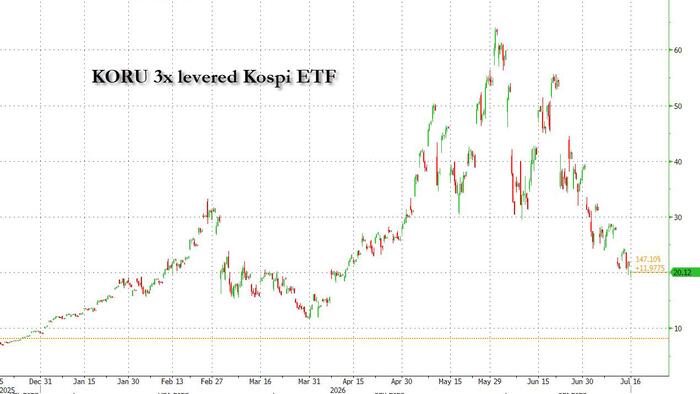
Yes, they help accelerate gains on the way up, but once momentum turns, what ensues is a historic destruction of wealth. Nowhere is this more obvious than in the 3x levered Kospi ETF, KORU, which is down 70% from its all time high hit on June 1, and is back to where it was at the end of January.

Herald van der Linde, HSBC’s head of equity strategy for Asia Pacific, said in a note Thursday that risks include intensifying retail participation, much of it through newly issued leveraged single-stock ETFs and margin lending, estimated at $23 billion, in South Korea. Foreign investors’ exposure to South Korean memory-chip stocks is rising, likely keeping market volatility elevated and reinforcing the case for diversification, he said.
Foreigners, however, were not hanging around for today’s rout: they, together with local institutions, jointly turned back as net sellers in KOSPI, with selling focused on Tech (-$1.0bn/-$1.6bn), while retail investors were net buyers (+$2.6bn in Tech). Local instos were the main net sellers today (selling -$1.6bn in KOSPI), while their ETF net-selling (-$738mn) amounted to c.46% of the total net-selling.

At the forefront of today’s rout were the usual suspects: SK Hynix plunged -11.5% and Samsung Electronics tumbled -8.8%, giving back all of yesterday’s gains to retrace towards the 100DMAs as they tracked US overnight weakness in the SOX/SKHY.
Unfortunately, the “emergency measures” are too little too late. as we said earlier this week, the party for Retail Kospi investors – who have bought everything foreign investors had to sell – is ending: retail Margin Calls are soaring, hit 5% last Friday and on Monday will be far higher. Finally, retail brokerage deposits plunge by 30trn won to lowest level since feb 20
Retail Kospi investors bought everything foreign investors had to sell. But the retail party is ending: retail Margin Calls are soaring, hit 5% last Friday and on Monday will be far higher. Finally, retail brokerage deposits plunge by 30trn won to lowest level since feb 20 https://t.co/XuxMwzBx3G pic.twitter.com/rwhQtDOYLT
— zerohedge (@zerohedge) July 13, 2026
What’s worst of all is that as Ioannis Blekos on Goldman’s trading desk noted, as of July 13, “a total of over 1.2 million leveraged retail accounts across the Korean market triggered margin calls. Approximately 320,000–360,000 accounts were fully liquidated by brokers. South Korea has an adult population (aged 15–64) of 35.7 million people… i.e. 1 in 30 (3.4%) adults got margin called.”
And so, once again regulators are “boldly” stepping in only after the market tumbles, and millions of local investors are left with nothing. If only they had been more proactive, and popped the Korean stock bubble before it reached record proportions and assured huge losses…
So what happens next, now that the Korean bubble has burst: look for all that capital to shift to China.
“Now that selling momentum builds in the Korean semis, investors are returning to China where valuations are depressed,” Vey-Sern Ling, managing director at Union Bancaire Privee, said, adding China’s tech performance has been inversely correlated with high-flying Korean memory names recently.
With leading Korean chip names down, investors are rotating out of the country, said Yi Ping Liao, portfolio manager at Franklin Templeton. “But interestingly it doesn’t look like a broad based rotation out of tech as Taiwan tech and China tech remain well supported.”
Conveniently for those wondering where to go, one week ago Goldman gave the answer in “As Korea Tumbles, Goldman Tells Clients To Rotate To “China AI Value Chain”.“