
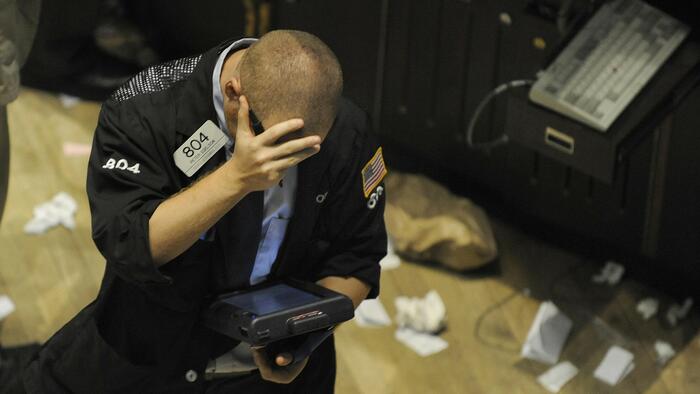
US equity futures are higher, overlooking both tech-led declines in Asia which saw the Kospi crash as much as 13% and trigger a second consecutive 20 minute market-wide halt, and the 5% jump in oil prices which has pushed Brent over $88. As of 7:30am ET, S&P 500 and Nasdaq 100 contracts are each up 0.2%, reversing sharp overnight losses, with tech flipping from laggard to leader and reversing (for now) a chip rout overnight which saw SK Hynix plunge 7.6% after tumbling 17% the session prior. With hyperscaler earnings today (MSFT and META), JPMorgan’s trading desk – which has incorrectly called the bottom in the chip rout almost every day in the past month – asks if “perhaps we finally establish a floor within the Tech trade.” Semis are higher pre-market with Mag7 mixed. Overnight, Korea / Semis took another leg lower with JPM’s Mixo Das seeing the levered ETF unwind in its 9th inning (90% complete). Defensives are leading Cyclicals (ex-Tech & Energy) with the Energy bid returning on news of renewed attacks in the Middle East. In fact, oil is trading 5% higher at session highs (above $83 for WTI and above $88 for Brent) which is pushing bond yields up 1-2bp as the curve flattens, USD is weaker. Today’s macro focus is on the Fed (read out preview here). Most banks (but not Citadel) expect the Fed to hold with two or more hawkish dissents; the market is pricing a 32% chance of a hike.
In premarket trading, Mag 7 stocks were mostly, if modestly, higher: (Alphabet +0.6%, Amazon +0.1%, Apple +0.2%, Meta +0.3%, Microsoft +0.2%, Nvidia +0.1%, Tesla +0.2%)
- Avantor (AVTR) rises 4% after the life-sciences company reported adjusted Ebitda and net sales for the second quarter that beat the average analyst estimate. The company also boosted its adjusted profit guidance for the full year.
- Bloom Energy (BE) jumps 8% after the fuel-cell maker posted earnings that were more than double expectations and raised full-year guidance for the second consecutive quarter, a sign of rampant demand from data centers.
- Caterpillar (CAT) falls 4% after Baird cut its recommendation to neutral, citing a growing trend of state and local government actions targeting data centers, which have become a key growth driver for the industrial giant.
- Ford (F) rises 5% after the automaker raised its profit outlook for the second time this year as consumers continue to snap up the automaker’s high-margin sutility vehicles.
- Garmin (GRMN) climbs 7% after the maker of GPS smartwatches boosted its pro forma earnings per share guidance for the full year.
- GE Healthcare (GEHC) climbs 11% after the maker of X-ray equipment reported adjusted earnings per share for the second quarter that beat the average analyst estimate. The firm also posted a booking ratio that was ahead of expectations.
- GlobalFoundries (GFS) gains 7% after the semiconductor contract manufacturing and design company signed a letter of intent with the US Department of Commerce.
- Humana (HUM) drops 7% after the insurer maintained its yearly profit guidance despite a strong second quarter.
- Johnson Controls International (JCI) rises 5% after after the HVAC equipment maker boosted its adjusted earnings per share forecast for the full year
- KLA Corp. (KLAC) falls 8% after the semiconductor capital equipment company reported fourth-quarter results that Morgan Stanley called “uninspiring.”
- Lemonade (LMND) falls 12% after the insurance company reported less customers for the second quarter than analysts expected. It also said Nick Stead, the company’s senior vice president finance, will replace Tim Bixby as CFO effective Jan. 1.
- Manhattan Associates (MANH) rises 11% after the software company reported second-quarter results that beat expectations, prompting an analyst upgrade.
- O-I Glass (OI) is down 13% after the manufacturer of packaging products reported adjusted earnings per share for the second quarter that missed the average analyst estimate.
- Procter & Gamble (PG) slips 3% after giving a conservative outlook for its current fiscal year, highlighting the challenges the maker of Downy fabric softener faces as consumers retrench.
- Seagate Technology (STX) gains 5% after the computer hardware and storage company reported fourth-quarter results that beat expectations and gave a revenue forecast that is ahead of the consensus estimate.
- Teradyne (TER) gains 7% after the semiconductor manufacturing company reported second-quarter results that beat expectations and it gave a third-quarter forecast that is much stronger than expected.
- Vertiv (VRT) falls 14% after the power equipment company’s net sales missed estimates.
In other corporate news, Cigna must defend against most claims of a proposed class action alleging the health insurer disclosed the personal information of patients to third parties in violation of federal and state privacy laws. Visa said it’s taking a $563 million charge tied to job cuts affecting about 7% of the workforce, part of an effect to operate more efficiently and focus on its biggest opportunities for growth. Canada plans to scrap a levy on entertainment companies including Netflix and Walt Disney, according to a court filing, after pushback from US officials and Hollywood studios
Futures are tentatively higher, ignoring a continued tech rout in Korea, and surging oil, but as Bloomberg notes, price action at this stage of the session likely offers little insight into how equities will trade over the next 24 hours, with the FOMC policy announcement and Meta and Microsoft earnings later. Stripping away the ongoing meltdown in the chip/memory bubble, the equal-weight version of the S&P 500 reached another record high in Tuesday’s cash session and themes of rotation, divergence and dispersion continue. Of course, nobody cares about that; instead what people do care about is that the high beta momentum index, which we warned at the start of the month would have a terrible July…
High Beta Momentum is disintegrating in July. Every July https://t.co/7jnnW8v7Yt pic.twitter.com/lc2IhHG7yQ
— zerohedge (@zerohedge) July 2, 2026
… had a terrible July, and is on track for the biggest monthly drop on record in data going back to 1999, eclipsing the dot-com era, while an equal-weight version of the Nasdaq 100 is trailing the S&P 500 Equal Weight Index by the most in two decades of data.

As always, AI remains in the spotlight, with SK Hynix shares crashing – again – after forecasting a record outlay of at least $31 billion for capital spending this year, a jump of around 50% year-on-year, adding to concerns that tech companies are overinvesting in AI. The pace of capex growth mirrors a similar trajectory at rival Micron, and with hyperscalers capex’ bills projected to exceed a $1 trillion next year, some analysts estimate memory could account for more than a third of that.
Update: SK Hynix last 3 days “price discovery”
7/27: +2.13%
7/28: -16.16%
7/29: -7.61% https://t.co/sEikDsiNIo— zerohedge (@zerohedge) July 29, 2026
The biggest loser from the latest SK Lonix rout was, of course, Korea’s Kospi which slid as much as 12.6%, triggering a circuit breaker for a second straight day, and is on course for a record monthly loss of ~35%. And just when you thought it couldn’t get any more farcical, South Korea’s finance minister apologized on Wednesday after retail investors racked up heavy losses from leveraged bets on stocks, following rule changes earlier this year. The May 27 introduction of single-stock leveraged Exchange Traded Funds has seen Korean retail investors pile in with net purchases of 14 trillion won ($9.7 billion), compared with roughly 2 trillion won by foreign investors, according to KB Financial Group. But the speculative trading boom that helped fuel one of the world’s hottest equity markets has resulted in those investors nursing catastrophic losses, leaving millions liquidated after margin calls, that have seen thousands owing money to their banks after being wiped out.
And while we wait to find out just how many millions of broke and margin called Koreans will participate in the next season of Squid Games, we have a Fed decision later today where traders are eyeing the possibility of a surprise hike as patience with high inflation wears thin, and Chair Warsh’s avoidance of the past practice of giving signals on the future rates path. JPMorgan’ Market Intel analysis shows a 28% probability of the central bank keeping rates unchanged, while sounding accommodative on the inflation outlook. This would trigger gains of 0.5% to 1% in the S&P 500 Index, the team said (full analysis here).
“It’s really rare to have the market split just hours ahead of a Fed decision,” said Amélie Derambure, a senior multi-asset portfolio manager at Amundi. “That means some investors will necessarily be hurt. A hike could have harsh consequences on equities if it announces a fresh cycle.”
Earnings from Meta and Microsoft arrive as the AI trade is faltering, with traders questioning whether the vast and often debt-fueled spending behind the buildout of the technology can deliver adequate returns. “I hope that Meta and Microsoft can confirm the capex spree in the industry and reassure the market about semiconductors,” said Fares Hendi, a portfolio manager at Société de Gestion Prévoir in Paris.
In other AI related news, the OpenAI models that hacked the startup Hugging Face this month also gained access to a customer account on the cloud platform Modal and used it to launch attacks, underscoring the broad scope of the incident. Meta CEO Mark Zuckerberg said the US administration should not block Chinese models to gain an edge in the AI arms race, in an interview with the Financial Times. It follows Nvidia CEO defending open-weight AI models earlier on Tuesday. And Moonshot AI secured a $35 billion valuation after raising $3.5 billion in a round of financing, exceeding its initial target of $1 billion to $2 billion.
Elsewhere, Washington tightened curbs on some foreign-made robots and inverters, vital components of solar-powered electricity, in a sweeping move that risks widening its tech confrontation with Beijing less than two months before a meeting between the countries’ leaders.
In the latest Iran escalation news, Brent jumped to session highs after Iran fired pre-emptively on American forces overnight and the US and Saudi Arabia struck Tehran-backed militias in Iraq, ending a days-long pause in hostilities. Elsewhere, Reuters reported that Iran is expected to receive within weeks a first shipment out of up to 400 Chinese-made shoulder-fired air-defense missile launchers, as it rebuilds its defenses amid war with the United States.

Initial gains in European stocks faltered with the Stoxx 600 down 0.2%, following a flurry of earnings as Hermes weighs after missing expectations for its key leather goods unit. Real estate and retail sectors fall the most and energy and miners are the biggest gainers. Here are some of the biggest movers on Wednesday:
- Deutsche Bank shares jumped 6% after the German lender reported strong earnings supported by a fixed-income trading beat and announced a share buyback of €500 million.
- Reckitt shares jump as much as 7.4% after the maker of Dettol and Durex delivered better like-for-like sales growth than expected in the second quarter, with the core business accelerating more than anticipated, according to analysts at Barclays.
- Kering shares gain as much as 12% after the luxury goods maker reported better-than-expected revenue at Gucci in the second quarter.
- UBS shares gained 3.7% after the Swiss lender announced a new $3 billion share buyback program and reported second-quarter earnings that analysts said were strong.
- Sopra Steria shares jump as much as 17% after the IT firm boosted its organic revenue forecast for the full year.
- Porsche shares rise as much as 4.8% after the German carmaker posted what analysts called a strong set of results, including an operating profit beat driven by sales of its 911 model.
- BASF shares rise as much as 4.3% after the chemicals company announced a new €1 billion buyback program and beat EPS expectations.
- Electrolux shares gain as much as 23% after the Swedish home appliance manufacturer’s second-quarter earnings exceeded estimates and the company lowered its capex forecast.
- RWE advances as much as 4.4%, the most since mid-March, after delivering preliminary second-quarter results ahead of expectations and lifting its guidance for both 2026 and 2027.
- Endesa shares gain 2.4% after the Spanish electricity company reported net income for the first half that beat the average analyst estimate.
- Hermes shares fall 8.1% as the French maker of the Birkin bag missed analyst expectations for its key leather goods unit and was punished by investors.
- DWS shares plunge as much as 8.9% after the asset management firm posted pretax profits below expectations in the second quarter as heavier costs weighed, with analysts noting the strong share price performance leading into the print.
- CaixaBank shares fell as much as 6.7% after the Spanish bank’s second-quarter results missed expectations for net interest income.
- Auto1 shares fall as much as 16% after the German used-car retailer reported second-quarter results that Morgan Stanley analysts said leave it needing a stronger second half to achieve management’s full-year goal.
Earlier in the session, Asian stocks declined as a selloff in heavyweight chipmakers deepened, and oil prices rebounded following a fresh round of fighting across the Middle East. The MSCI Asia Pacific Index lost 0.7%, with shares of SK Hynix plunging almost 10% to be among the biggest drags. The firm’s quarterly profit fell short of lofty estimates despite surging sixfold, and its plan to spend at least $31 billion on capital expenditures intensified existing market worries that companies are overinvesting in AI capacity. Samsung, which is due to report results Thursday, also saw its stock slump more than 5%. TSMC slid 3.5%. South Korea’s Kospi index swung wildly again, tumbling 13% intraday before closing 6% lower. The declines in tech-heavy indexes in Korea, Taiwan and Japan outweighed gains in places like India and some Southeast Asian markets, which have relatively less exposure to the AI theme.
“The deleveraging and selloff in Korea have increasingly taken on a life of their own,” said Rajeev De Mello, global macro portfolio manager at Gama Asset Management. “Concerns about excessive optimism around AI initially triggered the correction in semiconductor stocks, but the latest acceleration lower looks less driven by fundamentals and more by positioning, forced selling and investor psychology.”
Sentiment was also cautious ahead of the Federal Reserve’s rate decision later on Wednesday. While the central bank is expected to hold, market participants are eyeing the possibility of a surprise hike as patience with high inflation wears thin. “Investors have re-focused on the downside surprise to earnings, and also recognized the constraint of the Fed decision,” said Damien Boey, portfolio strategist at Wilson Asset Management. A gauge of Chinese stocks listed in Hong Kong jumped more than 2% to be the top gainer in Asia on Wednesday. Still, the MSCI Asia Pacific was on course for its lowest close since April 23, having slumped 3.4% in the previous session, when it also entered a technical correction.
In FX, the Bloomberg Dollar Spot Index is fractionally weaker, while the Aussie dollar is the standout laggard following soft CPI data.
In rates, firmer crude prices have weighed on global fixed income markets, with US yields up around 1bp across the curve and those of EGBs up slightly more.
In commodities, oil is back on the rise, with Brent crude futures up 3.7% as fighting erupted once again in the Middle East. Spot gold and silver are posting respective gains of 0.2% and 1.3%. Bitcoin adds 0.9%.
Looking to the very busy day ahead, the main event will be the Fed’s policy decision. The attention will then shift to the earnings from Microsoft and Meta after the US close. Before that, we also have Lam Research, ARM, L’Oreal, Hermes and Airbus.
Market Snapshot

Top Overnight News
- Brent rose after Iran fired on American forces overnight and the US and Saudi Arabia struck Tehran-backed militias in Iraq, ending a days-long pause in hostilities. BBG
- Iran is expected to receive within weeks a first shipment out of up to 400 Chinese-made shoulder-fired air-defense missile launchers, three sources familiar with the deal told Reuters, as it rebuilds its defenses amid war with the United States. BBG
- Iran rejected a proposal to evenly divide control of the Strait of Hormuz, jeopardizing hopes that Tehran and Washington would quickly resume negotiations to end the war. WSJ
- South Korea will hold an emergency meeting Wednesday evening to discuss the market situation after a stocks rout that has wiped billions of dollars off investors’ holdings. BBG
- SK Hynix shares slumped after the company missed lofty expectations while committing at least $31 billion in capex this year. BBG
- The US plans to end a subsidy program that helped hold down costs for Medicare drug plans. BBG
- The Senate voted 86-12 to advance a bill that would empower Trump to impose tariffs on major buyers of Russian energy, as well as Iran, with a final vote possible later this week. BBG
- Wall Street banks have demanded more collateral from hedge funds in recent weeks as a rout in AI stocks accelerates and triggers heavy losses across several popular strategies. FT
- Moonshot secured a $35 billion valuation after raising a larger-than-anticipated $3.5 billion in a just-closed round of financing, people familiar said. BBG
- US President Trump posted “Senator Johnson is working hard with Senate Republican leadership to adopt a budget resolution before the August recess. This is the first step towards getting as much of the Save America Act as possible in the budget bill..”. Full post: “Senator Ron Johnson is working hard with Senate Republican Leadership to adopt a Budget Resolution before the August recess. This is the first step towards getting as much of THE SAVE AMERICA ACT as possible in a Budget Bill, funding our Troops, and helping our Farmers. I am calling on the Senate to get this critical first step done before the August recess. This Resolution can be adopted at a simple Majority threshold. GET IT DONE! Thank you for your attention to this matter. President DONALD J. TRUMP”.
- Majority of US Senate votes to confirm Trump nominee Jay Clayton to be the Director of National Intelligence.
A more detailed look at global markets courtesy of Newsquawk
APAC stocks were choppy with mixed, two-way trade seen as bourses initially began on the front foot as an initial tech rebound helped the region shrug off the geopolitical risks following the Iran attack on a US base in Jordan, although the tech-related gains were eventually wiped out. ASX 200 bucked the trend amid outperformance in defensives and as participants reflected on Rio Tinto’s earnings and softer-than-expected inflation data, which saw an unwinding of RBA rate hike bets. Nikkei 225 initially rallied amid early tech momentum and reports the government will finalise a food sales tax cut next month, but then slipped into the red as tech stocks reversed course. KOSPI suffered at the whim of tech fluctuations, with stocks initially buoyed following mixed results from SK Hynix, which beat on Q2 net, but missed on oper. profit and revenue, stoking concerns of lofty expectations, despite oper. profit jumping 557%. However, the index then slumped and eventually triggered circuit breakers. Hang Seng and Shanghai Comp were mixed, with the Hang Seng driven by Chinese automakers/EV names, while the mainland is subdued amid ongoing trade-related frictions.
Top Asian News
- South Korean Lawmaker said Finance Minister, BoK Governor and Financial regulatory Chiefs to meet on Thursday afternoon.
- Japan’s Chief Cabinet Secretary said Govt. will not pre-determine whether to use reserve funds for earthquake relief.
- Japanese PM Takaichi plans to cut food sales tax to 1% for two years starting April 2027, while government will finalise plan in August.
European Bourses began the session on a softer footing but remain relatively resilient to the firmer oil prices and prior APAC weakness, with earnings also providing somewhat of a cushion/impetus in the absence of macro updates. The IBEX 35 (-1.6%) underperforms following CaixaBank results, while the FTSE 100 (+0.1%) outperforms on earnings, including Rio Tinto, and a strong Glencore production update, whilst heavyweights BP and Shell cheer the higher oil prices. Sectors are mixed, with resilience across the board despite energy strength and prior APAC weakness, while sentiment remains capped by ongoing memory concerns and China competition following KOSPI volatility. Movers: SK Hynix (-9%) weighs on sentiment after earnings miss lofty expectations. In Europe, Kering (+12%), Gerresheimer (+5%), Eni (+4%), Deutsche Bank (+4%), BASF (+4%), Rio Tinto (+4%), UBS (+3%), Glencore (+3%) and Standard Chartered (+3%) gain after earnings. To the downside, ASM International (-8%), Hermes (-8%), CaixaBank (-6%), Aberdeen (-5%), Remy Cointreau (-4%) and EssilorLuxottica (-2%).
Top European News
- UK Net Lending to Individuals MoM (Jun) M/M 9.5B vs. Exp. 5.5B (Prev. 4.6B).
- UK Mortgage Lending (Jun) 7.73B vs. Exp. 3.95B (Prev. 2.89B).
- UK Mortgage Approvals (Jun) 58.20K vs. Exp. 56K (Prev. 56.21K).
- UK M4 Money Supply MoM (Jun) M/M 0.8% vs. Exp. 0.2% (Prev. 0.1%).
- UK BoE Consumer Credit (Jun) 1.807B vs. Exp. 1.7B (Prev. 1.662B).
- Italian Industrial Sales YoY (May) Y/Y 5.3% (Prev. 3.2%).
- Italian Industrial Sales MoM (May) M/M 0.60% (Prev. 0.3%).
FX
- DXY is relatively uneventful within a narrow band ahead of the FOMC, despite the overnight geopolitical escalation which saw crude gap higher. The index trades within a 101.23-101.49 range, holding broadly flat as markets priced around a 36% probability of a hike, with focus on the Fed decision and Chair Warsh’s presser.
- JPY modestly firmer overnight on potential haven demand following geopolitical tensions and APAC equity weakness, though USD/JPY came off best levels and now trades around the middle of a 163.28-163.88 range, below the prior session’s trough of 163.64.
- EUR holds a mild upward bias amid a subdued Dollar, with EUR/USD just below 1.1400 and trading within a 1.1382-1.1404 range. Newsflow is light from the bloc, with a smaller-than-expected softening in German import prices and a modest increase in the ECB Wage Tracker failing to move the needle.
- GBP trades with a modest upside bias in rangebound conditions, oscillating around the 1.3300 mark within a 1.3277-1.3307 range. Focus turns to the BoE on Thursday, where a hold is expected, with attention on the vote split and guidance and then the press conference.
- Antipodeans are mixed, with AUD under pressure after softer-than-expected inflation data prompted Westpac to shift its RBA view to a prolonged hold (vs prev. view of an August hike). AUD/USD trades at the bottom of a 0.6943-0.6979 range. NZD is relatively cushioned by AUD/NZD downside but remains soft overall, with NZD/USD in a 0.5775-0.5794 range.
Fixed Income
- USTs are modestly softer, down by a handful of ticks, as geopolitical escalation and firmer energy prices weigh on the space. The contract remains comfortably above recent lows at 108-15+ and 108-12+, with focus turning to the FOMC where a hold is expected, though risks are tilted hawkish amid the recent rise in energy, and with markets implying a 30-35% chance of a hike.
- Bund are under pressure, down around 15 ticks, with only a fleeting lift seen on softer German import prices (6.1% Y/Y vs prev. 6.8%). The benchmark trades just above a 124.95 low, holding above Tuesday’s 124.93 base. No move was seen to the 2036 Bund auction, which was moderately weak but showed slightly better underlying demand compared to the prior.
- Gilts are lower, opening down 16 ticks before extending losses to an 87.08 base, taking out Tuesday’s trough but remaining above Monday’s 86.83 low. Price action is largely driven by the broader energy-led move, with limited UK-specific catalysts.
- Germany sold EUR 4.5bln (exp. 6bln) 3.00% 2036 Bund: b/c 1.1x (prev. 1.03x), average yield 3.13% (prev. 3.09%) & retention 25.05% (prev. 35%).
Commodities
- Crude futures are firmer after gapping higher overnight on escalating geopolitics, with Iran striking a US base in Jordan and subsequent US-Saudi strikes on Iranian-backed militia. WTI Sept’26 and Brent Oct’26 hit highs of USD 83.30/bbl and USD 85.63/bbl respectively, before waning as the US had not yet officially retaliated to the Jordan strike. Dutch TTF found resistance at EUR 59.50/MWh, then support at EUR 58/MWh, stabilising around EUR 58.50/MWh. Prices rose further after sources said Yemen’s Houthis are considering imposing fees on commercial ships transiting the southern Red Sea.
- Precious metals are firmer but to varying degrees, supported by geopolitically driven haven demand amid a flat/subdued Dollar, though upside is capped ahead of the FOMC. Spot gold trades within a USD 4,010-4,047/oz range, while spot silver posts larger gains but remains off the USD 58.53/oz peak, within a USD 56.85-58.23/oz range.
- Base metals are mixed to subdued as geopolitical tensions weigh on the growth outlook. 3M LME copper trades within a narrow USD 13,584.00-13,690.90/t range, while iron ore prices waned overnight amid weak steel demand concerns.
- Egypt aims to drill 160 new oil and gas wells with investments of USD 7.2bln, according to Al Arabiya.
- US invests USD 1bln to combat New World Screwworm outbreak,a ccording to Agricultural Secretary Rollins.
- US Private Inventory Data (bbls): Crude +3.3mln (exp. -1.4mln), Distillates +0.4mln (exp. +0.6mln), Gasoline +0.9mln (exp. -1.2mln), Cushing -0.3mln.
Trade/Tariffs
- US tariffs are sending some firms back to China, NYT writes.
- UK Foreign Secretary Miliband will play a “greater role” in the UK’s Brexit reset talks than previous foreign secretaries, the FCDO told POLITICO.
- China Commerce Minister held a call with the UK Trade Secretary and said China is willing to strengthen cooperation in service trade, green transition and renewable energy. said:. Highly concerned about nationalisation of British steel and urged the UK to abide by relevant international rules. Urged favourable business environment for Chinese enterprises in the UK.
- China’s MOFCOM said regarding US putting Chinese research institutions on sanctions list, that it is aware of the situation and strongly dissatisfied and firmly opposes this. said:. China urges the US to stop smearing Chinese research institutions, correct its approach, and provide fair, impartial, non‑discriminatory treatment. China will take necessary measures to safeguard the legitimate rights of its research institutions and to protect normal scientific exchanges and cooperation.
- Trump administration bans foreign made robots and power inverters amid fears of Chinese influence, according to POLITICO.
Geopolitical – Iran
- US CENTCOM said US and Saudi forces strike Iran-backed terrorist sites in Iraq.
- Iranian state TV cites an unnamed military source stating that Iran denies any link to projectiles fired from other countries at targets in Saudi Arabia.
- Chinese Foreign Ministry denies reported that Iran will received Chinese-made man-portable air defence systems in the coming weeks.
- Iran official said Oman proposal for Hormuz Strait joint regional management is to fail.
- Iran will get Chinese shoulder launched missile systems in weeks, according to Reuters.
- US President Trump said in a tele-rally that Iran wants to make a deal so badly, adds we’ll get Iran to sign on the dotted line and we’ll get the war over with.
- US CENTCOM said at 17.45EDT, IRGC forces launch multiple ballistic missiles from Iran and all Iranian missiles were effectively intercepted.
- US official said Iran launched missiles at a US base in Jordan, but noted missiles were intercepted, according to Axios.
- Iran considered retaliatory strike on Ukrainian seaport, although a flurry of diplomacy has eased tensions, according to NYT citing officials.
- US official said Iran is over reaching with demands that Oman, US and the international community are rightly rejecting on Strait of Hormuz. Deal being discussed is a coordination deal, there are no tolls and no fees.
- Iraq PM’s planned visit to Saudi Arabia tomorrow has been cancelled, Iraqi government source tells Al-Araby.
- A senior Iranian official said Tehran has rejected Oman’s proposal for regional joint management of the Strait of Hormuz as unworkable, reported suggest.
- Iraqi sources said US and Saudi Arabia targeted a mosque and water purification plant in Baghdad.
- IRGC noted that 3 tankers were hit and seized in the Hormuz Strait, adds US interference in the region will not go unanswered.
- Explosions were heard in south Baghdad, while reported noted US and Saudi strike in Kirkuk and Salah Al-Din.
- Israeli PM Netanyahu said meeting with Trump is one of the best we’ve had.
- IRGC confirmed that they fired ballistic missiles at the US Air Base and US Military Central Command Center in Jordan.
- US President Trump posted that he had a very good meeting with Israeli PM Netanyahu and many important subjects were discussed.
- Explosions reported in Al-Suwayrah, Wasit province South of Baghdad.
- Source circulates ‘footage of a direct hit on Muwaffaq Al Salti Air Base in Jordan’.
- IRIB reported explosions in Jordanian airspace and that US base in Jordan was possibly targeted.
- Iranian media sources report explosions in US base in Jordan due to Iranian missile attack.
- Three Japanese-linked vessels have exited the Strait of Hormuz via Iran’s designated route, Kyodo reported.
- An Israeli military source said Defence Minister Katz disclosed operational details about the takeoff of US fighter jets from Israel to carry out strikes on Iran, Al Hadath reported.
- Several loud explosions are being reported in Jordan, according to Nour News.
- Sources said Yemen’s Houthis are considering imposing fees on commercial ships transiting the southern Red Sea.
Geopolitical – Ukraine
- Ukrainian President Zelensky said forces struck Russian oil refinery in the Perm region, export terminal and military plant in Rostov region.
- Russian forces hit two vessels carrying weapons to Ukrainian ports near Odesa, according to Russia’s defence ministry.
- Ukrainian President Zelensky said had a very good meeting with US President Trump and that Trump accepted that he’ll give Ukraine licenses for Patriot missiles.
- US President Trump posted that it was a great honour to meet with Ukrainian President Zelensky and that the meeting went well with many things discussed.
- Large majority of US Senate voted to advance Russian energy sanctions, with the bill targeting Russian officials and oil-dependent nations.
US Event Calendar
- 7:00 am: Jul 24 MBA Mortgage Applications, prior 1.9%
- 2:00 pm: Jul 29 FOMC Rate Decision Upper Bound est. 3.75%, Lower Bound est. 3.5%
DB’s Jim Reid concludes the overnight wrap
As we head towards a highly anticipated Fed decision this evening, over the past 24 hours markets were again caught in the crosswinds of volatile oil prices and an ongoing chip rout. A continued decline in oil prices had won out yesterday, with a -4.83% decline in Brent crude helping the equal weighted S&P 500 (+1.14%) to a new record high and the regular S&P 500 (+0.21%) also advancing even as the Philly semiconductor index fell -4.49%.
However, sentiment has soured overnight as the US said that it intercepted an Iranian attack against its bases in the Middle East, ending a pause in the fighting that had seen Brent crude decline from above $100/bbl last Thursday to only $84.09/bbl at yesterday’s close, marking its sharpest three-day decline (-16.5%) since April 2020. Iran’s IRIB News reported that missiles were fired in response to “aggressive US actions”. This comes as the US and Saudi Arabia carried out strikes on Iran-backed militants in Iraq in response to recent drone strikes. IRIB also reported that the IRGC targeted three tankers in the Strait of Hormuz “moving along an unsafe and illegal route”. With the news raising the risk of a return to a full war, Brent crude is trading about +4% higher as I type.
Together with a continued sell-off in chip stocks, this has weighed on the mood in Asian markets this morning. The KOSPI (-8.65%) is seeing another dramatic sell-off, triggering a circuit breaker for the second time in two days after tumbling by -11.0% yesterday. A reassessment in Korea’s AI-driven valuations has been boosted by results from semiconductor heavyweight SK Hynix, which is down -16.5% as its +557% surge in quarterly profits failed to meet elevated market expectations. Shares in Samsung, which reports tomorrow, are down -11.0%. The Nikkei (-2.29%) is also extending Tuesday’s decline, while in mainland China the CSI 300 (-0.24%) and Shanghai Composite (-0.50%) are posting more modest declines. In contrast, the Hang Seng (+1.34%) is outperforming the broader regional trend, while the S&P/ASX 200 (+1.10%) is advancing after softer-than-expected inflation data eased concerns about further RBA tightening (details below). Equity futures are also losing ground, with those on the S&P 500 (-0.20%), NASDAQ 100 (-0.62%) and STOXX 50 (-0.58%) all lower.
All that leaves a volatile backdrop ahead of today’s FOMC decision, which is the most finely poised in years in terms of market pricing. With a 32% chance of a rate hike today priced as of last night, this is the most uncertain that the market has been on whether the Fed will change rates going into a meeting since December 2018, when the eventual 25bps rate hike was about 65% priced the day before. We’ve seen considerable volatility in the July hike pricing over the past couple of weeks, falling as low as 10% in mid-July following the soft June US CPI print but rising to as high as 38% on Monday. So with Chair Warsh shying away from policy guidance, we’ve seen one regime shift compared to the past few years when markets received a steer from officials’ commentary or via the financial press.
In terms of today’s decision, our US economists expect the Fed to leave rates unchanged but see the risks of a hike as significant with the renewed escalation in the Middle East complicating the inflation outlook. If the Fed holds rates steady, they expect at least a couple of dissents in favour of a hike.
Prior to the overnight moves, a continued fall in oil prices had dominated yesterday’s market action, as more positive signals on Iran negotiations stabilized inflation concerns. Trump said in an interview with Fox News that the US had a “strong position” and that Iran has essentially agreed to not have a nuclear weapon but would now need to make it formal. Markets reacted positively to his comments as well as reports of continued talks between Iran and Oman over control of the Strait of Hormuz, with front-month Brent crude down -4.83% and 6-month Brent sliding by a sizeable -3.60%.
That helped markets to dial back near-term inflation pricing. The 1 yr US inflation swap (-5.3bps) retreated to 1.88%, while the 1yr Euro inflation swap continued to post bigger declines (-13.8bps to 2.28%). In turn, Treasury yields pulled back across the curve with 2yr yield down -3.5bps to 4.29%, while the 10yr yield fell -4.3bps to 4.61%, which was actually its biggest daily decline in over a month. And this time real yields also fell, with the 10yr (-3.5bps to 2.41%) real yield retreating from Monday’s post-2023 high.
The decline in oil and rates also helped support equities, with the S&P 500 closing +0.21% higher. And the broader market mood was more clearly positive, with the equal-weighted version of the S&P (+1.14%) posting its best day in over a month and hitting a new record high. This came amid a broad rotation into non-tech and defensive sectors, though it was partially offset by continued losses for chipmakers. A -4.49% decline for the Philly semiconductor index left the gauge -24.6% below its June 22 high, though it is still up +55.8% YTD. Yesterday’s decline also left the NASDAQ 100 (-0.98%) just half a percent from technical correction territory. But it was not all bad news for tech yesterday, with Apple (+0.94%) exceeding the $5trn market cap for the first time, though it ended the session just below it at $4.995trn. The company is set to report its earnings tomorrow along with Amazon, after reports from Microsoft and Meta this evening.
In Europe, the market mood was positive yesterday, with the Stoxx 600 up +0.35% as the CAC 40 (+0.61%) and FTSE 100 (+0.83%) and DAX (+0.41%) all saw decent gains. Optimism over lower oil-driven inflation also boosted sovereign bonds, with yields on 10yr gilts (-5.2bps), OAT (-4.0bps), and bunds (-2.9bps) all heading lower. Outperformance of French assets was helped by an improved consumer confidence reading for July (86 vs 84 prev., 85 exp.) but this is still below the level that prevailed before the Iran war.
Ahead of the Fed decision, we also had some data releases out in the US. US July consumer confidence saw an unexpected decline to 90.8 (vs 92.4 expected), as the present situation component fell to its lowest level since early 2021. More positively, US house prices increased in May in both the FHFA (+0.3% m/m vs +0.1% m/m exp.) and S&P Case-Shiller (+0.15% vs 0.00% expected) indices, though this improvement comes after house price growth fell to effectively zero during the Feb-Apr period. As I discuss in my latest note on money and credit yesterday, housing looks more vulnerable to the recent move higher in yields. The report (see here) also dives into what the credit cycle suggests for policy direction of the G4 central banks as well as in China, where the Politburo meeting will be in focus later this week.
In data out this morning, Australia’s consumer price index (CPI) rose +0.6% qoq in Q2 (vs. +0.7% expected and +1.4% in Q1), supported by easing fuel prices. Annual inflation moderated from +4.0% to +3.8% yoy. Annual core inflation edged up from +3.5% to +3.6%, but remained below the consensus estimate of +3.7%, reducing the urgency for additional interest rate hikes after the RBA already raised rates three times this year. Following the release, yields on 2yr Aussie government bonds are down -8.3bps to 4.49%, with markets paring back the chance of a rate hike next month to just 2%, from 18% previously. The Australian dollar is down -0.40% against the US dollar.
To the day ahead now, the main event will be the Fed’s policy decision. The attention will then shift to the earnings from Microsoft and Meta after the US close. Before that, we also have Lam Research, ARM, L’Oreal, Hermes and Airbus. Data releases include UK June net consumer credit, M4, Germany June import price index, Italy May industrial sales, Australia June CPI, Sweden Q2 GDP indicator.