
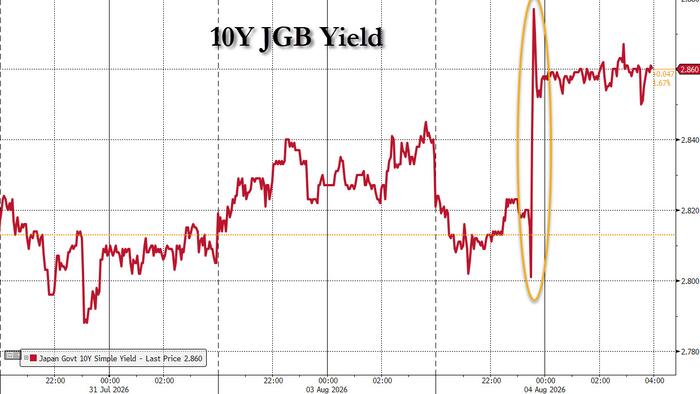
While much of the market focus has fallen on the US long-end, which saw substantial pressure in the past week, sending 30Y yields to 5.27%, the highest level since 2007, it was Japan again which stole the show overnight. But first, recall that the primary tradeoff for the BOJ preventing it from raising rates and comfortably pushing up the yen without needing to spending tens of billions in massive interventions (whether individual or joint with the US), is that raising rates risks collapsing the world’s biggest house of cards, which is the Japanese bond market, the world’s, second biggest of which half is now owned by the Bank of Japan.
Well, early on Tuesday morning Japan had its first major coupon auction since the latest intervention and it went… catastrophically.
The auction, which saw a huge tail, the second highest since the start of the century…
… and dismal demand in the form of a collapsing 2.56 bid to cover, far below the 3.3 average, the lowest since May 2025…

… and the third lowest going back all the way to 2015.

… sent the yield on 10Y paper as spiking as much as 5bps higher to 2.87% with JGB futures tumbling as much as 34 ticks to 126.37.

The lowest price was also a long way off from pre-sale estimates. In a nutshell, as Bloomberg’s Mark Cranfield put it, it was a “horrible auction” and ominously adds that “this is such a bad bond sale it could spill over negatively to Treasuries and other G-10 bonds.” The Bloomberg strategist also notges that “investors appear to be giving the BOJ pay back for not be clearer in their intentions to get ahead of inflationary forces and raise interest rates more quickly.”
The auction was so bad, even domestic Japanese investors seem to have been surprised at the poor metrics. As a result, 10-year yields fast approached the peak seen in July around 2.90%, with Cranfield warning that “should Japanese bonds go beyond that threshold seen last month, it is likely to send a deeply negative read across to G-10 peers, which will reverberate through global fixed-income trading.”
Elsewhere, Bloomberg strategist Ven Ram points out the obvious noting that “the lukewarm reception to Japan’s latest bond auction shows that the latest round of currency intervention has failed to turn around sentiment toward the nation’s assets…. While the Japan-US joint currency intervention shored up the yen, the follow-through needs to come not from the US Treasury or Japan’s finance ministry, but rather from the Bank of Japan.”
The bottom line: unless the BOJ follows through on the intervention either by raising rates outside its normal policy review cycle or by signaling an urgent intent to follow through with successive hikes, bonds will continue to falter. That, in turn, bodes poorly for the yen’s outlook — regardless of what the authorities do in the short term.
Sure enough, after dropping as low as 155.20 yesterday, the USDJPY is now almost 300 pips higher and has already erased a third of the full intervention impact which cost Japan just shy of $100 billion.
