
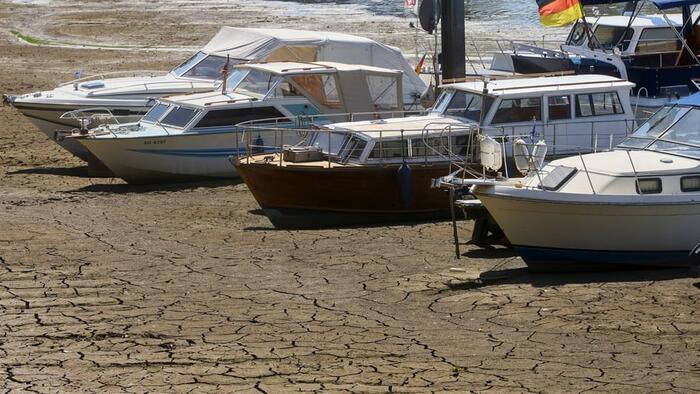
Thyssenkrupp’s steelmaking plant in Duisburg, Germany, is facing disruptions to raw material supplies as a “persistent and worsening low-water situation” restricts barge traffic on the Rhine River. Navigable depths along parts of this critical waterway have fallen to record lows, threatening to curb German economic growth just as the country begins to show signs of recovery.
Bloomberg cited a statement from Thyssenkrupp saying, “The persistent and worsening low-water situation is now affecting the supply of raw materials” to the Duisburg facility. The company added that it has chartered external vessels capable of operating at lower water levels, after suspending its own push-barge operations.
Germany’s inland navigation agency WSV reported that the navigable depth at the Kaub chokepoint near Koblenz fell to just 15 centimeters on Tuesday, breaking the previous record low of 25 centimeters.
The river’s actual depth is roughly one meter greater than the navigable reading, but conditions have become too shallow for most commercial cargo operations.
Burg Pfalz-Grafenstein bei Kaub am Mittelrheintal am 2.8.2026.
Der #Pegel des Rheins liegt aktuell bei 16 cm und soll noch diese Woche einstellig werden.
Bild 3 Loreley Flussabwärts.
Mit der Einstellung des Schiffsverkehrs ab Köln wird fest gerechnet. pic.twitter.com/QUrYhF6EtG
— WernerH777 (@H777Werner) August 10, 2026
“Commercial sailings through Kaub have basically stopped; it is no longer possible to book cargo shipments on the Rhine past Kaub today,” one commodity trader told Reuters. “Some vessels south of Kaub face being trapped.”
The trader added, “There is no actual rule on when sailings at Kaub should stop because of low water, so you could see a couple of empty vessels risking it, but most sailings there have stopped.”
Ongoing heatwaves and limited rainfall have forced cargo vessels to operate at roughly 20% of capacity, sharply increasing transportation costs on the waterway. Freight is being diverted to trucks as analysts warn these disruptions and higher costs could dent German economic growth.
UBS analyst Felix Huefner told clients on Tuesday to expect “modest and temporary hit to growth” in the third quarter because of the Rhine disruptions to commodity flows:
Rhine water levels: Disruptions, but likely temporary
Water levels at Kaub, the Rhine’s key shipping bottleneck, recently fell to a record low.
Reportedly, cargo ships are currently only 20% full and in response several German states are now allowing trucks to drive on Sundays to ease the transport bottleneck.
While inland waterway transport accounts for just c.4% of goods transport in Germany, the Rhine is particularly important for transporting energy products, chemicals and industrial inputs. Historical evidence from 2018 suggests that low water levels can weigh on GDP.
In Q3 2018, GDP growth was dampened by 10-20bp according to estimates. While water levels are lower today compared to history, firms have increasingly adapted through alternative transport routes and lighter vessels as our equity analyst colleagues report for the chemical sector.
So far, business sentiment indicators for the most affected sectors have given conflicting signals: while the chemical and petroleum/refining sectors reported weaker current activity in the July ifo index, the freight transport component improved markedly.
Overall, we expect only a modest and temporary hit to growth, concentrated in Q3 and largely reversed once water transport normalises.
The Rhine disruption comes as Europe confronts twin diesel and natural gas crunches, a combination that Goldman commodities analyst Samantha Dart recently identified as a key risk keeping her up at night (read the full report).