
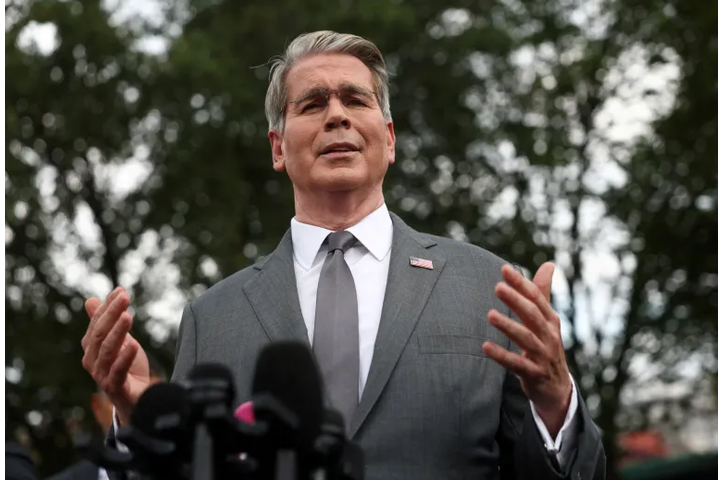

Newsmax: Treasury Secretary Scott Bessent warned that the U.S. is launching an “economic D-Day” against Iran, vowing to sever every remaining financial lifeline to Tehran and punish countries that continue doing business with the Islamic Republic.
In a guest column for the Financial Times published Sunday, Bessent said President Donald Trump’s military campaign has significantly degraded Iran’s armed forces and weakened its nuclear program, setting the stage for what he described as the economic “endgame.”
“At dawn begins an economic D-Day — the single greatest financial offensive ever marshaled against an adversary,” Bessent wrote.
The warning comes as the Trump administration prepares to dramatically intensify economic pressure on Tehran following months of war and stalled efforts to reach a lasting agreement.
Trump last week warned that countries providing Iran with “any type of lifeline” would face major economic penalties of their own.
Bessent said Friday that the administration’s goal is to impose the “toughest sanctions in history” and economically “collapse the regime,” arguing that overwhelming financial pressure could eliminate the need for another major U.S. military escalation.
In his FT column, Bessent said Trump’s pressure campaign has already driven Iran’s currency to record lows and inflation sharply higher. He accused countries still buying Iranian oil, moving Tehran’s money, and facilitating its shipping and aviation operations of helping keep the regime afloat.
“Any nation that serves as a financial artery of a withering regime should expect to share in its isolation,” Bessent wrote. “To become a sanctuary for terror is to become, in the eyes of the United States, a global pariah.”
Bessent argued that countries cooperating with Washington would benefit from stronger access to global capital and greater confidence in their markets, while those maintaining economic ties to Tehran would risk being cut off themselves.
The administration’s strategy marks a shift toward attempting to economically strangle Tehran after months of military operations and faltering diplomacy.
A 60-day negotiating window established under a U.S.-Iran memorandum expired last week without a final peace agreement, leaving the two countries at odds over several of the same issues that have dogged negotiations.
Trump has since threatened countries that help Tehran evade U.S. pressure, while Iranian officials have warned of severe retaliation against Washington and governments that participate in the sanctions campaign.
Bessent made clear that the administration does not intend to be deterred by those threats.
“Under President Trump, that era is over,” he wrote. “And those who fear the danger of defying Tehran ought not to discount the cost of testing Washington.”
Bessent also warned that the U.S. remains prepared to use military force if Tehran responds to the economic campaign by attacking American troops or neighboring Gulf states.
“If, as the regime’s grasp on power crumbles alongside its economy, Iran resorts to military action against U.S. forces or its Gulf neighbors, make no mistake: President Trump will respond swiftly and decisively,” he wrote.
Bessent said the administration’s ultimate objective is straightforward: “to sever every economic lifeline that sustains the tyrannical regime until Tehran stands alone.”
He closed by challenging countries still helping Iran to decide whether protecting their ties with Tehran is worth risking their economic relationship with Washington.
“As a great wave of American resolve comes ashore,” Bessent wrote, “are Iran’s enablers willing to wager their future against it?”