
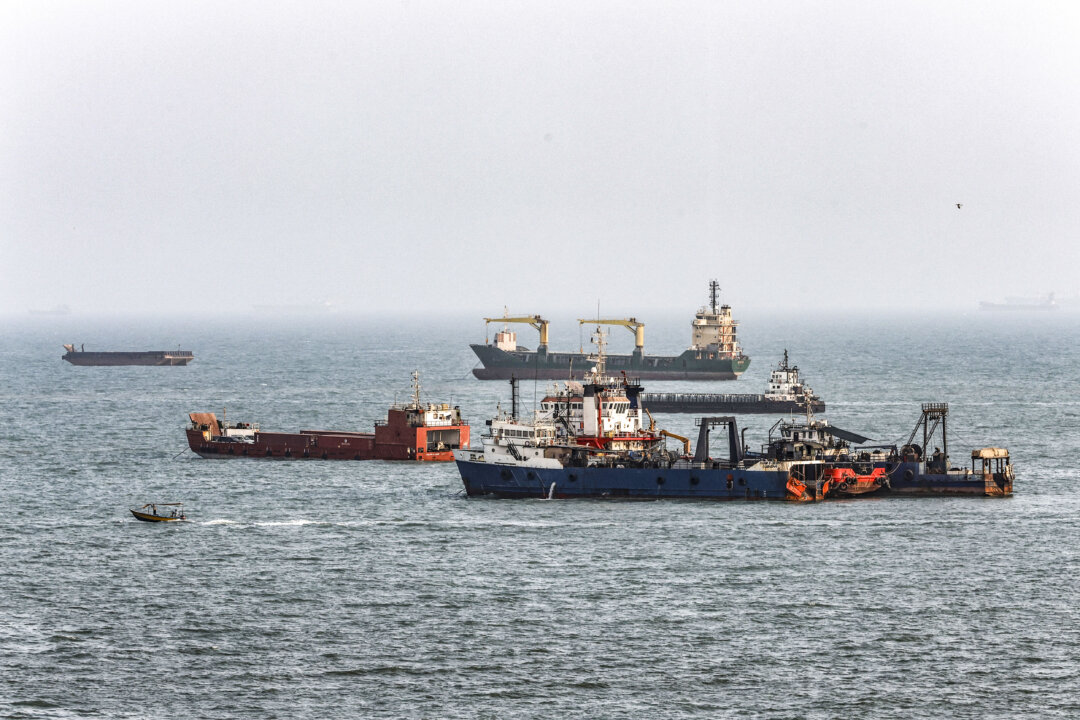
 U.S. Forces struck two Iranian rocket launchers loaded with sea mines on Larak Island in the Strait of Hormuz on Aug. 30.
“Islamic Revolutionary Guard Corps forces were observed preparing to launch rockets with sea mines into the Strait of Hormuz,” U.S. Central Command (CENTCOM) spokesman Navy Capt. Tim Hawkins told the Epoch Times in an email on Aug. 30.
The Aug. 30 attack on the Iranian island marks the first military action by U.S. forces in a month.
“U.S. forces are monitoring the area closely and remain prepared to protect the free flow of commerce through this essential waterway,” Hawkins said.
The Islamic Revolutionary Guards Corps (IRGC) said several Iranian military personnel and civilians were killed and wounded in the attack, according to Iranian state media.
Iranian state television later reported that ballistic missiles were fired by the IRGC at U.S. bases in Jordan in retaliation for the U.S. strikes. The IRGC said it targeted the King Hussein and Al Azraq U.S. bases.
Jordan’s military said it intercepted eight missiles that entered the country’s airspace early on Aug. 31.
The attack happened one day after a UK Maritime Trade Operations report suggested on Aug. 29 that a tanker was struck by an unknown projectile near Khasab, Oman, as it was transiting inbound in the Strait of Hormuz.
Meanwhile, the U.S. blockade of ships entering and exiting Iranian ports continued over the weekend.
“As of Aug. 30, CENTCOM forces have redirected 83 commercial vessels, disabled 3 and boarded 2 to ensure compliance with the blockade,” CENTCOM reported in an X post on Aug. 30.



The war sparked uncertainty in the region and raised gas prices across the world, including in the United States where the average cost for a gallon of regular gas surged by $1 in one month, rising from $2.98 in late February to $3.98 on March 26.
As of Aug. 30, the nationwide average for a gallon of regular gas cost $4.07, according to AAA data.
The Energy Information Agency predicts that gas prices will drop to $3.29 in 2027 and that crude oil production in the region will return to pre-war averages in early 2027.