
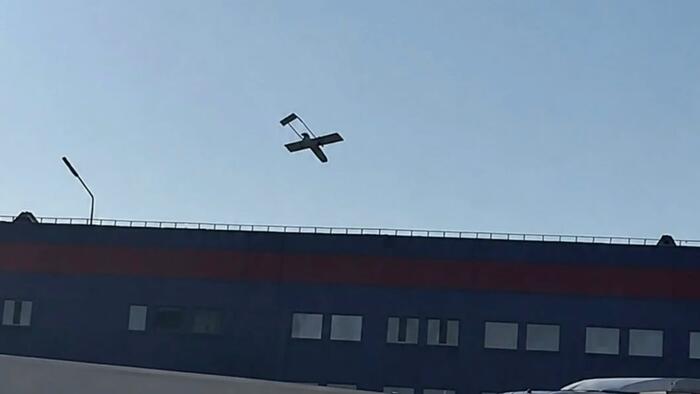
For most of the war, Russia’s Arctic was the part of the map nobody bothered to defend. That changed a month ago.
On September 9, Ukraine’s Special Operations Forces said their drones flew “more than 3,000 kilometers” to hit two gas condensate plants in the Yamalo-Nenets region: Gazprom’s Novy Urengoy condensate treatment plant, with a design capacity of 19.5 million tons of feedstock a year, and Novatek’s Purovsky plant near Tarko-Sale, which processed 13.4 million tons of condensate in 2025 (Hromadske, Al Jazeera). “Until today, this was considered an absolutely safe rear area for the aggressor,” the SOF said. Bloomberg and Reuters both picked up the claim; the Kremlin’s envoy to the Urals, Artem Zhoga, confirmed it was the first attack to reach the Arctic.
On Tuesday Moscow gave its answer: cash. The Yamalo-Nenets government approved a payment of 1 million rubles (about $11,700) for every drone destroyed over the region, the highest bounty any Russian region has offered, according to TASS (others pay 20,000-200,000 rubles). The money goes to local “mobile fire groups,” and there is a catch: per the decree, it is paid only if the defended facility suffers no damage, and the kill has to be confirmed by the military commissariat. Joining a fire group pays 100,000 rubles if you have a job and 150,000 if you don’t, and requires signing a Defense Ministry contract (Barents Observer).
Paying the unemployed more than the employed to stand on the tundra with a machine gun: nothing says confident air defense quite like it.
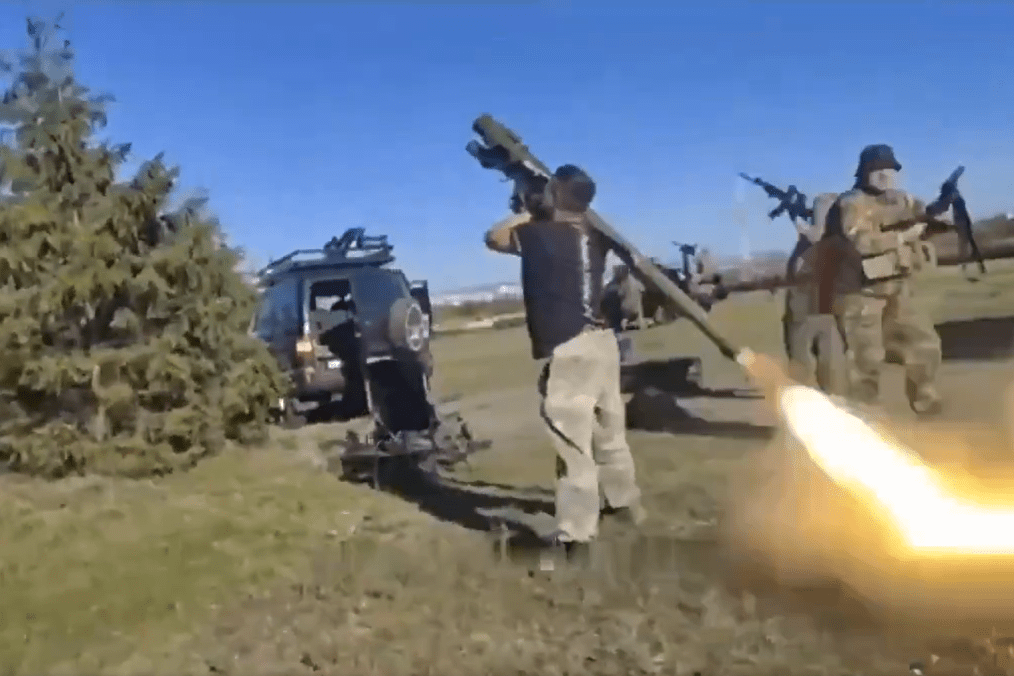
Regular readers know we have been tracking Ukraine’s drone range creep since it first reached Western Siberia last October. Since then the line has moved from Tyumen to Omsk (hit again on Thursday) to the Arctic Circle. So the obvious next question, and the one now going viral on X, is whether Norilsk, home of the world’s biggest palladium miner, is next. As we show below, that is the wrong question: the Nornickel asset that matters for palladium is not in Siberia at all, and it is much closer to Ukraine than Novy Urengoy.
What Actually Got Hit
As usual, Russian officials described the strike as a successful interception. Yamal governor Dmitry Artyukhov said “falling debris” caused a fire at “one of the city’s industrial facilities,” with no casualties (NV). Somehow the debris keeps landing on the most expensive equipment.
Ukrainian OSINT group CyberBoroshno says the drones hit the de-ethanization unit at Novy Urengoy. That matters more than it sounds: the unit’s gas feeds the Novy Urengoy gas chemical complex, which can make up to 400,000 tons of low-density polyethylene a year, so without it the chain from condensate to plastic stops (per RBC-Ukraine, Militarnyi). Satellite imagery also reportedly shows damage at Purovsky. Both of those claims come from Ukrainian OSINT and Russia has published no production data, so treat them accordingly.
Purovsky is the more interesting target for markets. According to Novatek’s own description, most of its stable condensate goes by rail to Ust-Luga on the Baltic for processing and export, the same port complex Ukraine has hit repeatedly, most recently when drone strikes crippled Russia’s key Baltic ports in March. Ukraine has now hit Novatek’s condensate chain at both ends, 2,800 km apart.
The region is not a side show either. Yamalo-Nenets produces roughly 80% of Russia’s natural gas and holds about two-thirds of its gas reserves (Al Jazeera); Yamal LNG and Arctic LNG 2 sit at its northern edge. The Fire Point FP-1 that its maker says carried out the attack costs under $60,000 to build. Even in Arctic economics, a million-ruble bounty per drone and a $60K drone is a trade that only works for one side.
All of this lands while Moscow’s oil and gas budget is already shrinking: the Finance Ministry cut its 2026 oil and gas revenue estimate to RUB 7.6 trillion from RUB 8.9 trillion.
The Norilsk Siren That Wasn’t (Quite)
Which brings us to this morning’s viral claim, courtesy of Visegrád 24: “The city of Norilsk has started testing its air raid alarm system” because Ukraine “could be about to extend the range” of its drones, which “have a range of 3500 km. Norilsk is 4500 km away.“
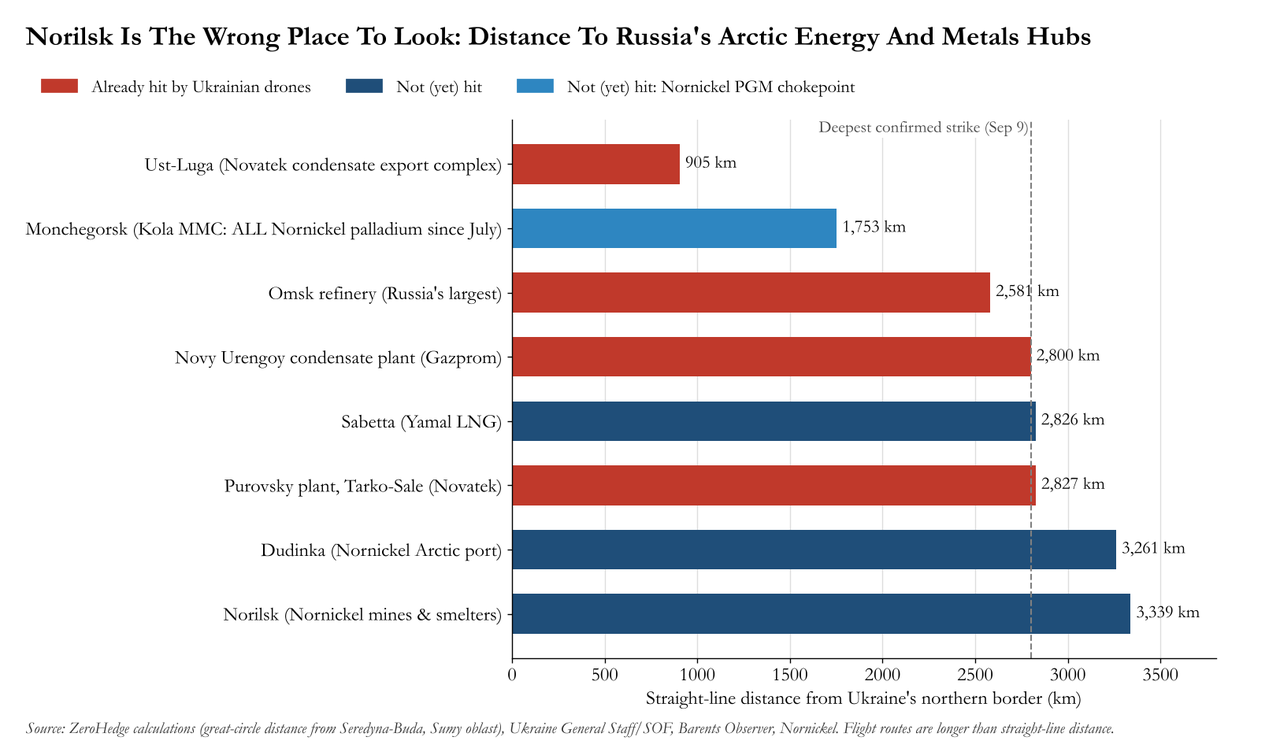
There are a few problems with that. First, Russia’s emergencies ministry ran a scheduled, nationwide test of its warning sirens on October 9, with sirens and loudspeakers switched on “across the whole country“. Second, by our math Norilsk is about 3,340 km in a straight line from Ukraine’s northern border, not 4,500 km, and the drones that hit Novy Urengoy (2,800 km by the same measure) reportedly logged about 3,300 km of actual flight. So Norilsk is a stretch for now, but not science fiction.
Third, and more important: Norilsk is barely connected to anything Ukraine has hit. The Norilsk industrial district runs on its own gas from four Nornickel-owned fields on the Taimyr peninsula; its gas network is “not connected to the Unified Gas Supply System of Russia,” and it is powered by three gas-fired CHP plants and two hydro plants. Last month Nornickel finished five new wells at its Pelyatkinskoye field for 10 billion rubles. In other words, burning Yamal’s condensate plants does nothing to Norilsk’s furnaces.
So if you are worried about Russian palladium, stop looking at Norilsk and look 1,600 km closer.
The Real Chokepoint: Monchegorsk
In July, with almost no fanfare outside the Barents press, Nornickel moved the last stage of its precious metals chain out of Norilsk. It shifted processing of copper anode slime calcine from the Norilsk Copper Plant to Kola MMC in Monchegorsk, on the Kola Peninsula. The result, per the plant’s chief technologist: all of Nornickel’s palladium concentrate is now produced in one place, a plant she says accounts for around 40% of global palladium production. Nornickel spent about 500 million rubles to do it, citing higher recovery and lower costs (AK&M, Yle).
Monchegorsk is also Nornickel’s main nickel refinery, reportedly able to produce more than 165,000 tons of nickel a year, against company guidance of 193,000-203,000 tons for all of 2026.
Now look at the map. Monchegorsk is about 1,750 km from Ukraine’s northern border, closer than Omsk and 1,000 km closer than Novy Urengoy. The Olenya bomber base, a 30-minute drive up the road, was hit during Ukraine’s truck-launched “Spiderweb” operation in June 2025. Nornickel itself saw this coming: back in 2024 it tendered for six steel-and-cable “shields” over fuel tanks and key installations in Monchegorsk, “capable of dealing with possible kinetic attacks from any objects.”
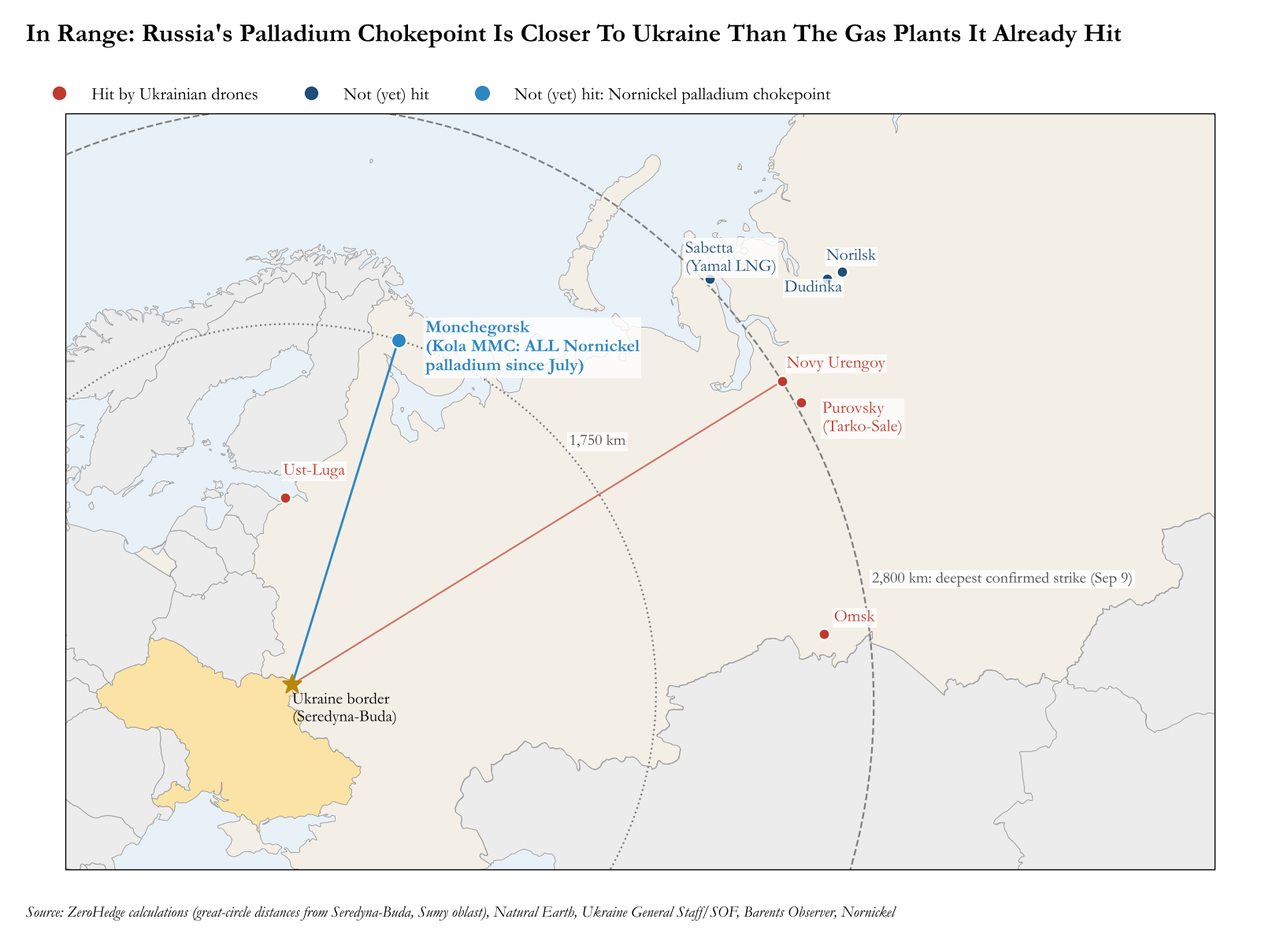
Put differently, Nornickel concentrated 40% of the world’s palladium refining into one plant that sits well inside the range Ukraine has already demonstrated, and did it in the same summer that Ukraine’s drones were setting distance records every few weeks. Efficiency at its finest.
To be clear, there is no sign Kyiv intends to hit Monchegorsk. Ukraine has stuck to energy and military targets, Nornickel is not under major Western sanctions, and Western automakers still buy its metal (which is precisely what makes it so valuable). But Kyiv’s targeting is explicitly about revenue that funds the war, and Nornickel is one of Russia’s biggest exporters: its H1 net profit doubled to $2 billion on revenue of $8.3 billion. The risk is not zero, and the market prices it as if it were.
A Palladium “Surplus” That Is One Bad Month Away From Vanishing
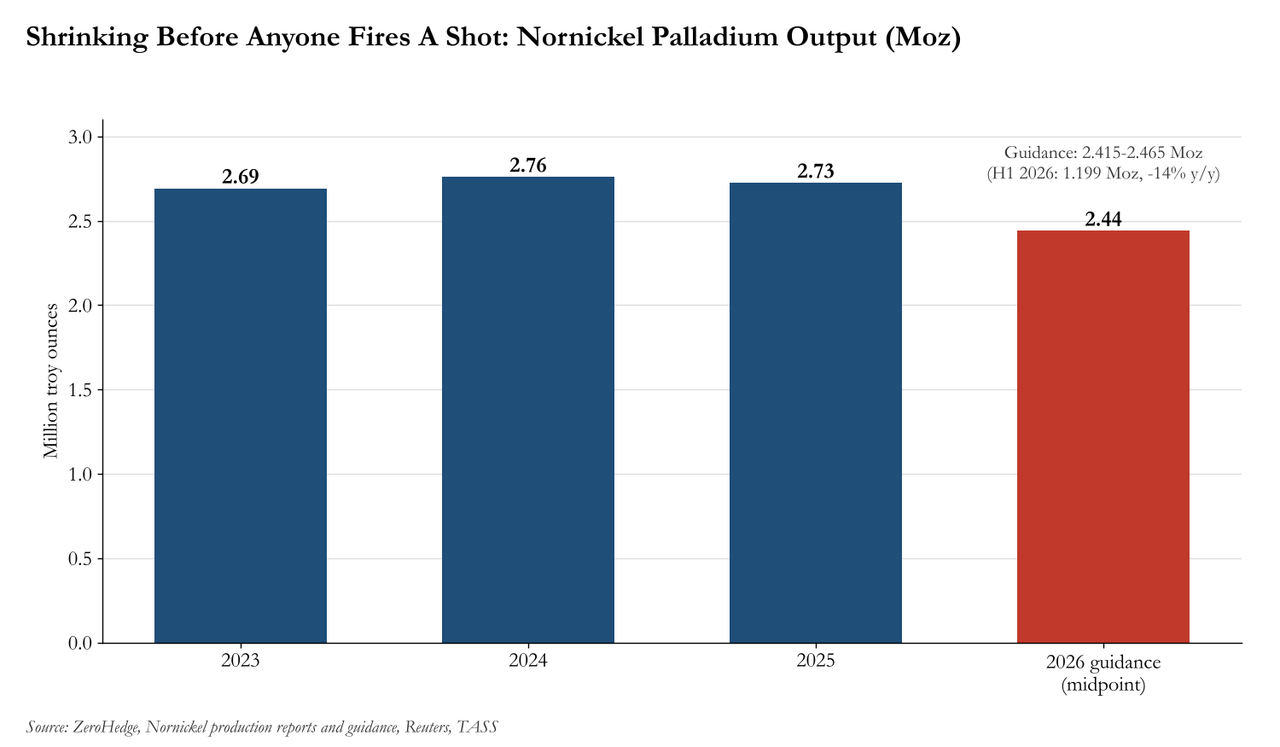
Nornickel was shrinking well before anyone pointed a drone at it. Output guidance for 2026 is 2.415-2.465 million ounces of palladium, down from 2.725 Moz in 2025 and, per Reuters, potentially the lowest in 20 years. First-half output fell 14% y/y to 1.199 Moz. The company blames depleting ore and the forced switch away from Western mining equipment, and says recovery comes in 2028.
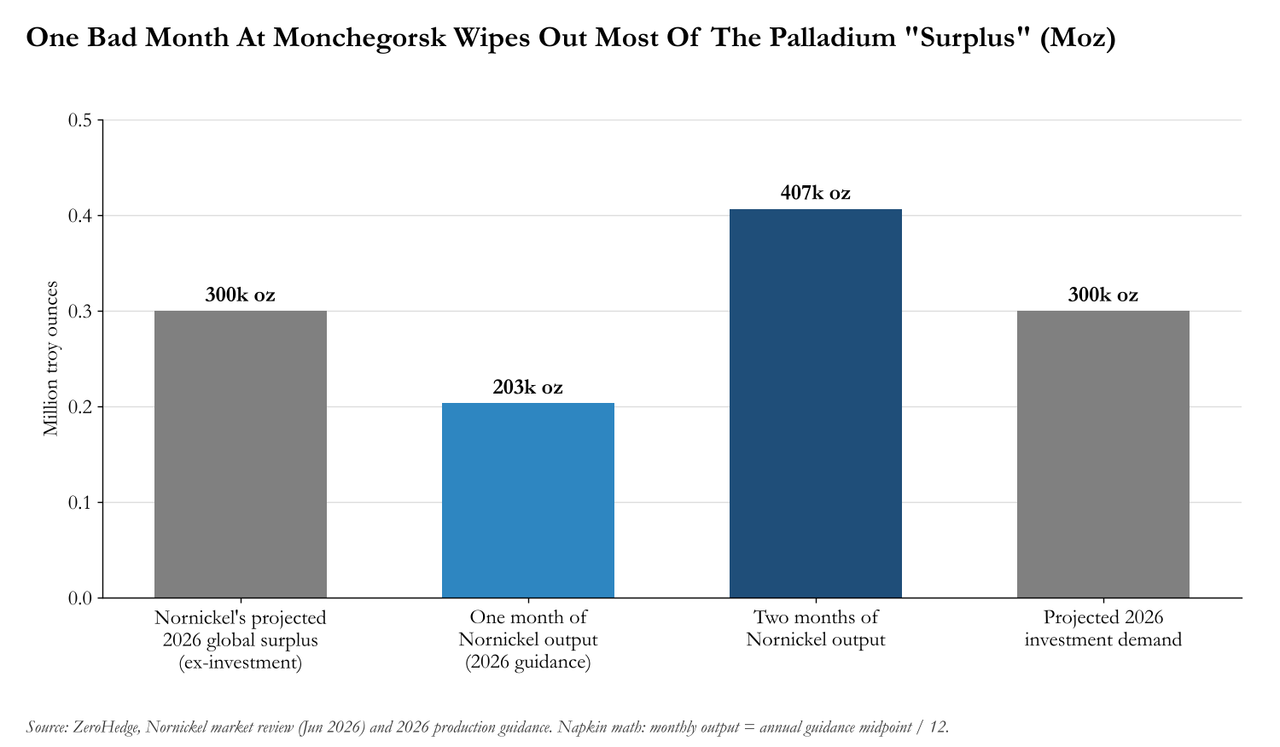
Against that, Nornickel’s own market review sees the global palladium market in a surplus of just 0.3 Moz in 2026 (supply 9.4 Moz vs. demand ex-investment of 9.1 Moz), and expects investment demand of about 0.3 Moz to “effectively” bring it back into balance. Nornickel puts global primary production at 6.1 Moz, so it is roughly 40% of the mined supply.
Now the napkin math (approximate, and generous to the bears): at guidance, Nornickel produces about 200,000 ounces a month. One month of lost output at Monchegorsk erases two-thirds of the projected surplus; six weeks erases all of it. That doesn’t take a destroyed plant. A fire in the wrong workshop, a damaged substation or even a precautionary shutdown during drone alerts would do it.
Liquidity makes it worse. In their latest Commodity Analyst note (available to pro subs), Goldman’s commodities team (Lina Thomas, Daan Struyven) argues that tariff risk has pulled precious metal into the US, where it is likely to stay, leaving ex-US inventories tight:
“The tightening in available ex-US inventories came as investor interest broadened beyond gold into silver, platinum, palladium, and even copper. In a less liquid market, the same investor inflow can have a disproportionate impact on prices. While investor demand has softened as the market now prices a Fed hiking cycle, we expect much of the metal pulled into the US to remain trapped there, leaving available ex-US inventories tight and creating scope for a repeat of the 2025H2/2026H1 volatility should investor demand recover.”
Swap “investor inflow” for “supply outage” and the logic is the same: a thin market amplifies any shock to it. And palladium is about as thin as metals get.
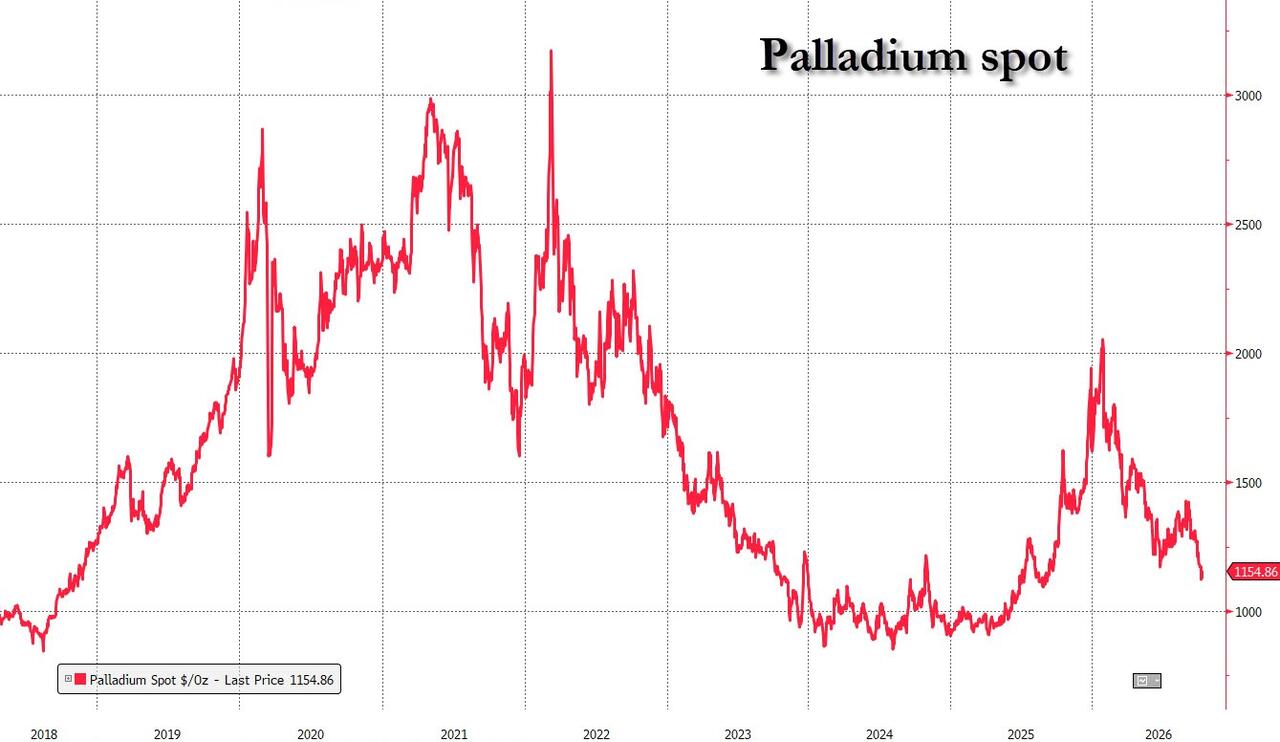
That is also why the market’s complacency is notable. Spot palladium is around $1,154/oz, roughly 30% below where it started the year, under the weight of the Fed hiking cycle, EV substitution and the end of US trade-case drama.
Washington set anti-dumping and countervailing duties of 132.83% and 109.1% on Russian palladium, only for the ITC to rule in May that Russian imports do not harm US industry, so no duties (for now). US imports of Russian palladium were 27.6 tons in 2024, up every year since the invasion. Meanwhile Brussels’ 20th sanctions package banned transactions involving Murmansk port, one of Nornickel’s main export hubs, and the same Kola peninsula.
Regular readers will recall that we called palladium “the heavily-shorted high beta meme commodity of the PGM space” right before it ripped last summer:
Palladium is the heavily-shorted high beta meme commodity of the PGM space
— zerohedge (@zerohedge) July 2, 2025
As we said last June, both platinum and palladium have exploded https://t.co/w9xHzsNmZd
— zerohedge (@zerohedge) March 1, 2026
And Nickel?
Less so. Nornickel’s 2026 nickel guidance of 193,000-203,000 tons is a sliver of a global market of well over 3 million tons dominated by Indonesian NPI, and Nornickel itself expects a nickel surplus of 20,000 tons this year and 55,000 tons in 2027. Russian metal produced after April 2024 also can’t be delivered against LME contracts, so a Kola outage would show up in premiums for high-grade Class 1 nickel and in Shanghai long before it hits the LME screen. Palladium is the one to watch.
Bottom Line
The Arctic strikes are mostly a story about Russian gas, condensate and budget revenue, and Moscow’s million-ruble bounty is a tacit admission that its northern energy base can no longer be defended by distance. For metals, the takeaway is not that Norilsk is about to be hit. It is that Nornickel has put all of its palladium in one basket, and that basket is already in range. All it takes, is one enterprising Ukrainian drone operator to completely destroy the global palladium supply chain.
The timing is awkward too. Trump is openly calling for Ukraine to “get a new leader” after Zelensky ignored six pleas to stop hitting Russian diesel facilities, and Kyiv answered his Putin diesel deal by hitting a Rostov fuel export terminal just hours later. A Ukraine fighting with Washington over energy targets has every reason to look for targets that hurt Moscow without raising US pump prices. A metals refinery whose output trades in a few hundred thousand ounces (and accounts for nearly half of global production) fits that profile.
We don’t think Kyiv goes there soon (or maybe it does, who knows). But with palladium down about 30% this year, consensus fixated on EVs and a “surplus” smaller than two months of Monchegorsk output, the market is pricing the tail at zero. It isn’t.
Much more in the full Goldman “Copper, Silver, PGMs: Tariff Uncertainty Likely to Persist” note, available to pro subs.