
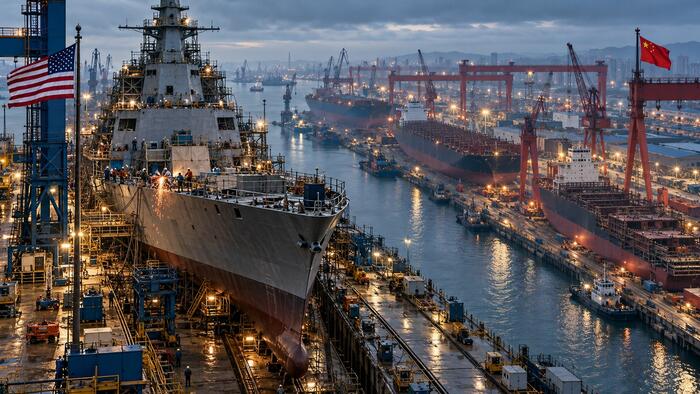
The Navy is asking for $65.8 billion in shipbuilding funding for 2027 as Washington tries to close a production gap with China, whose shipyards turn out about 1,700 ships a year versus roughly five from American builders, according to a new report from Business Insider, U.S. officials now describe that gap as a national security threat.
The government has turned to South Korea, the world’s second-largest shipbuilder, for help restoring domestic production, and the Navy is counting on at least seven shipyards to speed up deliveries.
In 2016, the Navy calculated how many battle force ships it would need in a war with rivals including China and settled on 355. China’s fleet stood at about 255 ships at the time. Current estimates put it above 400. The Navy remains about 60 ships short of its 2016 target, and the requirement has grown since then.
Business Insider reported from Austal USA, a shipbuilder on Blakeley Island in Mobile, Alabama, where even a lightly armed vessel such as the Expeditionary Fast Transport takes 32 to 33 months to deliver. The outlet identified several bottlenecks: the industry lacks roughly 250,000 skilled workers and training 200 apprentices over several years costs more than $3 million. Harsh conditions and hourly pay also drive turnover. Design changes on the first ship of a class can also add months and tens of millions of dollars to a program. Building a ship in the United States also costs four to five times as much as in China or South Korea.
The report compared the current situation with World War II, when Washington invested about $900 million in shipbuilding in 1941 (equivalent to about $20 billion in today’s dollars), and within three years American shipyards were launching more than 1,900 ships each year. After the war, federal support declined, and subsidies ended in 1981. Since 2000, China has expanded by carrying out both commercial and naval construction and is now responsible for more than 53% of the world’s ship tonnage.
After years of little interest in America’s shipbuilding capacity, things have finally started to change.
“In 2025, the administration signed into law $30 billion for new Navy and Coast Guard ships, and for 2027, it’s asking Congress for another $65.8 billion,” explains Olivia Nemec of Business Insider. “That’s more than double what President Biden requested in his final year in office. To put that in perspective, America’s shipbuilding budget alone is about equal to the entire defense spending of nuclear powers like France. Yet this historic naval expansion represents just over a 4.3% slice of President Trump’s unprecedented $1.5 trillion total defense request for 2027.”
President Donald Trump also signed an executive order on shipbuilding in 2025 to rebuild America’s maritime industry, strengthen national security and counter China’s dominance in commercial ship production, and called for a Maritime Action Plan to include proposals for shipyard investment incentives, dedicated funding, expanded workforce training and reforms to reduce procurement delays and regulatory costs.
Those goals are clearly being implemented. A separate Business Insider report revealed last week that shipyard workers in California and Maine have secured higher pay, improved benefits and more influence over new technology through union contracts. In March, union workers at the Ingalls Shipbuilding division of Huntington Ingalls Industries, the country’s largest shipbuilder, negotiated an immediate base-wage increase of at least 18%, with total raises of 35% to 47% through 2031. HII said last fall that higher wage spending had brought in more experienced hires. However, union members told the outlet that pay alone will not hold skilled workers, and that yards must offer a long-term career with healthcare, flexibility and retirement benefits. Shipbuilders are also investing in infrastructure, hiring campaigns, training pipelines and transportation aid such as gas and transit cards.
At NASSCO in California, union membership rose from 21% to 67% during contract talks. Luis Silvas, an IAM Western Territory special representative, said the shop’s culture has shifted toward more solidarity, with younger workers who see themselves as skilled. Richard Suarez, the IAM Western Territory coordinator, said half of the union’s NASSCO members cross the border from Mexico each day, and some leave home at 2 a.m. to reach the yard by 6 a.m.
The Navy is bringing artificial intelligence and robotics into the yards to automate labor-intensive tasks. The Maine contract creates a formal process to bring workers in earlier as new technology arrives. Tim Suiter, president of IAM Local S6, said employees previously joined near the end, which caused confusion and worry about automation.
The Navy’s plans include a 15-ship battleship program with a projected cost of $275 billion.
The United States spent decades watching its shipyards shrink while China built the world’s largest fleet, and the bill for that neglect has now come due. Whether the U.S. can close the gap will depend on how long Congress and the Navy sustain the effort after the initial funding surge.