
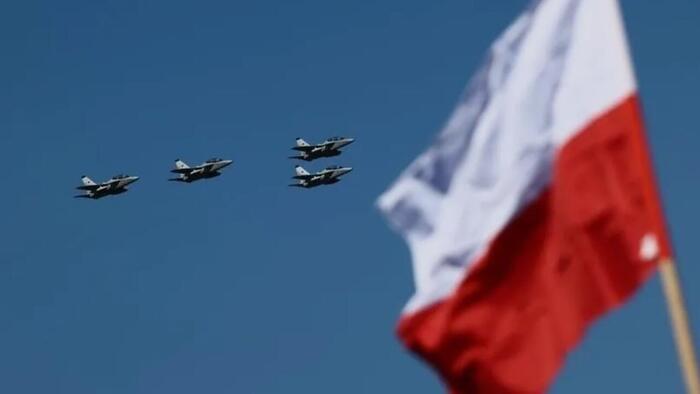
The past year has seen a surge in ‘errant’ cross-border drone as well as aircraft incursions in Eastern Europe and the Blatic region, in connection with the Ukraine war.
Poland has seen plenty of incidents throughout the war, including a November 2022 tragic incident which saw a stray Ukrainian S-300 air defense interceptor missile hit the Polish village of Przewodów, killing two Polish civilians. However, of most concern remains Russian-fired projectiles. Warsaw is now taking a very proactive, and sure to be controversial approach, declaring its border region with Ukraine to be a ‘no-fly zone’. It will given NATO pilots greater freedom to act immediately against inbound threats.
The Polish government has been highlighting and condemning repeat Russian aircraft incursions into NATO airspace of late.
“An ordinance is already being prepared by the government and should enter into force at the end of December or the beginning of January,” said Poland’s Deputy Defense Minister Cezary Tomczyk
“We will also urge our allies — the entire NATO alliance — to establish such a principle along the eastern flank,“ he continued, “Poland was a pioneer in this regard, and the Baltic states have since followed our lead.”
Tomczyk detailed that the proposed zone will extend over several dozen kilometers of territory, and that the Polish military will conduct heightened monitoring and responses to the area. In effect it could mean that NATO missiles shoot down ‘threats’ while they are still inbound over Ukrainian territory.
According to more details and confirmation via Ukrainian media:
Polish Deputy Defense Minister Cezary Tomczyk said the planned no-fly zone would extend to over ten kilometers (six miles) from the country’s eastern border. The government wants the relevant regulation to take effect by late December or early January, Tomczyk said, according to Polish media.
The zone would support a recently introduced procedure that allows Polish pilots to identify and potentially engage aerial targets based on radar information, intelligence from allies, altitude, and speed, rather than requiring visual identification, Tomczyk said.
Polish Foreign Minister Radosław Sikorski said on Nov. 25 that shooting down Russian missiles over Ukraine at Kyiv’s request could constitute an act of self-defense.
The inherent dangers of the plan are quite obvious, as this could bring Russian aerial forces and NATO aircraft into a direct clash over Western Ukraine.
Western allies have additionally long been talking about also establishing a ‘drone wall’ of defense across NATO’s eastern flank. They’ve further accused Moscow of conducting covert sabotage campaigns in Europe.
This ‘drone wall’ planning began in earnest in 2025 after repeat aerial spillover incidents related to the Ukraine war – at various times errant drones, missiles, interceptors – and also even warplanes – have breached Baltic and Eastern European nations’ airspace. Often, however, these incidents arise from off-course Ukrainian drones.
Earlier this year, the Polish presidency’s office said the United States “systematically informs Poland about ever-new Russian plans for a conventional attack on NATO’s eastern flank, from which Poland is by no means excluded.” These reports are rife with wild speculation, however, and thus could be standard wartime propaganda.