
Authored by Jason Locasale via The DisInformation Chronicle,
Today’s guest essay comes from Jason Locasale who looks at academia’s embrace of authority over scientific data and evidence to preserve narratives and protect those in power.
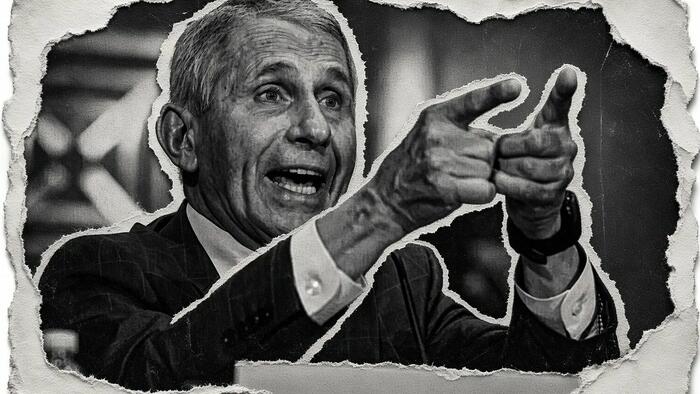
Anthony Fauci is now facing intense scrutiny. His diaries, emails, and testimony have raised fundamental questions about what he knew, what he then told the public, and how he exercised authority during the pandemic. Many outside of academia read these documents and view this moment as his fall from grace, while universities and medical institutions seem willing to ignore this new evidence and continue to celebrate Fauci as a heroic public servant with unmatched scientific authority.
Academics’ unconventional viewpoint cannot be ignored. Fauci matters not only because of his individual conduct, but because he exposes the institutions that produced, empowered, and continue to protect him – Georgetown rewarded him with a prestigious position after he retired from the government in his 80s.
The pandemic did not create the dysfunction inside biomedical science. It placed a magnifying glass over science institutions that had been decaying for decades. Grant politics, unfounded hype, administrative expansion, scientific gerontocracy, institutional self-protection, and the punishment of dissent were already pervasive. Fauci enabled the public to watch those forces operate through one person on television every day.
Biomedical institutions did not create a single Fauci. They created thousands. The pandemic spotlight simply made one of them famous.
What the diaries reveal
Fauci’s diaries offer an unusually revealing account of how he understood his role during the pandemic. Written as notes toward a future autobiography, they show what he considered important enough to preserve about those years.
The diaries undermine the mythology of a reluctant scientist who was unexpectedly thrust into politics and celebrity. They reveal a bureaucrat celebrity preoccupied with attention, status, prominent relationships, TV appearances, reputation, his own place in history, and cash money.
His interest in how he was portrayed, whom he met, who praised him, and how his public image was developing consumes far more attention than any serious engagement with the complex science of COVID-19 and the pandemic. The office shrine, the concern with his portrait, the meticulous record of his fame, and the diary itself as material for an autobiography all expose the same fixation.
Those self-curated notes reveal his priorities. Science is less as an intellectual pursuit than as the credential supporting the public performance.
The related emails and documents complete the picture. Fauci sought nominations for cash prizes from influential friends and used federal employees to help him win those awards. These awards were then presented publicly as independent acknowledgments of merit.

One of the most important revelations in the new documents was the distance between private uncertainty and public certainty. Fauci and those around him privately discussed scientific possibilities that they publicly dismissed and even attacked as conspiracies. The authors of the Proximal Origin paper privately assigned a laboratory origin for the COVID pandemic as a substantial probability, then helped present that possibility to the public as impossible.
The same pattern appeared in pronouncements about masking, vaccine transmission, and other major pandemic questions. The issue is not hindsight. The issue is presenting uncertain claims as settled truth while privately recognizing that the evidence was unresolved.
Authority substituted for scientific judgement
Fauci projected an image of authority, and for too many, image alone was sufficient. His title, confidence, and media presence substituted for careful engagement with data..
Masking, for example, involved questions of aerosol physics, fluid mechanics, particle size, droplet formation, airflow, filtration, leakage, and fit. These are concrete scientific and engineering questions. But Fauci’s own diary finds that he showed no interest in working through the scientific complexity before making definitive public pronouncements.
We can read in his own words that Fauci approached scientific disagreement more like a party in an adversarial legal proceeding than a scientist. Once an institutional position had been adopted, contrary evidence became an obstacle and dissenting scientists became opponents to defeat. The objective shifted from determining what was true to defending political ground and preserving authority.

This is the opposite of a scientific temperament. A good scientist is skeptical, including of his own conclusions. He is comfortable acknowledging uncertainty and may spend days thinking privately through a problem. He does not need a camera, a slogan, or the appearance of omniscience.
Fauci illustrates the difference between projecting authority and possessing a curious, scientific mind.
Scientific credentialism
Fauci majored in classics before earning an MD when medical education was driven by rote memorization and provided little formal preparation for scientific research. His degree was a clinical credential to treat sick people, not a degree for lab research.
When he entered laboratory research, molecular immunology was not yet a developed science and when academic physicians could obtain laboratory directorships early in their careers. He then became an NIH administrator at a relatively young age.
The issue is not that he began his career before modern technologies existed. Every older scientist did. The relevant question is whether an aging scientist continues learning, adapting, and making discoveries as the field develops.
The best scientists remain intellectually active later in life because they master new technologies and continue challenging themselves and their own field. Unfortunately, too many establish their careers by being in the right place at the right time, then coast for another twenty or thirty years through networks that make adaptation unnecessary.
By the time the pandemic arrived, Fauci had spent decades as a bureaucrat, dealing with budgets and manuevering through arcane government policies – far removed from frontline science. Nothing in that history made him a universal authority on masking, vaccine transmission, population epidemiology, viral evolution, or every other field on which he pronounced.
His real expertise was navigating institutions, consolidating authority, cultivating relationships, and projecting the image of a scientist to the public.
The scientific gerontocracy
Fauci’s career fits a broader historical pattern created by universities and their research systems funded by NIH.
When the NIH budget doubled around the turn of the century, universities expanded their biomedical operations. Medical schools hired large numbers of professors whose income and laboratories depended on external grants – called “soft money” positions. Scientists who had attached their names to important genes or disease pathways during the previous era suddenly gained access to enormous new funding streams.
They built large laboratories, accumulated grants, generated indirect-cost revenue for their universities, and developed influence throughout NIH study sections, journals, professional societies, and university administrations. Money created authority, and authority attracted more money.
Many of these people later became department chairs, deans, institute directors, and even university presidents. A few continued doing important science, but most did not adapt as new technologies transformed biology. Their scientific contributions declined while their institutional influence continued growing.
The result was an academic aristocracy whose power survived long after the circumstances that created it disappeared. Seniority came to be treated as wisdom, incumbency as excellence, and grant accumulation as scientific achievement.
Fauci was the most visible member of this gerontocracy. Before the public knew his name, he had already spent nearly forty years controlling a major NIH institute, and there are countless others. The transformation of NIAID into a roughly $6 billion organization is not a self-validating accomplishment. Budget growth does not prove scientific success.
A serious evaluation must examine the priorities entrenched, the dissent discouraged, the opportunities lost, and the consequences of allowing one person to control a government agency for nearly four decades. In retrospect, J. Edgar Hoover served far too many decades running the FBI and history will likely not look kindly on Fauci’s term inside the NIH.
We must also ask what was not studied because Fauci had his thumb on the funding scales for so long. Basic questions about how sleep, diet, exercise, metabolism, stress, sunlight, and other environmental factors shape immunity received far less attention than Fauci’s preferred institutional agenda which was heavily focused on HIV.
The pandemic did not suddenly turn Fauci into a problem. It exposed the culture over which he had already presided for decades.
Scientific celebrity as product
The public sees a handful of scientific celebrities. Insiders know that universities manufacture them by the thousands.
Every major institution has its local circuit of people whose identities revolve around image, status, proximity to power, and the belief that they are stars. They perform the role of scientific authority even when they have shown little interest in science for years, if ever. Some convert the arrangement into wealth. Others are paid in prestige and deference.

These people are not scientists who reluctantly became administrators. They are administrators who use science as a credential. They become skilled at cultivating superficial impressions, repeating approved narratives, and moving through bureaucratic hierarchies. Their institutional rise is then treated as evidence of scientific judgement.
Fauci was the A-list version of this phenomenon. His media charm allowed him to become nationally famous, but his underlying career was familiar. He differed from thousands of university and NIH administrators mainly because he had a camera crew and never missed a moment to be on TV.
Favor-trading as independent recognition
Fauci’s documented relationships with influential figures at Duke illustrate how the establishment reproduces itself.
Fauci reached out to his friend at Duke for award nominations. Duke receives hundreds of millions of dollars in NIAID funding. Organizations then rank Duke according to how much NIH money it attracts. Those rankings are presented as evidence of excellence, and Duke administrators are considered for senior positions within NIH.

Funding, nominations, endorsements, appointments, awards, and prestige circulate through the same small network. Each transaction is then presented as an independent recognition of merit.
This does not require a cinematic conspiracy with a mastermind issuing secret instructions. It just takes time and a bit of curiosity to read the documents laying this out. Aligned incentives, expectations of reciprocity, career dependence, and institutional self-preservation are sufficient. The network coordinates itself because everyone understands which relationships and financial streams must be protected.
And for all these exchanges made public in the news documents, thousands of similar arrangements remain hidden but just as concrete in study sections, professional societies, journal boards, university committees, philanthropic organizations, and government agencies.
Anyone who challenges the arrangement risks being marginalized or blacklisted. Those who participate are promoted as respected scientific leaders.
Narrative management replaces truth
Universities, NIH, journals, scientific societies, medical organizations, biotech, pharma, venture capital, and science media form a self-reinforcing network. Each organization looks to the others for validation. A prestigious paper creates enthusiasm. Academics repeat the narrative. Investors interpret that consensus as reduced risk. Companies raise capital. Advisors and board members reinforce the story. Pharma later treats the institutional excitement as evidence that the underlying biology is sound.
Everyone benefits from optimism until the science fails. Then the network moves on to the next target without confronting why they got the previous consensus wrong. Because self-examination might lead to loss of prestige, authority, or cash to keep the scientific enterprise afloat.
The same institutional structure rewards grant volume over insight, compliance over skepticism, and institutional pedigree over independent judgement. Peer review is not a neutral mechanism floating above these incentives. It is embedded within them.
Fauci made this process visible. Information was accepted or discarded according to whether it advanced the preferred narrative, protected institutional authority, or preserved reputation. Contrary evidence was not evaluated neutrally. It was treated as a political and professional threat.
Labels such as “conspiracy theory” became tools for dismissing plausible evidence without answering it. Institutional authority was used to define what could be discussed, and then the resulting silence was offered as proof of consensus.
Mythology survives inside academia
Many outside academia say Fauci has fallen from grace, that his legacy is destroyed, and that his reputation has collapsed. Nothing could be further from the truth inside academic medicine and biomedical research.
Within universities, medical societies, and the organizations controlling credentials and prestige, Fauci remains a celebrity and hero. He continues to receive invitations, prestigious platforms, awards, and public praise. Major universities still present him as one of the nation’s most important public-health leaders.
The managerial class sees Fauci as the embodiment of itself. His career validates the qualities that it rewards: institutional longevity, bureaucratic influence, narrative discipline, media skill, prestigious relationships, and the ability to present authority as expertise.

Fauci is not merely protected by that class. He is its idealized self-portrait.
These institutions can maintain their own universe of facts because their revenue streams continue regardless of their performance. Taxpayers, donors, tuition, hospital income, grants, and endowment returns allow them to survive without admitting error. There is no effective mechanism of accountability.
The ship is not sinking because the public discovers misconduct. The ship can take on water indefinitely because someone else keeps paying to repair it.
Why Fauci remains important
I keep returning to Fauci not because I claim expertise in every aspect of the pandemic. I do not.
I return to him because he gave the public a rare view of how scientific authority is manufactured and protected. Most people never see the senior administrators, grantmakers, journal editors, society leaders, and local scientific celebrities who shape permissible narratives inside biomedicine. Fauci placed this old way of doing science with TV appearances and shaping of the media.
His diaries and records offer a watershed opportunity. The lesson should not end with deciding whether one man lied, exercised bad judgment, or deserves punishment. The more important question is why the institutions surrounding him showed so little interest in determining the truth and remain so committed to protecting his mythology.
Scientific integrity cannot be partisan. Every person should demand honesty and accountability from institutions that claim the authority of science.
Public-health messaging must be honest before it is clear. Real leaders explain uncertainty, earn trust, and rally the public toward sound action. Manufactured certainty is not leadership. Clarity without honesty is propaganda.
What reform requires
The administrative machinery cannot investigate or reform itself. Its leaders know how to convert criticism into committees, reports, mission statements, listening sessions, and carefully worded promises while leaving the underlying structure untouched.
Reform requires enforceable transparency, external oversight, public accountability, and meaningful consequences for failure. Funding must move away from administrative empires and toward scientists capable of producing important knowledge.
The NIH-centered, large-institution model should face competition from smaller, independent research institutes with lower overhead, clearer missions, and greater accountability. Philanthropy should stop enlarging university endowments and begin building alternative institutions for science, education, and career development.
Scientific leadership should not become a throne occupied for decades. Older scientists should be judged by whether they continue learning, adapting, and contributing, not by the authority accumulated from work performed thirty years earlier. Dissent must be treated as part of science rather than a threat to institutional reputation. Uncertainty must be communicated rather than edited out. Scientific merit must be separated from grant volume, celebrity, political alignment, and bureaucratic skill.
Fauci is not the entire problem. He is just its clearest illustration. He placed the biomedical establishment under a spotlight, and they have failed to confront the harsh light.
Jason Locasale is an American biochemist and former tenured professor specializing in cancer metabolism, nutrition, and the application of AI to health and longevity research. With over two decades in academia and more than 200 peer-reviewed publications, he is recognized as a Highly Cited Researcher (top 0.1% globally) for six consecutive years. He has held advisory roles with biotech firms, the National Cancer Institute, and the National Institutes of Health, and has contributed to textbook chapters and patents.
* * *
The views expressed in this article are those of the author and do not necessarily reflect the views of zh.