
OAN Staff Addie Davis
11:15 AM – Tuesday, April 7, 2026
The Artemis II crew completed the historic seven-hour lunar flyby on Monday, marking the first time humans have seen the far side of the moon in more than 50 years.
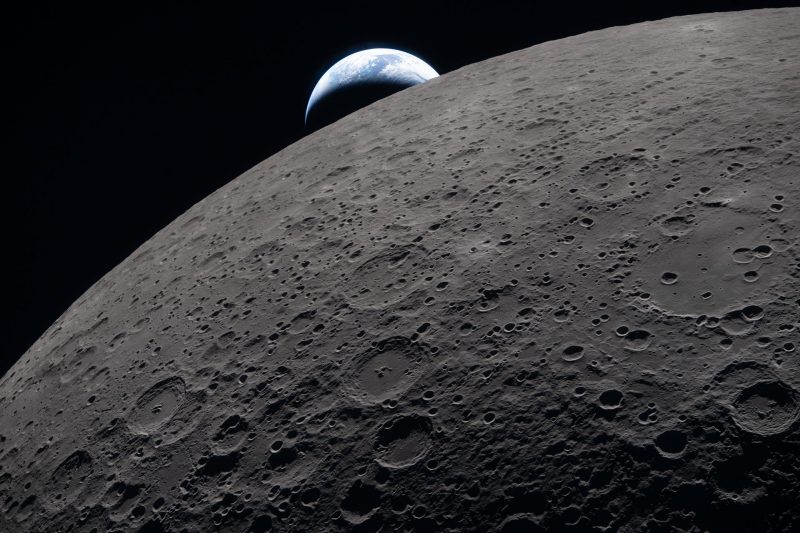
NASA released images taken by the astronauts, and the White House posted the first image of the far side, attaching the caption “EARTHSET.”

NASA astronauts Reid Wiseman, Victor Glover, Christina Koch and Canadian Space Agency (CSA) astronaut Jeremy Hansen make up the Artemis II crew.
On Monday, they set the record for the farthest humans have ever gone into space, surpassing the distance of Apollo 13 in 1970, and reaching a maximum distance from Earth of 252,756 miles.
“As we surpass the furthest distance humans have ever traveled from planet Earth, we do so in honoring the extraordinary efforts and feats of our predecessors in human space exploration,” Hansen said.
“But we most importantly choose this moment to challenge this generation and the next to make sure this records is not long-lived,” he added.
His nod to past triumphs was reciprocated by a pre-recorded message of astronaut Jim Lovell, who died in 2025.
Lovell was a part of both Apollo 8, which was the first time humans had ever orbited the moon, and Apollo 13, which set the record for the farthest distance from Earth with a wide “free-return” loop after having to abort their moon landing following an oxygen tank explosion.
“Hello, Artemis II! This is Apollo astronaut Jim Lovell. Welcome to my old neighborhood!” Lovell said in the recording. “When Frank Borman, Bill Anders, and I orbited the moon on Apollo 8, we got humanity’s first up-close look at the Moon and got a view of the home planet that inspired and united people around the world. I’m proud to pass that torch on to you.”
“But don’t forget to enjoy the view,” Lovell added.

On Monday, President Donald Trump spoke with the NASA crew, congratulating them on their historic achievement.
“You really are modern-day pioneers, all of you,” Trump said, recognizing future plans for landing on the moon and travelling to Mars.
During the lunar flyby, the crew photographed the heavily-cratered surface and made scientific observations: At 3:00 p.m. ET on Tuesday, the crew is expected to speak with science officers on the ground for a debrief, gathering insights that will help inform future lunar science and exploration efforts, according to NASA.
Shortly before then, the Artemis II crew is also scheduled to speak with astronauts onboard the International Space Station during a 15-minute call to share mission experiences.
While flying around the moon, the crew was able to provisionally name two craters on the moon to honor both their mission identity and personal legacy, with the name proposals having to be formally submitted to the International Astronomical Union (IAU) after the completion of the mission.
One crater would be named “Integrity,” reflecting the crew’s official mission call-sign. The second would be named “Carroll,” a tribute to Carroll Taylor Wiseman, the late wife of mission commander Reid Wiseman.
The Orion spacecraft will exit lunar gravity today, on Tuesday, on their trajectory to return to earth and are scheduled to splashdown off the coast of San Diego, California, on Friday.
Stay informed! Receive breaking news blasts directly to your inbox for free. Subscribe here. https://www.oann.com/alerts
What do YOU think? Click here to jump to the comments!
Sponsored Content Below