
OAN Staff Lillian Mann
3:05 PM – Monday, April 6, 2026
The Artemis II crew officially surpassed the record set by Apollo 13 in 1970 earlier on Monday.
For 56 years, the crew of Jim Lovell, Jack Swigert, and Fred Haise held the record for the farthest humans had ever traveled from Earth, due to their wide “free-return” loop after an oxygen tank explosion forced them to abort their moon landing.
The Artemis II crew, consisting of NASA astronauts Reid Wiseman, Victor Glover, Christina Koch, and Canadian Space Agency astronaut Jeremy Hansen, has officially surpassed the distance record set by Apollo 13.
At approximately 1:57 p.m. ET on Monday, the crew moved beyond the 248,655-mile mark, setting the stage to reach a maximum distance of approximately 252,752 miles from Earth later this evening. This new record occurs nearly 56 years after the Apollo 13 crew set the previous milestone on April 15, 1970.
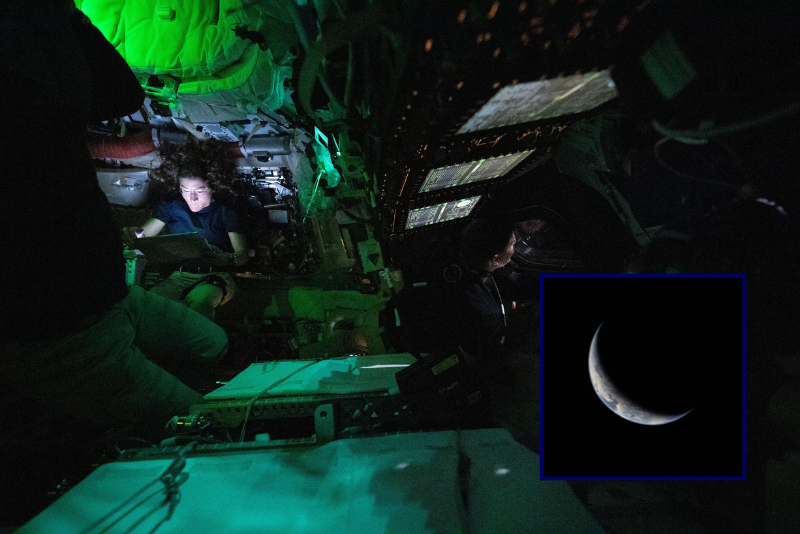
The peak distance will be achieved shortly after the Orion capsule makes its closest approach to the moon, passing roughly 4,070 miles above the lunar surface. During their seven-hour flyby, the astronauts will be conducting intensive observations and capturing high-resolution imagery of the lunar far side.
Due to the specific solar alignment of this mission, the crew is able to view and document surface areas of the moon under lighting conditions that reveal details never before seen firsthand by human eyes.
The record-breaking distance occurred during Artemis II’s planned communications blackout, which lasted approximately 41 minutes while the moon’s mass blocked all radio and laser signals between the Orion spacecraft and Earth.
During the flyby, the four astronauts divided into pairs to rotate through intensive observation shifts. While one pair focused on mission operations and physical exercise, the others conducted scientific observations of the lunar surface.
Using high-resolution zoom lenses and handheld digital cameras, the crew also documented specific geological targets on the lunar far side, while recording detailed visual descriptions of nuances in the terrain that are often difficult for robotic sensors to detect.
When not behind the moon, the crew maintained an active dialogue with lunar scientists in Houston, relaying insights as they explored the “free-return” trajectory — the same gravity-driven path used by the Apollo 13 crew to safely swing back toward Earth.
In addition to their lunar research, the astronauts witnessed a unique solar eclipse caused by the moon passing directly in front of the sun from their perspective, using specialized protective eyewear to safely observe the Sun’s corona during the roughly 53-minute occultation.
Following the lunar flyby, the Orion spacecraft will use the moon’s gravitational pull to swing around the far side, performing a celestial “U-turn” onto its free-return trajectory back toward Earth.
The return transit will take about four days. The Artemis II mission is scheduled to conclude with a splashdown in the Pacific Ocean off the coast of San Diego on Friday, April 10th, at approximately 8:07 p.m. ET.
At its peak distance, the crew will observe the moon appearing roughly the size of a basketball held at arm’s length. While previous crews, beginning with Apollo 8 in 1968, have passed over the far side, those missions were timed for near-side landings, which left much of the far side in shadow or less favorably lit from their perspective.
Thanks to Artemis II’s specific timing, the sun is illuminating about 20% of the far side during the flyby. This allows the astronauts to observe and document sunlit regions and features of the lunar far side that were not visible under the same lighting conditions during any previous human missions.
Stay informed! Receive breaking news alerts directly to your inbox for free. Subscribe here. https://www.oann.com/alerts
What do YOU think? Click here to jump to the comments!
Sponsored Content Below