
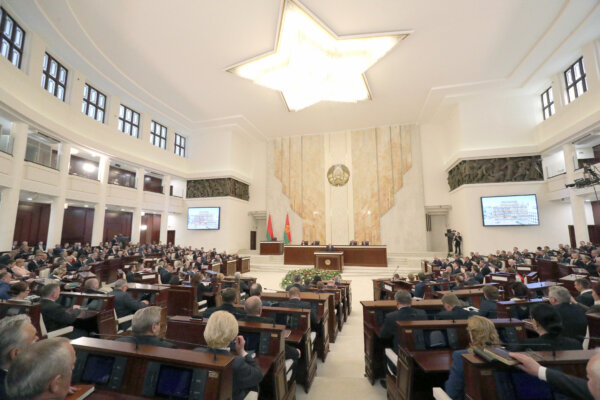
 The Belarus parliament has passed a bill to criminalize the promotion of gender ideology, pedophilia, homosexuality, and deliberate childlessness, mirroring the laws of its neighboring ally, Russia.
The upper house gave the legislation the seal of approval on April 2, following its passage last month by the lower house, with Belarusian President Alexander Lukashenko expected to sign it into law.
The bill makes the “propaganda of homosexual relations, gender charge, refusal to have children, and pedophilia” punishable by fines and community labor.
Homosexuality was decriminalized in Belarus in 1994, following the collapse of the Soviet Union. Same-sex marriage is unlawful in Belarus and in many European nations, including Italy, Cyprus, Poland, Hungary, Romania, Bulgaria, Slovakia, and Croatia.
‘The Classic Family’
Russian state media reported him as saying in March 2023 that although he thinks gay men may be “golden people,” he does not believe in the promotion of homosexual relationships because “we need people. Babies. Men don’t give birth. So let’s stick with the classic family.”
Some transgender activists have said that the country’s top security agency, which still bears its Soviet-era name, the KGB, has blackmailed individuals to force them to cooperate.


Alisa Sarmant, the head of TG House, a Belarusian transgender rights group, said the legislation has sparked fears among transgender-identifying people that they could be denied permission to purchase cross-sex hormones.
“The Belarusian authorities have lumped together gays, lesbians, transgender people, and pedophiles, creating additional grounds for social rejection and stigmatization,” Sarmant said.
“Belarus is copying Russia’s sad experience, creating unbearable conditions for (LGBT) people.”
The Russian government does not issue gender recognition certificates, and health authorities do not provide treatments such as gender reassignment surgery, cross-sex hormones for adults, or puberty blockers for children.
Under Russian President Vladimir Putin’s push for family values, the LGBT movement has been branded as extremist in Russia, and those found guilty of extremism can face jail sentences of up to 10 years.
The Russian policy has been condemned by groups such as Amnesty International and the United Nations as a violation of human rights.
The move was backed by the Russian Orthodox Church, which described it as “moral self-defense.”


Russian Emphasis on Christianity
“The LGBT movement’s activities are aimed at removing Christian ideas of marriage and family from the public and legal sphere,” the Russian Orthodox Church said in a statement.
“If such a movement is given free rein in Russia, it will pursue the same goals as it has in the West.”
Russian law also bans anyone who lives as the opposite sex from adopting children.
Under a 2022 law passed in Russia, any attempt to “promote homosexuality”—in films, books, or online—was made punishable by stiff financial penalties.
The Russian authorities have used recent legislation to ban public “gay pride” events and detain pro-LGBT activists, as well as to slap fines on social media companies.
Along with the Russian Orthodox Church, Putin has frequently stated that pro-LGBT “activism”—especially the notion of “gender fluidity”—conflicts with traditional Russian values.
While several Western countries have objected to the recent Russian legislation, some have had similar laws in place, including the UK and the United States.


In the UK, a piece of legislation known as Section 28 banned the promotion of homosexuality in schools from 1988 until 2003, when it was repealed by Sir Tony Blair’s Labour government. Its stated aim was to protect the nuclear family, while critics said it was discriminatory and fought a long campaign for its repeal.
In the United States, laws have existed in several states relating to homosexuality education in schools. While some have been repealed in recent years, regulations exist in some states, including Florida, on the teaching of sexuality and gender ideology to children.