

Nigel Farage has a new answer to Britain’s asylum backlog: abolish the asylum system.
Standing in Hythe, Kent on Monday in front of a replica Channel “mega dinghy,” the Reform UK leader pledged that a Reform government would suspend the asylum system for a full parliamentary term: all new claims rejected, all pending applications voided, and every claimant marked for deportation, according to the BBC. No refugee status, no humanitarian protection, no tribunals and no resettlement schemes. Home affairs spokesman Zia Yusuf put it in three words: “Britain is full.”
“The country is currently facing a national security emergency and the first duty of government is to protect its citizens. We cannot accept more asylum seekers while we still have no idea how many people are in the country illegally and the threat they pose. A Reform government will always put British people first and protect our borders.” — Nigel Farage, to The Telegraph (emphasis ours)
Translation: rather than fix the queue, Reform proposes to delete it. Regular readers will recall that when Farage first sketched out his migration plan (ECHR exit, an asylum ban for illegal arrivals, migrants moved from hotels to disused RAF bases), we called Reform’s plan for dealing with UK illegal migrants a good start (Aug 27, 2025). Fourteen months later, the “start” has become a full stop.
Reform’s Plan For Dealing With UK Illegal Migrants Is A Good Start https://t.co/j0UlzNMa7S
— zerohedge (@zerohedge) August 27, 2025
Below we lay out what’s in the plan, the numbers behind it, the (predictable) reaction, and the awkward fact that it lands just as Reform’s poll lead has evaporated.
What’s In “Restoring Justice”
Per the BBC, PA and The Telegraph (via the Daily Sceptic), the plan, dubbed “Restoring Justice,” would:
- Void the applications of the ~90,000 people currently in the asylum and humanitarian protection appeals queue and deport the claimants to their home country or “a safe neighbouring country” (PA via AOL).
- Scrap all asylum tribunals, legal refugee routes and resettlement schemes, including immediately closing the resettlement scheme Home Secretary Shabana Mahmood reopened in September. Homes for Ukraine would be abolished for new arrivals, but Ukrainians already here could stay.
- Re-task every Home Office official now working on asylum cases to “reviewing and overturning previous refugee grants.” Any refugee granted asylum in the last five years would have their case reviewed (The Independent reports the review would cover grants since 2024, with those from “safe” countries losing their status).
- Pull Britain out of the ECHR, repeal the Human Rights Act 1998 and disapply the 1951 Refugee Convention to head off the inevitable legal challenges (BBC).
- Create a dedicated detention-and-deportation agency needing 24,000 to 28,000 detention spaces. The BBC notes it is “unclear how this would provide enough capacity.”
- Ban UK visas for Pakistan, Somalia, Eritrea, Syria, Afghanistan and Sudan if they refuse deportation flights, and hit countries with few nationals in the UK with tariffs, airline bans and asset freezes. As Farage put it: “People will accept their bad guys back” (The Independent).
It sits on top of Reform’s earlier pledge to deport up to one million people in its first term (Telegraph via Daily Sceptic), and the August “Operation Fortress” plan to have the Royal Navy intercept dinghies and return them “under escort” to France or Belgium (Guardian). Asked how many civil servants it would take, Farage declined to say, only that it was “going to save us a fortune.”
Tariffs as an immigration weapon: someone in Hythe has clearly been watching Washington.
The Numbers: Down 41%, Still 20,935
Farage opened by recalling the day in May 2020 he took a fishing boat out of Dover and called the crossings “the beginning of an invasion,” noting that “over 200,000 illegal immigrants have come” since (Reform UK). The Home Office’s own series backs him on that one: small-boat arrivals total 213,545 since 2018, including 41,472 last year, the second-highest year on record behind 2022’s 45,755.
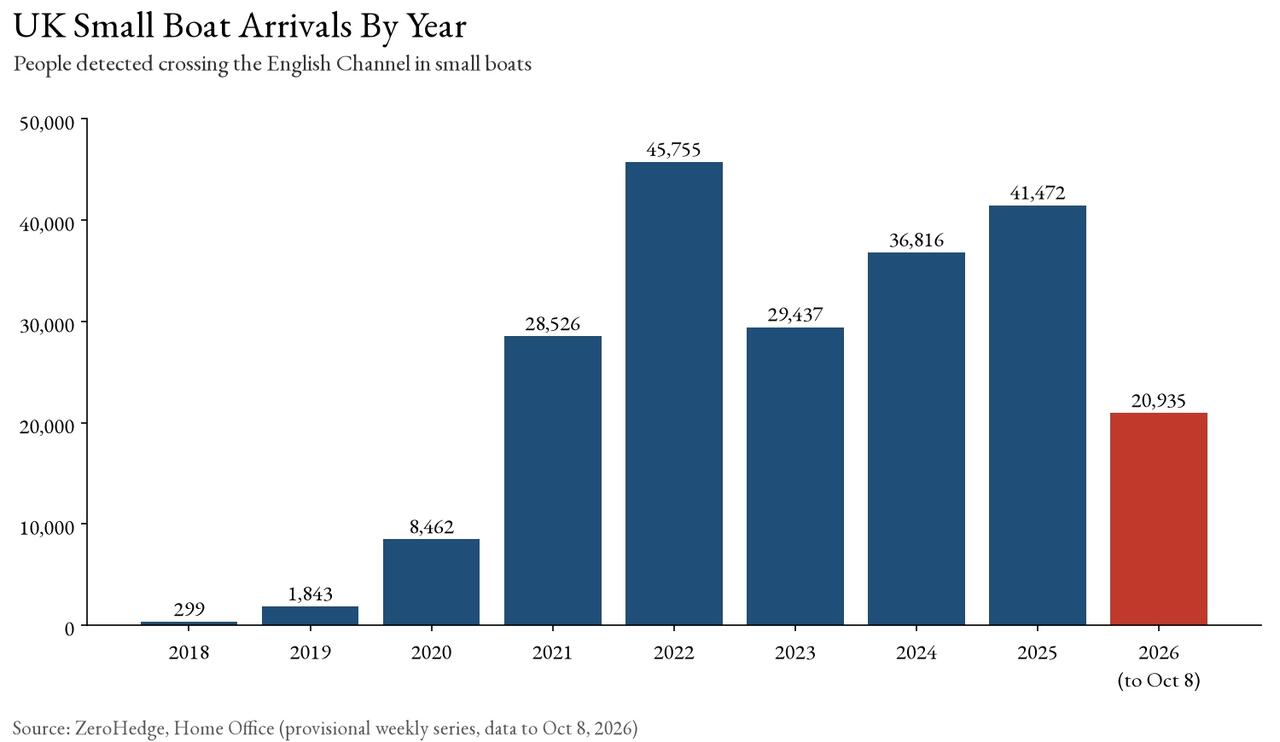
Which, as we noted last month, means that boat migrants who have entered Britain now outnumber its soldiers (Sep 28).
Boat Migrants Who Have Entered Britain Now Outnumber Its Soldiers https://t.co/QN8ZQJ5sGs
— zerohedge (@zerohedge) September 28, 2026
The awkward bit for Reform’s “emergency” framing: crossings are actually falling. Provisional Home Office data show 20,935 arrivals from Jan 1 to Oct 8, down 41% from 35,476 over the same period of 2025, on 305 boats averaging 68.6 people each. The boats, however, keep getting bigger: in August a single “mega-dinghy” brought a record 230 people across (The Independent), hence Farage’s line that this is no longer “a small boats crisis.” And the 2026 lull can turn fast: 1,648 people landed on 22 boats in the seven days to Oct 9 alone (Home Office).
The Reaction: “Desperation,” “Copycat,” “Chaos”
Everyone hated it, though for impressively different reasons.
Labour chair Bridget Phillipson called it “a clear sign of desperation and weakness,” adding that Farage “is casting around for more and more extreme policies as he tries to deal with scandals, police investigations and a growing challenge from Restore — this is a carbon copy of their policy” (The Independent).
The Tories, meanwhile, complained it wasn’t extreme enough to be original. Shadow home secretary Chris Philp said the proposals “largely copy” Conservative policy: “Banning asylum claims by illegal immigrants, abolishing the immigration tribunal and ending Labour’s resettlement routes are all existing Conservative policy. Our detailed BORDERS plan also sees us coming out of the ECHR… and closes the modern slavery claim and judicial review loopholes, both of which Reform seems to have missed.” The Tories have separately pledged to remove 750,000 illegal immigrants within five years (BBC). So Labour says Reform copied Restore, and the Tories say Reform copied the Tories.
The Refugee Council’s Jon Featonby called the plan “unworkable”: “Closing our asylum system would cause chaos. Desperate people would still arrive on our shores, but instead of entering an orderly system, they would be driven underground and vulnerable to exploitation and abuse.” The Lib Dems’ Max Wilkinson suggested the UK join the EU migration and asylum pact instead (BBC).
The legal hurdles are real. Repealing the HRA needs Parliament, and a unilateral ECHR exit by executive power would likely be challenged in court (The Independent). Readers will recall that even a council trying to shut a single asylum hotel in Epping lost: the Court of Appeal sided with the government to keep the migrant hotel open (Sep 1, 2025), after a summer of protests. Strasbourg’s critics aren’t confined to Clacton either: a top German judge warned that an overzealous ECHR “endangers the existence of Western democracies” (Sep 5, 2025).
The Politics: A Pledge In Search Of A Poll Lead
The timing tells its own story. Five months ago Reform was the party to beat: Farage’s Reform UK stormed to historic gains in the May “midterms” (May 8), and in August Farage crushed the Clacton by-election with 63% (Aug 14) after resigning his seat to force a “People vs. The Establishment” vote (Jul 7).
Farage Crushes Clacton By-Election With 63% As Comedy Candidates Dominate Longest Ballot In British History https://t.co/HIC8Ykgjd6
— zerohedge (@zerohedge) August 14, 2026
Since then, the summer of donation stories has taken its toll. In YouGov’s latest poll for The Times and Sky (Oct 4-5), Labour leads on 27%, with Reform down 3 points to 22% and the Conservatives on 20%; Restore Britain is on 3% (YouGov). That’s Labour’s best YouGov showing since January 2025 and the first statistically significant lead for any party in three months, after Andy Burnham’s conference speech.
Read the plan as the political move it is: with the Tories and Restore Britain competing for the same voters, Reform is staking out the hardest line on its strongest issue.
Bottom Line
As policy, the plan has obvious holes: no headcount, 24,000-28,000 detention spaces nobody has found, and a legal path that runs through the ECHR, the HRA, the Refugee Convention and every judicial review a well-funded NGO can file. As politics, it is shrewd. Britain has taken in 213,545 small-boat arrivals since 2018, and voters have watched one government after another promise to “stop the boats” while the dinghies got bigger. Farage doesn’t need the plan to be workable. He needs it to be the only one voters remember, and with Labour and the Tories busy accusing him of plagiarism, he’s halfway there. We side with Farage on the diagnosis. Whether the cure survives its first High Court hearing is another matter.
Next test: the Home Office’s next weekly small-boat release on Friday, Oct 16, and the next round of polls, which will show whether “Britain is full” can win back the 3 points Reform lost.
Much more in the full Reform UK speech here.