
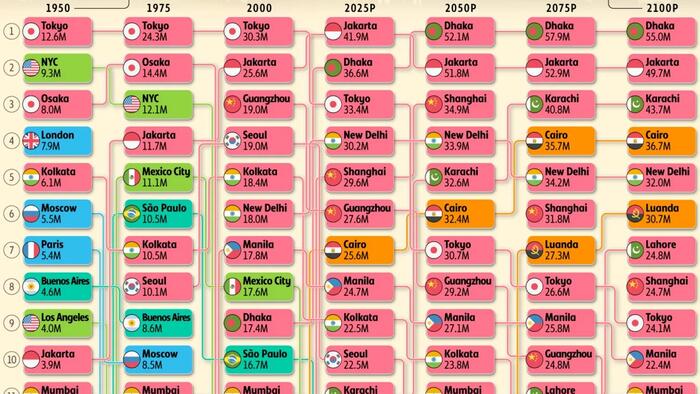
Across 150 years, familiar urban giants rise, fall, and give way to a new generation of megacities.
This visualization, via Visual Capitalist’s Gabriel Cohen, ranks the 15 most populous cities worldwide from 1950 to 2100 using population estimates from the European Commission’s JRC via Our World in Data. City boundaries were consistently defined based on satellite imagery and population data.
The Transatlantic Era
Tokyo led the 1950 ranking with 12.6 million people, followed by New York with 9.3 million.
The Big Apple was not the only massive Western city at the time. Of the 15 most populous cities in 1950, over half were found in either Europe or the Americas. This included London (7.9 million), Moscow (5.5 million), and Paris (5.4 million).
The table below ranks the 15 most populous cities in 1950:
| Rank | City | Population in 1950 (Millions) |
Region |
|---|---|---|---|
| 1 | 🇯🇵 Tokyo | 12.6 | Asia |
| 2 | 🇺🇸 New York City | 9.3 | North America |
| 3 | 🇯🇵 Osaka | 8.0 | Asia |
| 4 | 🇬🇧 London | 7.9 | Europe |
| 5 | 🇮🇳 Kolkata | 6.1 | Asia |
| 6 | 🇷🇺 Moscow | 5.5 | Europe |
| 7 | 🇫🇷 Paris | 5.4 | Europe |
| 8 | 🇦🇷 Buenos Aires | 4.6 | South America |
| 9 | 🇺🇸 Los Angeles | 4.0 | North America |
| 10 | 🇮🇩 Jakarta | 3.9 | Asia |
| 11 | 🇮🇳 Mumbai | 3.8 | Asia |
| 12 | 🇲🇽 Mexico City | 3.7 | North America |
| 13 | 🇪🇬 Cairo | 3.1 | Africa |
| 14 | 🇨🇳 Shanghai | 3.1 | Asia |
| 15 | 🇧🇷 São Paulo | 3.1 | South America |
The rankings began changing quickly over the following decades. By 1975, London had fallen out of the top 15, while Paris (7.4 million) and Los Angeles (7.7 million) had also slipped in rank.
The second half of the 20th century also saw the rise of Latin American metropolises such as São Paulo and Mexico City, which by 2000 had surpassed New York as the most populous cities in the hemisphere.
The Rise of Asia
By 2000, Asia dominated the upper reaches of the ranking.
Tokyo maintained its lead at 30.3 million inhabitants, while Guangzhou had climbed to third with 19 million and New Delhi to sixth with 18 million.
Urbanization and a continental population boom continued, and by 2025 all but one of the 10 most populous cities worldwide were in Asia. The sole exception was Cairo, with 25.6 million people.
| Rank | City | Population in 2025 (Millions) |
Region |
|---|---|---|---|
| 1 | 🇮🇩 Jakarta | 41.9 | Asia |
| 2 | 🇧🇩 Dhaka | 36.6 | Asia |
| 3 | 🇯🇵 Tokyo | 33.4 | Asia |
| 4 | 🇮🇳 New Delhi | 30.2 | Asia |
| 5 | 🇨🇳 Shanghai | 29.6 | Asia |
| 6 | 🇨🇳 Guangzhou | 27.6 | Asia |
| 7 | 🇪🇬 Cairo | 25.6 | Africa |
| 8 | 🇵🇭 Manila | 24.7 | Asia |
| 9 | 🇮🇳 Kolkata | 22.5 | Asia |
| 10 | 🇰🇷 Seoul | 22.5 | Asia |
| 11 | 🇵🇰 Karachi | 21.4 | Asia |
| 12 | 🇮🇳 Mumbai | 20.2 | Asia |
| 13 | 🇧🇷 São Paulo | 18.9 | South America |
| 14 | 🇹🇭 Bangkok | 18.2 | Asia |
| 15 | 🇲🇽 Mexico City | 17.7 | North America |
The World in 2100
By 2100, Dhaka is projected to rank first with 55 million people, followed by Jakarta at 49.7 million and Karachi at 43.7 million. Tokyo, the world’s largest city in 1950 and 2000, is projected to fall to ninth place with 24.1 million residents.
| Rank | City | Population in 2100P (Millions) |
Region |
|---|---|---|---|
| 1 | 🇧🇩 Dhaka | 55.0 | Asia |
| 2 | 🇮🇩 Jakarta | 49.7 | Asia |
| 3 | 🇵🇰 Karachi | 43.7 | Asia |
| 4 | 🇪🇬 Cairo | 36.7 | Africa |
| 5 | 🇮🇳 New Delhi | 32.0 | Asia |
| 6 | 🇦🇴 Luanda | 30.7 | Africa |
| 7 | 🇵🇰 Lahore | 24.8 | Asia |
| 8 | 🇨🇳 Shanghai | 24.7 | Asia |
| 9 | 🇯🇵 Tokyo | 24.1 | Asia |
| 10 | 🇵🇭 Manila | 22.4 | Asia |
| 11 | 🇮🇳 Mumbai | 21.5 | Asia |
| 12 | 🇮🇳 Kolkata | 20.5 | Asia |
| 13 | 🇹🇿 Dar es Salaam | 20.1 | Africa |
| 14 | 🇨🇳 Guangzhou | 18.1 | Asia |
| 15 | 🇳🇬 Lagos | 17.9 | Africa |
Cairo will remain the most populous city outside of Asia, with 36.7 million people. It will be joined in the upper rankings by other African megacities including Luanda (30.7 million), Dar es Salaam (20.1 million), and Lagos (17.9 million).
Tokyo is projected to see its population fall below its 1975 level as declining birth rates contribute to long-term population decline.
To learn more about national population growth, check out The Top 10 Countries Driving Future Population Growth on Voronoi.