
Authored by John MacLeod via The Critic,
We have repressed the memories of the pandemic that changed all of our lives…
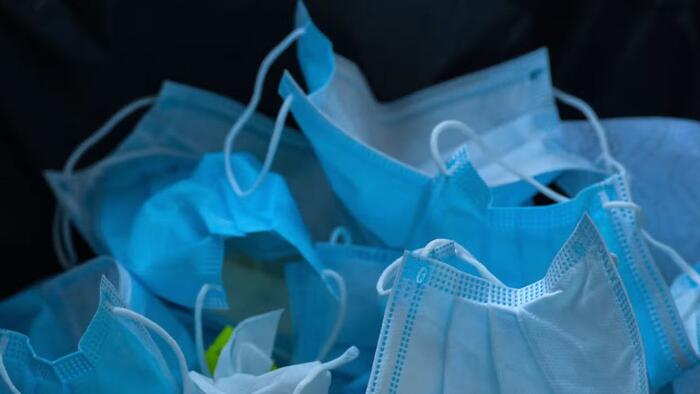
It is a little drawer in a cabinet by my bedside and I have not opened it in years. I have to steel myself to open it now. And, yes, they are all there yet in every variety – black, chequered, colourful.
The ear-looped face-coverings behind which I spluttered for two long years, tugging on and off as needs be, as we queued obediently outside supermarkets, danced on and off pavements, or chilled if anyone in the vicinity so much as coughed.
Obediently protecting the NHS by, um, not using it. And, for weeks on end in 2020, biddably stood outside our front gates to hail its endeavours each Thursday evening, clapping our hands and banging saucepans.
The initial weeks of panic, when hand-sanitiser, soap and masks were nowhere to be had. An inexplicable run on toilet-rolls. The later, weird scarcities: flour, yeast, eggs.
On all sides the shuttered shops and restaurants, many of which would never reopen. The funerals you could not go to and the weddings that never happened. Untold rings, accordingly, engraved with the wrong date.
I have the sort of bardic, Highland memory that could immediately tell you something interesting that happened in my life in, say, August 1976 or September 2002. I’d struggle to detail much between March 2020 and April 2022.
Those were months without form, and void. Without the usual milestones of big social occasions and family celebration. In hindsight, they have a nightmarish hue.
I was trapped in Edinburgh shielding two elderly parents, one living with cancer. I lurched out on my lonesome for daily needs and the weekly Big Shop, three debit-cards in my wallet.
In the early weeks – I was fifty-four; had a bit of a tummy – I was wholly resigned to catching Covid; darkly confident I would die. Time and again I washed my hands, till they were raw; sometimes I was tempted to wash the groceries – and I know of households where husbands, returning from such an outing, had to strip in the porch before being granted admittance.
Nicola Sturgeon? Gaw, that woman never seemed to be off the box. Nightly my mother tuned in for her latest and-furthermore-I-say-unto-ye lecturettes, screened live on telly by our reverent broadcasters and without the First Minister’s political rivals granted any part whatsoever.
In a particularly North Korean moment, STV even broadcast online sickly footage of assorted Scottish children mewling, “Thank you, Nicola, for keeping us all safe,” and variants thereof. (It was belatedly pulled, after an outcry.)
I still remember the worst moment. A Saturday evening in October 2020. It had rained all day. Our brief re-opening had ceased after a sustained uptick in infections: the First Minister (who, weeks earlier, had been braying to all Europe how Scotland had eliminated coronavirus) had announced a “16-day re-set” with renewed restrictions.
So successful was the16-day re-set it lasted till the spring of 2022. That October evening – I could not return to my own home; I was totally trapped; my parents had been in particularly foul temper that day – I stood at the kitchen sink and wept.
Weeks later, it was announced that the Oxford-AstraZeneca vaccine had been successfully trialled. Great-grandparents were enjoying their first armfuls by Christmas.
I had my own in March 2021 – for which I had to motor home, at last, to my Hebridean lair, by sleepy streets and through a deserted countryside, past fraying posters for 2020 Highland Games and agricultural shows that had never taken place.
I never caught coronavirus. Nor did my parents, nor either of my brothers. Even in my widest social circle, I only know of four people who died – all of them infected in hospital or care-home settings, and who may well have died with it rather than of it. In a national emergency that bore most brutally on schoolchildren and young adults, the average age of Covid mortality was eighty-two.
The abiding sense that Britain had a particularly awful pandemic under a particularly useless Government is not fair. We were among the first countries to have a reliable test for Covid-19. Humiliated the EU with our rapid development, testing and rollout of an effective vaccine.
Our world-leading research early identified useful treatments. (One, Remdesivir, in October 2020 might well have saved President Trump’s life.)
In terms of excess deaths, we fared better than Italy, Spain, Greece, the United States and indeed most of central and eastern Europe. Five European nations did worse than us: eight better.
Britain had three vulnerabilities: considerable population density, especially in England; a high BAME population, many in cultures of extended family in crowded homes; and, in London Heathrow, the world’s busiest international airport.
Yet appalling British mistakes were made and Sweden, which refused to lock down, had the lowest excess deaths of all.
Haplessly, back in 2011 and when detailed plans were laid, we had prepared for the wrong pandemic – influenza.
You might think flu and Covid much of a muchness. There are key differences. Flu has a briefer incubation period. It is potentially dangerous to children and in a bad year – our last was 2018 – can carry off over 30,000 people. (In 2020, seven British children of nine or younger died of flu: only three succumbed to Covid-19.)
Bluntly, more children, trapped out of sight in awful family situations, were ‘murdered’ as a consequence of coronavirus than would die of it.
There had been two fundamental mistakes.
One was that we were rather slow to grasp that many with Covid had no symptoms – after we had blithely decanted thousands of elderly hospital patients into eventide homes.
The other was the belief, in the early months, that Covid-19 was primarily spread by “fomites”. Things you touched that infected people had touched.
That’s certainly true of maladies like norovirus – the winter vomiting bug – but, in fact, coronavirus is essentially an airborne respiratory infection.
We would have been far better throwing our windows open and did have one great stroke of luck: the spring and summer of 2020 were exceptionally fine.
It took me time, after it was all over, to unlearn some habits, like raising my left hand in me-Tarzan-you-Jane greeting as I was being served in shops – the mask denied staff the dazzle of my disarming smile – or daring to press buttons on cash-machines and at pedestrian-crossings with a naked finger, rather than using the “Covid key” that long dangled from my belt.
Yet by the late summer of 2022, even as normality resumed, the public clamoured for vengeance and the most convenient scapegoat was Boris Johnson
Toppled hastily from power not on account of Covid misjudgements, but revelations as to how life in No 10 – at the height of the pandemic – had become something of a wine-fuelled Lower Sixth disco.
A far more extraordinary aspect of Covid-19 is how comprehensively it has been forgotten.
Most great affairs of moment are immortalised in our culture, and often for many years. Our broadcasters were still making Second World War dramas in the Eighties. John F Kennedy’s presidency and murder yet shift books and films. The 1936 Abdication crisis remains a lucrative cottage-industry for authors and screenwriters.
But there are no coronavirus movies. There may be no poems and novels – in stark contrast to the Aids pandemic, wherein more young Americans died than had fallen in Vietnam, and whose notable British casualties alone included everyone from Derek Jarman, to Freddie Mercury, to Bruce Chatwin.
There was much related fiction, drama and cinema, and as recently as 2021 we had Russell T Davies’s powerful Channel 4 drama, It’s A Sin.
But Aids – and this is in no way to belittle its victims, or those who loved them – tended to endanger a specific demographic. It was precisely because Covid-19 terrified the bejapers out of all of us that it has been collectively repressed as a memory.
Incredibly, given the huge decisions made around it and how these blew up our economy, the pandemic, its handling and those decisions were not even points for discussion at the 2024 general election.
There is an evident reluctance, too, in high places to discuss Covid-19’s origins – likely, far more sinister than some random in Wuhan nipping out for bat and chips.
And there is, in fact, a precedent for this strange amnesia.
The so-called Spanish flu pandemic of 1918-19, all the worse because it coincided with the last vital months of the Great War and the vast transport of American troops, killed – globally – some thirty million people.
At a conservative estimate, at least 550,000 Americans – 195,000 of them in just thirty-one days. In October 1918 11,000 perished in Philadelphia. The city ran out of coffins: at night, corpses were collected from porches by horse and cart, in scenes straight out of the Black Death.
In my late father’s native district on the isle of Lewis, forty people died in just five weeks, with four or five funerals every day. In a village further south, that November, my maternal grandfather lost a beloved sister to “influenzial pneumonia”.
That influenza – first noted in Kansas, brought to Europe by sniffling American doughboys and mutating to new horror amidst the filth and decay of the Western Front – was of special dread because it could kill with extraordinary speed and, rather than the very young or the very old, most who died were in their twenties – husky youths and bonny lasses, in the very prime of life.
“If the epidemic continues its mathematical rate of acceleration,” physician Victor Vaughan chilled that dreadful autumn, “civilisation could easily disappear from the face of the Earth.”
It did not, of course. By 1919 it was already in retreat and by March 1920 had burned itself out: like pandemics everywhere, it simply ran out of people to infect.
But there is no Spanish flu fiction. There was no subsequent cinema. It is remembered within families – earlier this summer, my 94 year-old uncle spoke sorrowfully of that aunt he had never known – but, collectively, and as a society, we wiped that tape.
“It is in the individual memory of a great many of us,” author Alfred W Crosby mused in 1998, “but it is not in the collective memory. That for me is the greatest mystery, how we could have forgotten anything so horrendous – so massively horrendous, which killed so many of us.
“Why was our reaction to forget it? So awful, so frightening, people just got rid of the memory. But it always lingers there, as a kind of uneasiness.”
Like those masks in my drawer – clung to, still, just in case…
We publish a variety of perspectives. Nothing written here is to be construed as representing the views of zh.