
Europe is in far greater economic trouble that most people realize. In an April 2026 report by the Institute of Economic Affairs (IEA), it was reveled that the UK’s GDP per capita is lower than all 50 U.S. states, including the poorest, Mississippi. While the majority of Britons mistakenly believe the UK is as wealthy or wealthier than the US, data shows the UK’s average income lags behind the lowest-performing US states, highlighting a significant economic gap.
The quiet decline of the once mighty British Empire right under the nose of the general populace is just one of many examples of Europe not understanding their own precarious economic circumstances.
Far-left governments on the other side of the Atlantic have openly sought to sabotage conservative political movements, imposing authoritarian lawfare and mass censorship in order to prevent losing their grip on power. The globalist leadership in these countries has designated the Trump Administration and US nationalist groups as a “bad influence” on their own citizens.
The key conflict is about forced third world immigration and forced multiculturalism. Leftist politicians desperately want this process to continue, but the US is enforcing a migrant reversal, which makes Europeans wonder why their governments are not doing the same? The juxtaposition is embarrassing and makes the liberal agenda more difficult.
Because of this snub against the multicultural project, the Trump Administration’s scrutiny of European censorship, tariff’s against nations that had their own tariffs on US goods and Trump’s demand that NATO countries pay their fair share in defense, the elitists across the pond have turned sour on their relationship with America.
They have been noticeably interested in undermining US operations in the Gulf against Iran, denying the US access to airspace and making things unnecessarily complicated. One can theorize the deeper motives behind this decision (the presence of 50 million Muslims in Europe, many of them migrants, might explain the apprehension to do anything that might be seen as European hostility to Iran), but it’s clear that the behavior of some EU leaders has grown increasingly petty.
German Chancellor Friedrich Merz recently sparked intense controversy by stating that the U.S. is being “humiliated” by Iran and lacks a clear strategy in the conflict, calling the situation “ill-considered”. It’s difficult to understand this assertion without knowing Merz’s definition of “humiliation”.
With the majority of Iran’s leadership dead or incapacitated, at least half of their missile stock destroyed and Trump’s reverse blockade crushing the Iranian economy within just a couple weeks ($1 US dollar is currently equal to around 1.8 million Rial), one has to wonder what success looks like to the Germans (perhaps an old-school blitzkrieg would impress them more).
It doesn’t really matter, because Merz’s comments were met with a sharp response from the Trump Admin, and now it is likely that US bases in the country will soon be shut down. Upon hearing this news, Merz suddenly changed his tune and praised the US partnership with Germany:
“The United States is and will remain Germany‘s most important partner in the North Atlantic Alliance. We share a common goal: Iran must not be allowed to acquire nuclear weapons…”
The United States is and will remain Germany‘s most important partner in the North Atlantic Alliance. We share a common goal: Iran must not be allowed to acquire nuclear weapons.
— Bundeskanzler Friedrich Merz (@bundeskanzler) May 3, 2026
That’s an incredible attitude adjustment in the span of only 24 hours. At the same time, a NATO spokesperson scrambled to rekindle diplomatic relations, claiming that European leaders were trying to understand the US decision to pull troops, as if the reasons were not blatantly clear already.

Why is Merz abruptly shifting his rhetoric? Probably because he just realized the benefits Germany draws from the US military bases in the region; benefits which Germany has enjoyed for decades.
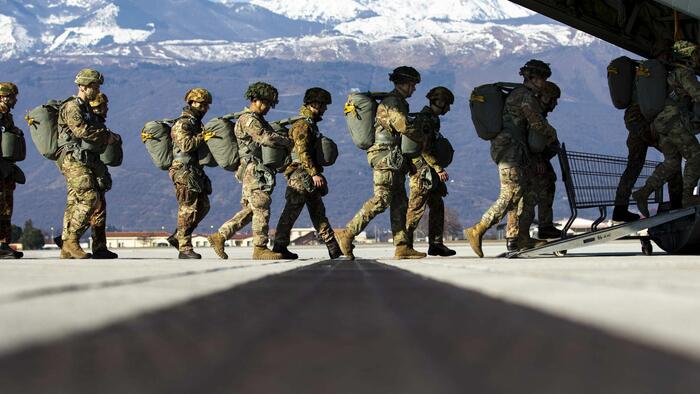
Citizens in Italy, Spain and Germany are expressing concerns that the removal of US bases will cost local and national economies dearly. With approximately 36,400 active-duty US personnel (as of late 2025) across major sites like Ramstein Air Base and facilities in Bavaria, the US military functions as a major economic engine, especially in rural and smaller urban areas.
Germany rakes in around $4.1 billion annually through US spending around military bases. US operations support more than 10,000 direct German jobs (civilian employees at bases) and an estimated 70,000 indirect jobs (in construction, services, and supply chains). The US also invests billions annually in base operations, expansion, and modernization. The removal of troops would squeeze these already struggling rural communities.
President Donald Trump’s plan to withdraw at least 5,000 US troops from Germany has raised concerns among residents living near Ramstein Air Base. pic.twitter.com/hllQNYiuYg
— DW News (@dwnews) May 3, 2026
Italy collects around $312 million every year in base generated revenues in Naples alone, and at least 5000 direct jobs are created.
In Spain, $713 million is pumped into local economies annually through US bases, plus around 8000 jobs for Spanish military staff and civilian workers.
U.S. defense spending directly supporting European security is substantial, with the U.S. maintaining a nearly $1 trillion global defense budget. While direct on-ground operational costs were previously estimated around $30–$36 billion annually in 2025. This might not sound like much, but the effects are substantial in poorer rural areas.
The economic advantages of the US presence go far beyond direct spending. US military security allows Europe to spend minimal on defense, which means they have far more cash to spend on social welfare programs like universal healthcare. All of these programs go away with a US exit from NATO.
Beyond the obvious loss of defense capability that comes with a US exit from NATO, the economic factor should not be overlooked.