
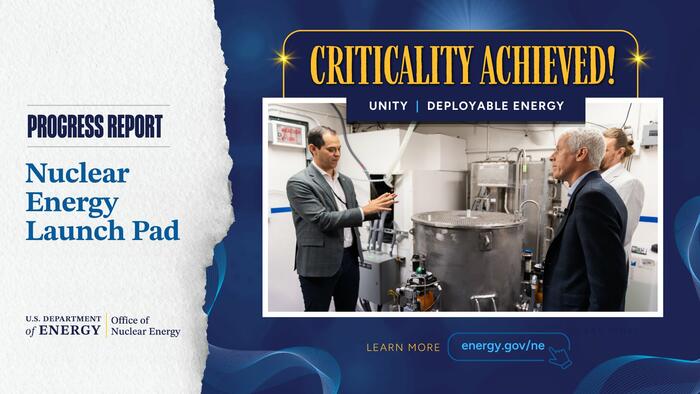
On July 1st, the Department of Energy (DOE) announced microreactor developer Deployable Energy had achieved criticality on their Unity reactor design at Idaho National Labs (INL).
CRITICALITY NUMBER THREE! 🎉
On June 30, 2026, at around 11:55 PM MDT, @DeployableE’s Unity microreactor achieved initial criticality at @INL. It is the third nuclear test reactor this year to go critical under @ENERGY authorization.
Congratulations to Deployable Energy on… pic.twitter.com/TaIKbtnNTx
— Office of Nuclear Energy | US Department of Energy (@GovNuclear) July 1, 2026
This is the third privately developed and funded reactor to have obtained the nuclear milestone of sustaining a chain reaction of fissioning uranium atoms inside of a reactor core.
Executive Order 14301, “Reforming Nuclear Reactor Testing at the Department of Energy”, was the starting point. The executive order contained, among many other things, a goal for the DOE to start up a reactor testing program that enabled rapid iteration and commercialization of advanced nuclear technology.
Soon after, the DOE launched the Reactor Pilot Program (RPP), as well as a sister program to fuel these reactors (in the future) called the Fuel Line Pilot Program (FLPP).
The selectees of the RPP included 11 different reactor projects:
- Aalo Atomics Inc.
- Antares Nuclear Inc.
- Atomic Alchemy Inc.
- Deep Fission Inc.
- Last Energy Inc.
- Oklo Inc. (two projects)
- Natura Resources LLC
- Radiant Industries Inc.
- Terrestrial Energy Inc.
- Valar Atomics Inc.
Over the next several months, the developers raced to iterate through their designs with the goal of achieving criticality before America’s birthday, this upcoming weekend.
First, Antares achieved zero power criticality on their sodium heat pipe design in the beginning of June. This was followed a couple weeks later when Valar achieved criticality on their gas reactor in Utah. Valar took the testing a step further to actually producing nuclear heat and performing critical safety tests on a live stream.
And just before reaching the July 4th holiday, Deployable Energy announced their success in achieving a chain reaction of fission in their core.
Deployable Energy’s success is most notable because the company was not even a part of the RPP. The company was achieving iteration and criticality of their reactor design under the more recently launched Nuclear Energy Launch Pad. This program is the long-term successor project that will succeed the RPP in the FLPP for the years to come.
Multiple other companies are still in pursuit of initial criticality, which will enable them to continue on their path of iteration and preparation for commercializing their designs under the Nuclear Regulatory Commission. This includes companies like Oklo, Radiant, and Aalo.