
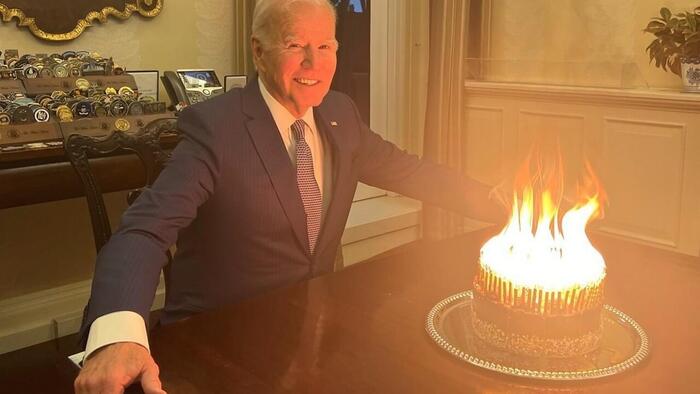
Former Justice Department prosecutor Carmen Mercedes Lineberger has been indicted for allegedly removing confidential Justice Department material and then concealing her efforts. Lineberger is accused of secretly transferring Jack Smith’s final report and hiding the material under files labeled “chocolate cake recipe” and “bundt cake recipe.” There has not been a greater recipe for disaster since aides tried to fit all of Biden’s candles on a cake. The case is particularly interesting because there was another person who was accused of a secret removal of Justice Department material who was not prosecuted: former FBI Director James Comey.
Linebarger, 62, of Port St. Lucie, Florida, has been indicted on four criminal charges: one felony count of obstruction of justice, one felony count of concealing government records and two misdemeanor counts of theft of government property valued at less than $1,000.
According to the indictment, Lineberger altered electronic file names of government records to conceal unauthorized transmissions of the documents to her personal email accounts and used file names for cake recipes to conceal her possession of the confidential information.
U.S. District Judge Aileen Cannon blocked the public release of the report after the prosecution collapsed against the President.
The Justice Department alleges that Lineberger received a copy of Smith’s report before the court sealed it. Months later, she allegedly decided to transfer it to her personal email account in violation of the court order and Justice Department rules.
She has now pleaded not guilty and faces up to 20 years on the obstruction charge and other charges.
The decision is notable for a couple of reasons.
First, Smith made one last move in dismissing the case against Trump that left the door open to resuming his prosecution. Smith moved to dismiss the indictment “without prejudice” and then stressed to the court that the Department has previously “noted the possibility that a court might equitably toll the statute of limitations to permit proceeding against the President once out of office.” In other words, Trump could be prosecuted after he leaves office.
It is not known what the motive might have been in this transfer. One possibility would be a type of souvenir or trophy grab, which would be ironic given Smith’s suggestion that Trump may have transferred classified material for that type of possessory thrill. Another is the possible use for a book. Finally, there might have been a desire to preserve evidence to avoid destruction during the Trump years or possible release to the media.
The second notable aspect is that Comey was accused of such a knowing removal, but he was never actually prosecuted.
There was no court order governing the material removed by Comey after his firing, but it was clearly departmental material.
The Inspector General, Michael Horowitz, found that Comey was a leaker and had violated FBI policy in his handling of FBI memos. He found that Comey grabbed the material on his way out of the Bureau, including those containing the “code name and true identity” of a sensitive source.
While he did not find a disclosure of the classified information, Horowitz found that Comey took “the unauthorized disclosure of sensitive investigative information, obtained during the course of FBI employment, to achieve a personally desired outcome.” He further added that Comey “set a dangerous example for the over 35,000 current FBI employees—and the many thousands of more former FBI employees—who similarly have access to or knowledge of non-public information.”
Comey later admitted that he asked his friend, Columbia Law Professor Daniel Richman, to leak information from the documents to the New York Times.
While Comey is facing a weak criminal case over threats conveyed through beach shells, some of us saw his conduct in removing this material as a more serious breach.
Comey went on to write books on “ethical leadership” and recently sent a message to current FBI personnel that they should “hang on” and wait out Trump: “In two and a half years, and then we can rebuild.”
Rebuilding the bureau in Comey’s image is a truly chilling notion. Those “good old days” with Comey allowed agents to launch a baseless Russian collusion investigation at the behest of the Clinton campaign and lie to a secret court to secure surveillance of Trump figures.
In the meantime, it will be Lineberger, not Comey, who will face a jury for the removal of confidential material.
For Lineberger, these types of charges tend to be cut-and-dried for prosecutors if they can show that the material was restricted and that she took steps to conceal the alleged theft. While she gained access before the court order, she allegedly transferred the material after the order and then hid the material in files labeled as cake recipes. If those facts can be established in court, prosecutors likely believe that she can stick a fork in herself because she is done.
Jonathan Turley is a law professor and the best-selling author of “Rage and the Republic: The Unfinished Story of the American Revolution.”