
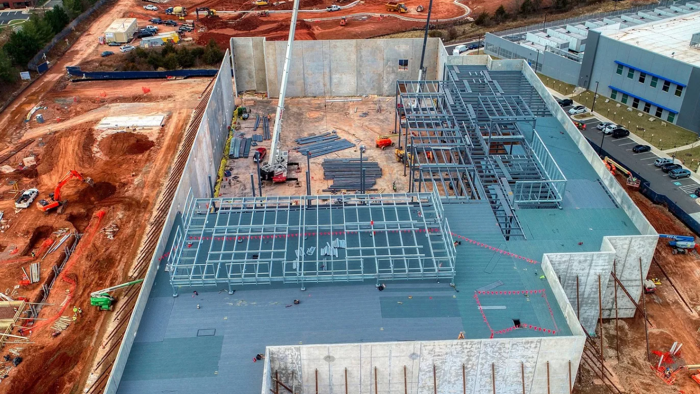
Bank of America unveiled a massive 18-month initiative to mobilize and deploy $250 billion across critical US infrastructure, targeting the computing, energy, and industrial systems needed to support artificial intelligence and accelerate the transition toward physical AI.
The announcement comes just days after Morgan Stanley launched its US Innovation Infrastructure Initiative, which aims to facilitate $1.5 trillion in capital raising and financing over the next decade. The back-to-back commitments signal that Wall Street is positioning for a multiyear capital-spending supercycle spanning data centers, power generation, grid modernization, semiconductors, advanced manufacturing and robotics.
*MORGAN STANLEY TO FACILITATE UP TO $1.5T OVER 10 YRS
this explains why they went so bullish on credit in the past 3 months https://t.co/nnhdOyD5x5
— zerohedge (@zerohedge) August 10, 2026
“Without hard infrastructure, it’s difficult to preserve our competitiveness and leadership for the next generation,” Karen Fang, global head of infrastructure and sustainable finance and co-head of global capital solutions, said in an interview with Bloomberg. “Old infrastructure has to be modernized.”
BofA’s financing will span three broad categories:
- Digital infrastructure, including data centers, computing equipment, chips, telecommunications and semiconductors
- Energy and power, including conventional and renewable generation, storage and distribution systems
- Core infrastructure, including transportation, electricity transmission, grid modernization, water systems, critical minerals and mining
Surging demand for computing power, energy, manufacturing capacity and more resilient supply chains is driving a new investment cycle across the US. BofA said the initiative could support tens of thousands of jobs in construction, manufacturing, technology and long-term operations.
Morgan Stanley mapped out the AI infrastructure supply chain:
Nancy Lazar, Piper Sandler’s chief global economist and head of the firm’s economics research team, recently outlined how data center construction, reshoring, infrastructure upgrading and the reenergizing of America’s industrial base are creating an all-American blue-collar comeback as goods-producing jobs begin to reverse their multidecade downturn and shift higher.
Lazar noted:
Bullish on Goods-Producing Jobs vs. Hotel & Restaurant Jobs.
When China joined the WTO in 2001, U.S. goods-producing jobs began a decade of decline, while leisure & hospitality and education & health jobs continued to rise…

…so today, goods-producing jobs are less than half those of low-paying service jobs; their share was over 50% in the mid-1980s.
That employment mix shift gave us the bifurcated consumer, as lower-paying jobs gained share. Goods-producing jobs pay more than overall service-producing jobs, and lots more than leisure & hospitality or education & health care jobs.

Good news: That mix is now shifting the other way, as the long-running (not just tech) capex cycle raises productivity and margins, encouraging companies to add headcount.

Look at relative earnings growth by sector below.

Let’s come back to our “Powering Up America” and nuclear-power investment themes (began Decemeber 2020) over the last several years. They were right on the money, and both remain intact ahead of the multiyear capital-spending supercycle that BofA and Morgan Stanley are about to unleash.
Related:
The infrastructure required to power the AI economy, strengthen energy security, and support the AI revolution will be central to writing the next chapter ofAmerica’ss growth story into the 2030s.