
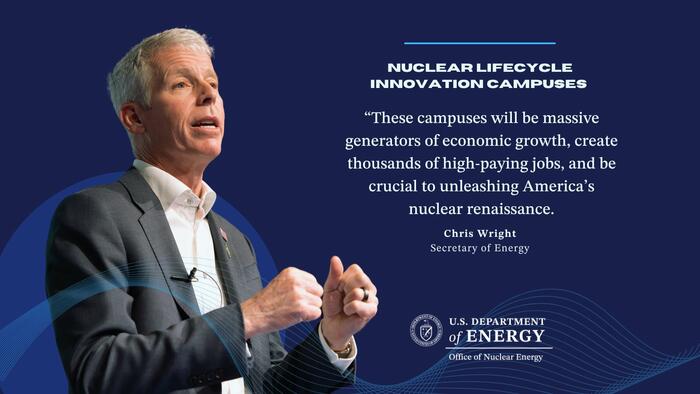
The Department of Energy has selected Utah, Tennessee, Oklahoma, Louisiana, and Idaho as the first five potential hosts for Nuclear Lifecycle Innovation Campuses (NLICs), advancing an effort that forced states to decide whether they support the entire nuclear industry or merely the convenient parts.
Energy Secretary Chris Wright signed Memorandums of Understanding with the five states after the DOE reviewed 28 applications from 26 states. The agreements allow the federal government and the states to continue exploring potential campuses.
The potential prize is substantial, with NLICs potentially attracting up to $50 billion in capital investment, generating almost $10 billion in state and local tax revenue and creating 25,000 jobs each.

These would not simply be reactor parks. The campuses are intended to accommodate multiple parts of the nuclear fuel cycle, including uranium enrichment, fuel fabrication, reprocessing or recycling of used nuclear fuel, and the final disposition of material that cannot be reused.
Depending on the state and location, a campus could also include advanced reactors, power generation, manufacturing facilities, and co-located data centers.
The DOE is offering states the opportunity to build entire nuclear industrial ecosystems, rather than collecting federal reactor grants while expecting somebody else to deal with the fuel afterward.
That distinction may explain why some supposedly pro-nuclear states are conspicuously absent from the first shortlist.
Texas has spent years presenting itself as the future capital of advanced nuclear power. In 2025, the state established the Texas Advanced Nuclear Energy Office and appropriated $350 million for reactor development, construction reimbursement, and supply-chain projects. State officials called it the largest state investment of its kind in the country.
Yet when Orano USA and Waste Control Specialists proposed a consolidated interim storage facility for used nuclear fuel in Andrews County, the state’s enthusiasm for nuclear technology suddenly became rather selective.
Gov. Greg Abbott urged the Nuclear Regulatory Commission to reject it, calling the location unsuitable and warning that the facility could threaten the Permian Basin. Texas legislators subsequently passed a law opposing high-level waste storage, and the state fought the NRC license all the way to the Supreme Court.
Apparently, nuclear reactors are an economic-development opportunity, while the fuel that actually ran through them is somebody else’s problem.
New Mexico produced an even clearer example.
The state has supported nuclear technology when it generates investment and high-paying jobs. It committed $3 million in economic-development funding and another $1.8 million in workforce assistance for Kairos Power’s expansion in Albuquerque, where the company is developing molten-salt coolant and fuel-manufacturing technology for advanced reactors.
But New Mexico’s reception was considerably less cheerful when Holtec International proposed its HI-STORE consolidated interim storage facility in Lea County.

The NRC licensed the multibillion-dollar project in 2023, but New Mexico’s governor and legislature fought it through legislation, permit threats, and litigation. Even after a favorable Supreme Court decision revived the federal licensing pathway, Holtec abandoned the project, describing the path forward in New Mexico as “untenable” and saying it would look toward states that were more amenable.
That history likely did not make New Mexico an especially convincing candidate for a federal program explicitly centered on the entire nuclear lifecycle.
As we have previously detailed, used nuclear fuel has been stored safely in pools and dry casks for decades. The United States has accumulated roughly 95,000 metric tons of it, much of which remains stranded at operating and decommissioned reactor sites because anti-nuclear activists have spent decades treating every proposed storage location like the opening scene of a disaster movie.
The NLIC program offers a different bargain. States willing to accept the responsibilities of the complete fuel cycle stand to enjoy tens of billions of dollars in investments and thousands of high-paying jobs for their constituents.
Texas and New Mexico may enjoy calling themselves pro-nuclear when reactors, research grants, and factory announcements are on the table. But supporting nuclear energy also requires dealing responsibly with what comes out of the reactor.