
One of the main macro drivers this week remains the Gulf energy shock, as chokepoints from the Strait of Hormuz to Bab el-Mandeb are disrupted. Turmoil in the Black Sea between Russia and Ukraine is also sending chills through commodities desks.
Related energy coverage:
Brent crude is back above $100 a barrel, while WTI has reached $92, pushing Treasury yields higher, tightening financial conditions and weighing on duration-sensitive and consumer-facing stocks.

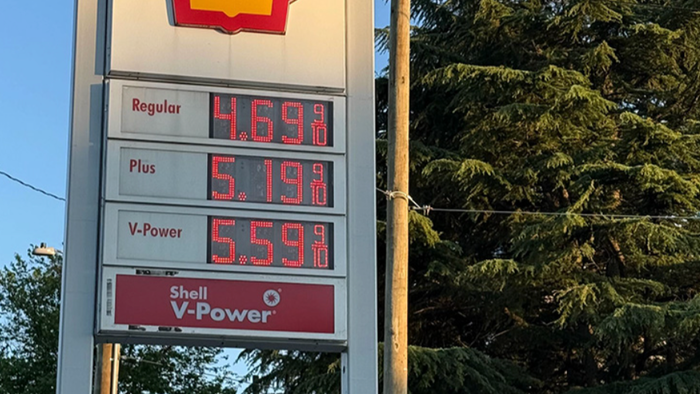
At the start of the week, AAA data showed that while prices vary across states…

… the national average for regular gasoline had exceeded the politically sensitive threshold of $4 per gallon.

And going higher…

JPMorgan’s head of Global Commodities Research and Strategy, Natasha Kaneva, told clients that Brent should average about $94 a barrel if the conflict is contained to one month, with each additional month of disruption adding roughly $7 to $8 as global inventories shrink.
Kaneva warned that a three-month disruption could lift Brent to around $114, while a 1 million barrel-per-day recovery in Chinese imports would add another $3 to fair value.
Related:
Under her base case, Brent averages $86 in Q3 and $80 in Q4, allowing gas prices to fall from just under $4 in August to about $3.30 by year-end.
However, she noted that another month of disruptions across the maritime chokepoints would push pump prices toward $4.20, while a two-month extension could lift them above $4.50.
Kaneva also pointed out that the $4.20 and $4.50 thresholds are where the Trump administration would likely face intensified political pressure to negotiate with Iran.
In the previous round of escalations, negotiations were initiated once US gasoline prices reached $4.20 and became materially more urgent as prices neared $4.50 (Figure 10). Oil may be a global commodity, but political tolerance for high energy prices remains overwhelmingly domestic

Separately, gasoline above $4 represents a line in the sand at which working-poor consumers begin trading down at convenience stores and gas stations, while broader sentiment shifts to the downside, which only means the political pressure heats up for Trump when gas prices rise north of $4.