
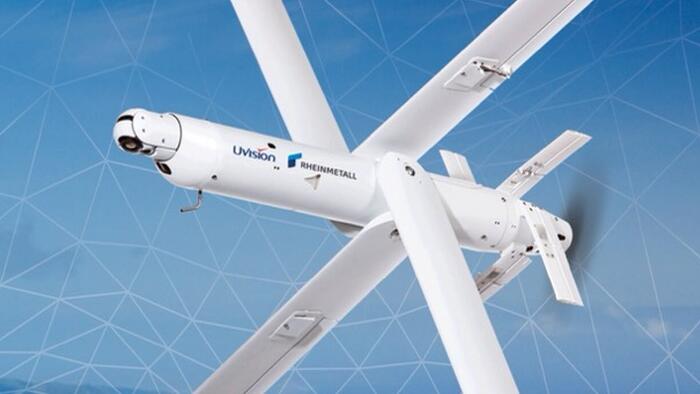
Germany’s parliament has approved a sizeable contract for defense giant Rheinmetall to supply loitering munitions, or kamikaze drones, to the Bundeswehr, underscoring just how quickly European militaries are internalizing drone warfare lessons from both the Russia-Ukraine war and, more recently, the U.S.-Iran conflict. Berlin’s latest procurement push makes it clear that one-way attack drones are becoming a serious threat, and the race to stockpile them has begun.
Bloomberg reports that the budget committee of the Bundestag approved the Defense Ministry’s proposal for an initial tranche of Rheinmetall’s suicide drones worth $345 million.
The deal is capped at around $1.2 billion for Rheinmetall loitering munitions and depends on the firm meeting development and delivery milestones. The drones are initially intended for Germany’s brigade in Lithuania, but there is a possibility that they will be deployed elsewhere.
The approval follows Germany’s February decision to purchase $637 million worth of strike drones from startups Helsing and STARK. Rheinmetall missed out on those deals because it lacked a working prototype at the time.
The Defense Ministry confirmed the latest contract without identifying Rheinmetall: “As with the other two contracts, there are clearly defined qualification requirements, termination milestones, and innovation clauses.”
Lessons learned from the current conflicts across Eurasia have served as a wake-up call for countries around the world, unleashing a frantic race among the world’s militaries to procure low-cost attack drones.
What follows will be counter-drone systems to combat this emerging threat, as the war in the Middle East showed that the US and its Gulf allies lacked low-cost solutions.
On the U.S. homeland front, the Federal Aviation Administration has given the U.S. military the green light to deploy high-energy counter-drone laser weapons in U.S. airspace. Alarmingly, there are very few, if not any, low-cost counter-drone systems guarding America’s data centers, transmission substations, stadiums, and other critical infrastructure.
One month before the US-Iran conflict broke out, we informed readers of the urgent need for data centers to consider counter-drone systems. What followed were multiple data centers struck by Iranian drones in the Gulf region. Civilian infrastructure will not be spared as the world becomes increasingly dangerous and chaotic.