
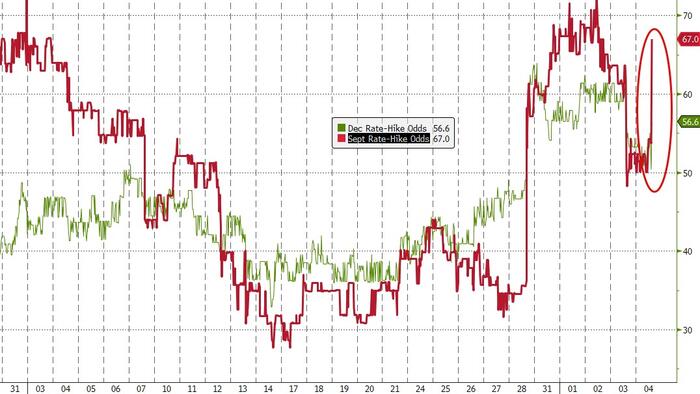
A four standard deviation beat for non-farm payrolls this morning (good news) is triggering ugly reactions (bad news) across markets with rate-hike odds for September ripping back up near recent highs (despite no signs of inflationary wage growth – in fact it is slowing)…
Audrey Childe-Freeman, Bloomberg Intelligence’s chief FX strategist:
“The strength in the latest NFP report will validate Sept. Fed rate-rise talks and most likely give the dollar a short-term-yield-driven lift.”
“But that’s priced, and unless the Fed signals the beginning of an aggressive tightening cycle, the Fed-driven dollar upside may be contained into 4Q.”
That in turn is hammering the short-end of the yield curve…

As Academy Securities’ Peter Tchir notes: The President seems highly likely to complain later today that the bond market is stupid – because he already argued this week (or last week, or both) that good data should be good for bond yields. It is good for credit spreads but is not going to help on bond yields.
And weighing on stocks…

Based on JPMorgan’s matrix, we should see a drop in the S&P of between 0.5% and 1.25%…

Significantly more than the options market implied (+/-0.52%)…

The dollar jumped…

Which in turn dragged gold down…

Christopher Hodge at Natixis reckons the doves will have to prove their case when the Fed meets later this month.
“Most policymakers seemed sanguine about the labor market so inflation will clearly still be the primary driver of near term policy. A softer print today could have given some wiggle room on what was considered to the an acceptable core CPI print, but clearly we didn’t get that. Instead, the onus will continue to be on the doves to get a disinflationary print that justifies another hold – we are putting that bogey at about 20bps. Absent that, the Fed will likely hike in September.”
Jeffrey Rosenberg, a portfolio manager at BlackRock Inc., says on Bloomberg TV that the biggest issue here for the Fed isn’t the job market but the extent of “pass through” of energy prices to broader inflation.
He still sees the Fed’s Sept. 16 decision as entirely dependent on the CPI report. If that shows continuing progress in inflation coming down, then he sees the Fed holding.
Vail Hartman at BMO Capital Markets reflects what’s emerging as the consensus view on this report:
Today’s data lends support to the hawkish camp, but stops shy of making a definitive case for a rate hike on September 16.
Olu Sonola, Head of US Economics at Fitch Ratings comes out swinging:
“This is an unequivocally strong report, which gives the Fed ample room to maintain that the labor market is stable and the economy remains at full employment. The Fed may want markets to “play the ball, not the referee.”
But a hot CPI print next week could be the whistle that pushes the Fed to move the policy rate higher.”
All of which makes us wonder if the knee-jerk response is an over-reaction since we note what Fed Chairman Warsh said last week: “I believe the labor markets are consistent with full employment,” he said, which is why policymakers have largely priced in healthy employment.
The bigger focus remains inflation.
Today’s numbers are still second fiddle to what we get next week – both producer and consumer prices, which will be used to compute the PCE numbers. While today’s strong jobs reading surely supports the case for a hike, wage gains don’t suggest any inflation pressures so it’s not like the labor market is a smoking gun for a hike.
‘Give disinflation a chance’, was the message from Waller yesterday (who basically corroborated Williams). The center of the committee has not shifted – it is still data-dependent.
He might hold in September unless inflation comes in hot, and he made clear that NFP matters less than CPI next week.
Event risk has effectively migrated from payrolls to CPI.
Seema Shah, Chief Global Strategist at Principal Asset Management doesn’t see these numbers having a major impact on the Fed debate:
“For the Fed, there is little here to challenge the view that inflation remains the primary concern. Markets may edge up their expectations for a September hike following today’s release, but next week’s CPI report is still likely to be the key swing factor for policy.”
Academy Securities’ Peter Tchir summarizes The Fed’s position as follows:
Those looking to hike rates will have a stronger argument to hike (or at least one argument against hiking that they no longer need to contend with).
Those looking to hold steady, will be able to argue that the volatility in payrolls means we shouldn’t overreact (garbage in, garbage out).
I do like the argument that looking at “annual” numbers can be misleading on the inflation side. If you take the last 12 months, we have 3.3%. If you take the last quarter and annualize it, we drop to 3% and if you take the last two months and annualize it, we are at 2.4% (maybe some of the lags and the garbage in/garbage out, are finally coming out of the data). Truflation “core” is down to 1.3%.
With plenty of “chatter” that the President is looking at exits for Iran we shouldn’t be hiking because of higher energy costs (it is difficult to see how hiking solves that problem at all).
(good for lower oil prices) and the reality the U.S. attacked Iran, but it was limited in scope to hitting launchers, that were set to send more mines into the Strait. That is consistent with the U.S. attempts to keep the Strait clear (which is something CENTCOM has stated).
Those looking to hold/cut, well, I’d like to have some of whatever they are having, because it has to be some pretty good “stuff” 😊
Seriously, cannot imagine anyone in the cut camp for this meeting, given even an optimistic take on inflation.
The news media will run with the “JOB JOBS JOBS” story, but the real news is next week’s inflation print, and a melt-up setup that still has to survive Hormuz (heating oil, diesel record highs).
To summarize, the jobs market appears strong but next week’s data will determine what the Fed does.