
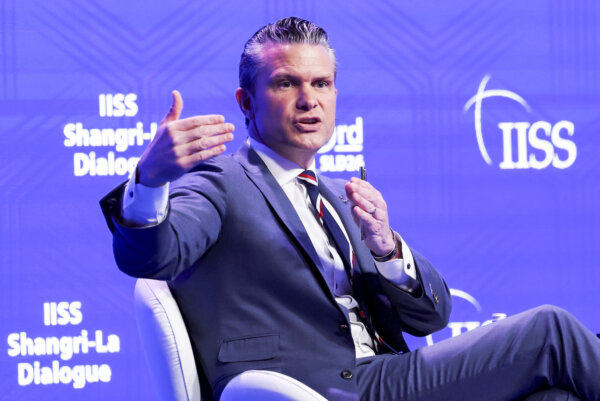
 U.S. War Secretary Pete Hegseth said on June 18 that the U.S. military will reimpose its blockade of Iranian ports if Tehran does not fulfill its part of an agreement between the United States and Iran that was signed by both nations.
On June 17, a memorandum of understanding was signed by U.S. President Donald Trump in Versailles, France, and later by Iranian President Mahmoud Pezeshkian.
The memorandum, in part, terminates military hostilities between the two countries, opens the Strait of Hormuz, and provides a potential reconstruction fund for Iran if Tehran agrees to give up or dilute its enriched uranium, ceases its nuclear program, and commits to further negotiations within 60 days, among other provisions.
But Hegseth said on the morning of June 18 that the United States “will be prepared to recommence if, underneath the timeline of these talks, Iran does not do what it says it’s going to do, which is give up nuclear weapons, give up nuclear ambitions, give away their nuclear material, [and] close nuclear facilities.”
“Then the War Department is here and prepared to restart if we need to,” he told reporters. “We prefer not to, but we are prepared.”
Hegseth said the Pentagon will review its force posture in the Middle East in the meantime before commenting on the U.S. blockade of naval ports that was announced in mid-April.
The U.S. Central Command (CENTCOM) said in its most recent blockade-related update on June 14 that 142 vessels have been redirected and nine disabled since the action went into effect. CENTCOM has not issued any updates on the blockade since then.
“When it comes to our alignment, or posture, in the region, we’ll review what capabilities we need,” Hegseth said. “When the blockade opens fully, we’ll step back and allow commerce to flow, but if Iran doesn’t comply, then we’re more than able to reimpose an ironclad blockade.”
The Pentagon chief also defended the memorandum of understanding—which was criticized by some Republican lawmakers as being an appeasement to Iran—saying that it was agreed upon only after the blockade and U.S. strikes against Iran.
Iran “had to come to the table” because of the U.S. military activities, Hegseth said.
“We’ve had [bases] in that region for a long time,” he said. “A lot of that will stay just as it is, and we’ll look at how many troops we need in the area and calibrate accordingly.”
His comments came after some Senate Republicans sounded the alarm over the contours of the memorandum, which were detailed by U.S. officials on June 17 for the first time.
[President Ronald] Reagan is rolling over in his grave,” outgoing Sen. Bill Cassidy (R-La.), whose GOP primary bid earlier this year did not receive backing from Trump, wrote in a social media post, calling the Iran war and the outcome the “worst foreign policy blunder in decades.”
Sen. Ted Cruz (R-Texas), a longtime Iran war hawk, told reporters on June 17 that “history teaches that giving billions of dollars to theocratic lunatics who want to murder [Americans] is not a good idea” and that Trump had received “very poor advice” on the deal.
In contrast, Sen. Rand Paul (R-Ky.) praised Trump’s decision on X, saying the conflict “must end” and that critics of the memorandums were “architects of every failed intervention” initiated by the U.S. military over his lifetime.
Trump himself pushed back against the critics on the morning of June 18 in a Truth Social post, saying that with the move, the stock market hit a new high and that oil prices are already dropping.