
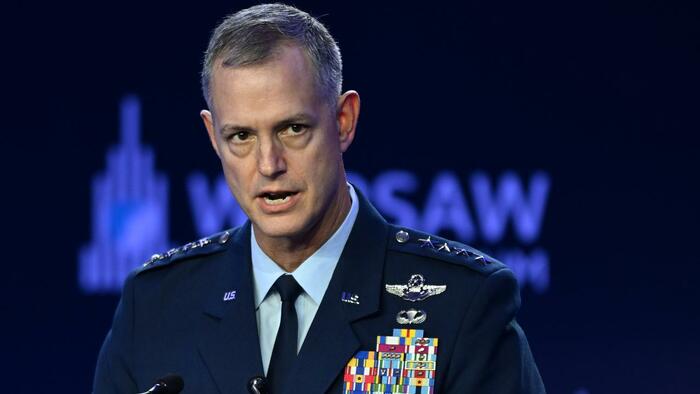
NATO’s top military commander, US Air Force General Alexus Grynkewich, on Monday gave an important speech presenting a “theory of victory” in the scenario of a future Russian attack along the Western military alliance’s ‘eastern flank’.
He asserted that NATO forces would “block, blunt and break” any Russian attack on member territory, which would make any such assault “utterly futile”. But he also characterized the plan as one that would seek to avoid a wider, prolonged war from erupting. But he insisted the alliance is “ready to fight tonight” even though it does not seek escalation.
“Should the adversary choose to press the attack or commit his reserves, we will break the warfighting system engaged against us,” Grynkewich declared at the speech given at the Warsaw Security Forum on Monday. “This includes not just the attacking force itself, but anything and everything that supports, sustains or controls that force.” This would suggest missile attacks deep into Russian territory, including on command-and-control centers.
“I think our populations around the alliance are a bit nervous,” Grynkewich acknowledged while explaining why he is taking what was a classified plan established months ago into the public realm.
He said NATO leadership must seek to assure member populations that it will successfully defend them. “What I want to do is assure the 1 billion citizens of our alliance that we’ve got this,” he said. “We know what we need to do. We know how we would do it, and it’s going to take all of us working together.” However, looming large over all of this is the specter of nuclear war – something not focused on in his strategic talk.
Below is a brief outline and blueprint of what he laid out in the speech…
He described the overall objective as to quickly neutralize a potential invasion force and its direct support systems, but crucially without seeking Russia’s wider strategic defeat. He presented that this would be according to multiple phases:
Phase 1 (Containment & Supremacy): Ground troops stop initial territorial grabs while air, naval, space, and cyber assets secure battlefield control.
Phase 2 (Disruption): Advanced sensors and drones stall enemy momentum if the assault persists.
Phase 3 (Dismantling): Relentless multi-domain pressure (kinetic and non-kinetic) destroys enemy logistics, communications, and command structures, cutting off supplies and isolating commanders.
From there Grynkewich emphasized deterrence, describing that NATO’s ability to match any enemy escalation will only solidify alliance unity and gradually weaken Moscow’s overall force posture and will to keep going.
Bloomberg summarized the talk according to the following key notes:
- Does not believe a conflict is imminent or inevitable.
- NATO will respond to attacks by blockading, degrading and striking adversary forces.
- If necessary NATO will neutralize systems targeting its combat systems.
- The alliance will pair high-end precision-guided munitions with large-scale, low-cost, scalable systems.
NATO’s SACEUR General Alexus Grynkewich: We know how we will fight if a fight comes to us. And we know we will win. And together we will ensure that any adversary who considers attacking our alliance reaches the only conclusion that matters: Today is not the day. https://t.co/tt1NfjeaX7
— Clash Report (@clashreport) October 12, 2026
The Wall Street Journal has further issued a detailed report going into more detail on the Ukraine war-inspired ‘autonomous zone’ on the eastern flank:
The approach was devised to block a Russian adversary whose geographic advantages and outsize defense industry could enable it to mass forces against Baltic states, Poland and other NATO allies before the alliance could marshal a robust response. Under its strategy, an extensive “autonomous zone” would be established so that drones and ground robots could blunt a Russian attack without extensive allied casualties.
At the same time, long-range missiles would strike Russian command posts and air defenses in the exclave of Kaliningrad, near St. Petersburg and in Belarus. That would puncture Russia’s efforts to control the skies and enable the U.S. Army’s V Corps and other NATO ground forces to counterattack.
NATO air forces would move swiftly to strike Russian reinforcements as they streamed toward the battlefield and to attack other targets in the rear.
The NATO attacks would be enabled by a “data backbone,” a system for instantaneously sharing classified targeting data through the cloud among allied forces. Elements of that network have been tested in the Middle East during the U.S. fight with Iran.
The approach has been dubbed the Eastern Flank Deterrence Initiative and its overall objective, U.S. military officials said, is to force Putin to look at NATO’s defenses and conclude “not today” if he considers attacking. To reinforce that, alliance forces constantly drill to both test and demonstrate their readiness.
Meanwhile European officials are still strongly hyping and warning about what they call a continuing sabotage campaign which has made heavy use of drones and other tactics that violate European airspace and security.
NATO’s SACEUR General Alexus Grynkewich: The risk of a major attack on NATO territory right now is actually relatively low. The reason is Vladimir Putin’s war is ongoing in Ukraine, and his military is unfortunately engaged in that conflict. That force is not available to threaten NATO territory. That doesn’t mean he couldn’t do something smaller, and obviously we do see the sabotage activity and everything else that’s ongoing.
— Clash Report (@clashreport) October 12, 2026
EU top diplomat Kaja Kallas is also on Monday calling on President Trump to sanction Russian and ditch the controversial diesel deal.
“Pressure on Moscow, not concessions, is the fastest way to end the war,” she said.